
These Bible Verses For Daily Devotionals are ready to open a quiet time, guide a short prayer or give you one line to carry through the day. Some help you slow down and listen, others help you confess, ask for wisdom or give thanks. Use them as a starting point whenever your daily time with God feels dry or rushed.
Bible verses for daily devotionals work best as an ongoing rhythm, not a single perfect session that carries the whole week. A short devotional done consistently outweighs an elaborate one attempted only occasionally. Sharing a verse from your devotional time with a friend or family member can also deepen the practice and open up meaningful conversation. Over months and years, a daily devotional habit slowly reshapes how you see ordinary circumstances, not through dramatic moments but through steady, repeated attention. There’s no single right way to keep a devotional practice, only the version that you’ll actually return to tomorrow. Start small, stay consistent, and let the habit grow naturally from there. That’s all a daily devotional practice needs to become something that genuinely shapes a life over time. One verse, read with attention, is always a good place to begin again. Whatever today’s reading brings, let it be enough for today. Tomorrow, come back and do it again. Small, steady steps build a lasting habit far better than occasional bursts of ambition. Keep showing up, one quiet moment at a time. That is what a lasting devotional life is built from. Begin today. Open to a single verse, and let it speak to whatever today holds. That’s where it begins. A short list of Bible verses for daily devotionals, kept nearby, removes the guesswork from starting each day’s reading. Returning often to favorite Bible verses for daily devotionals helps the practice feel familiar rather than like a new task each morning.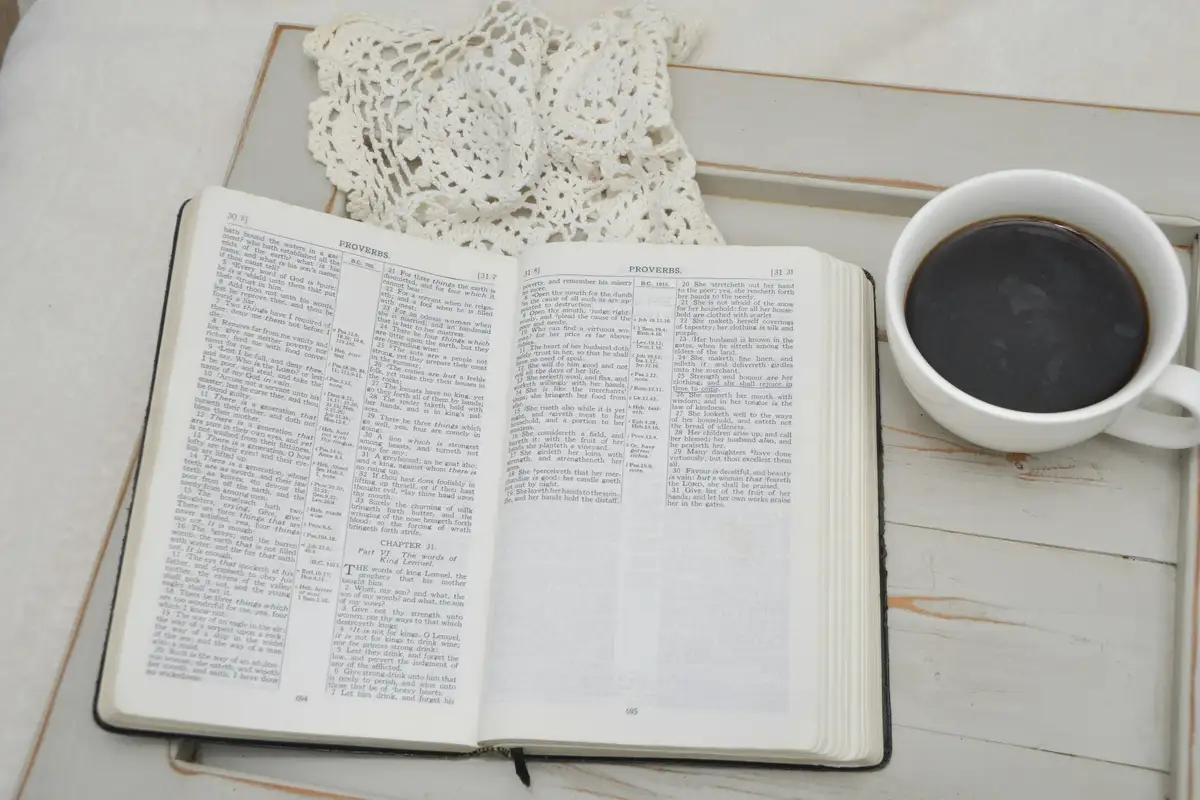
Open thou mine eyes, that I may behold wondrous things out of thy law.
Psalms 119:18 (KJV)
A perfect prayer to begin a quiet time: ask God to open your eyes to see wonderful things in His word.
Thy word is a lamp unto my feet, and a light unto my path.
Psalms 119:105 (KJV)
Read a passage expecting it to light the next step you need to take today.
My voice shalt thou hear in the morning, O Lord; in the morning will I direct my prayer unto thee, and will look up.
Psalms 5:3 (KJV)
Morning devotions can follow David’s pattern of directing prayer to God and then watching for His answer.
Be still, and know that I am God: I will be exalted among the heathen, I will be exalted in the earth.
Psalms 46:10 (KJV)
Be still, and know that I am God: a reminder to slow down before reading or praying.
But thou, when thou prayest, enter into thy closet, and when thou hast shut thy door, pray to thy Father which is in secret; and thy Father which seeth in secret shall reward thee openly.
Matthew 6:6 (KJV)
Jesus encourages praying in a private place with the door shut, where the Father sees in secret.
If any of you lack wisdom, let him ask of God, that giveth to all men liberally, and upbraideth not; and it shall be given him.
James 1:5 (KJV)
When a passage confuses you or a decision weighs on you, ask God for wisdom, which He gives generously.
Let the words of my mouth, and the meditation of my heart, be acceptable in thy sight, O Lord, my strength, and my redeemer.
Psalms 19:14 (KJV)
Close your devotional time asking that your words and meditations please the Lord.
Search me, O God, and know my heart: try me, and know my thoughts: And see if there be any wicked way in me, and lead me in the way everlasting.
Psalms 139:23-24 (KJV)
Use these lines to invite God to search your heart as part of daily confession.
It is of the Lord’s mercies that we are not consumed, because his compassions fail not. They are new every morning: great is thy faithfulness.
Lamentations 3:22-23 (KJV)
Starting with God’s faithfulness and new mercies sets a grateful tone for each devotion.
Shew me thy ways, O Lord; teach me thy paths. Lead me in thy truth, and teach me: for thou art the God of my salvation; on thee do I wait all the day.
Psalms 25:4-5 (KJV)
Ask God to show you His ways and teach you His paths as you read today.
Then shall ye call upon me, and ye shall go and pray unto me, and I will hearken unto you. And ye shall seek me, and find me, when ye shall search for me with all your heart.
Jeremiah 29:12-13 (KJV)
God promises to be found by those who seek Him with all their heart, an encouragement to keep showing up.
Teach me thy way, O Lord; I will walk in thy truth: unite my heart to fear thy name.
Psalms 86:11 (KJV)
Teach me thy way, O Lord; unite my heart to fear thy name, a prayer for undivided focus.
Let us therefore come boldly unto the throne of grace, that we may obtain mercy, and find grace to help in time of need.
Hebrews 4:16 (KJV)
Because of Christ, we can come boldly to the throne of grace for help in our time of need.
Rejoice evermore. Pray without ceasing. In every thing give thanks: for this is the will of God in Christ Jesus concerning you.
1 Thessalonians 5:16-18 (KJV)
These three short commands make an easy daily checklist: rejoice, pray and give thanks.
Cause me to hear thy lovingkindness in the morning; for in thee do I trust: cause me to know the way wherein I should walk; for I lift up my soul unto thee.
Psalms 143:8 (KJV)
Pray to hear God’s lovingkindness in the morning and to know the way you should walk.
Trust in the Lord with all thine heart; and lean not unto thine own understanding. In all thy ways acknowledge him, and he shall direct thy paths.
Proverbs 3:5-6 (KJV)
Finish your devotion by committing the day’s decisions to God and trusting Him to direct your paths.
A devotional habit does not need to be long to be meaningful. Start by choosing a regular time and place, even if it is only ten minutes before work or after the children are in bed. Open with a verse like Psalms 119:18, asking God to show you something in His word, and then read one of the verses on this page along with a few lines around it for context.
A helpful pattern is to read, reflect, pray and apply. Read the verse slowly. Reflect by asking what it says about God and about you. Pray it back to Him in your own words. Then choose one small way to act on it today, keeping James 1:22 in mind. Writing a sentence in a notebook each day can help you notice how God is speaking over time.
On busy or discouraging days, lean on the shortest verses. Psalms 46:10 or Psalms 86:11 can be prayed in a few seconds. If you miss a day, simply begin again the next morning; Lamentations 3:22-23 reminds us that God’s mercies are new. Sharing a verse with a friend or family member can also keep you encouraged and accountable.
A daily devotional isn’t about checking a box or completing a spiritual to-do list. At its core, it’s a small, repeated invitation to pay attention, to slow down long enough to actually hear something rather than let the day’s noise crowd out anything reflective. Bible verses for daily devotionals work because they give that attention a specific focus rather than leaving quiet time formless and easy to skip.
Over time, a consistent devotional habit does something that a single meaningful moment of reading can’t. It builds familiarity with scripture that deepens gradually, the same way any relationship deepens through repeated, ordinary contact rather than occasional grand gestures. Verses that seemed unremarkable on first reading often become significant after returning to similar themes again and again across weeks and months of devotional time.
This is also why consistency matters more than intensity when it comes to devotionals. Five focused minutes every day accomplishes more, over a year, than an hour once a month, even though the daily habit feels smaller in any single moment. The cumulative effect of showing up regularly is what actually shapes how scripture influences daily life.
Devotional habits fail most often not from lack of desire but from choosing a format that doesn’t fit realistically into an actual schedule. Someone with a demanding job and young children needs a different approach than someone with a quiet, flexible morning. Being honest about the time and energy actually available, rather than aspiring to a routine that looked appealing in a book or online, makes a devotional habit far more likely to last.
Some people do best with a single verse and a few minutes of quiet reflection, without any additional structure. Others prefer a devotional book that pairs a verse with a short reading and a guided question, giving the practice more shape and direction. Still others prefer journaling their response, writing a few sentences about what the verse means for their current circumstances. None of these approaches is more valid than another. The right format is whichever one you’ll actually return to tomorrow.
It also helps to choose a consistent time rather than leaving devotionals to whenever there happens to be a spare moment. Attaching the habit to an existing part of the day, morning coffee, a lunch break, or the last few minutes before bed, gives it a stable place to live rather than competing with everything else for attention.
Almost everyone who tries to build a daily devotional habit eventually misses a day, then a week, sometimes longer. This is normal, not a sign of failure or weak faith. The mistake many people make is treating a broken streak as a reason to abandon the habit entirely rather than simply picking it back up the next day. A devotional practice isn’t a perfect record to protect. It’s a relationship to return to, and relationships survive gaps far better than rigid schedules do.
When restarting after a break, it can help to lower expectations slightly rather than trying to immediately resume an elaborate routine. A single verse, read without pressure to reflect deeply or journal extensively, is enough to restart the rhythm. The goal is showing up again, not performing at full capacity from the very first day back.
With so much scripture to choose from, deciding what to read each day can itself become a barrier if it requires too much thought. Following a structured reading plan, moving through a single book of the Bible chapter by chapter, removes that daily decision and provides natural momentum, since each day’s reading picks up right where the last one left off. This approach also has the benefit of eventually covering passages you might never choose on your own, broadening your familiarity with scripture beyond a handful of favorite, frequently repeated verses.
Alternatively, choosing verses thematically, gathering passages around a specific topic like patience, gratitude, or trust, works well for people who want their devotional time to speak directly into a current season or struggle. This method allows the devotional to feel personally relevant in a way that a straight read-through sometimes doesn’t, especially during a particularly difficult or eventful stretch of life.
Whichever method you choose, keeping a running list of verses that stood out during devotional time, even just jotting down the reference, creates a resource to return to later during moments that call for exactly that kind of comfort or challenge.
It’s possible to read scripture daily and still keep it at arm’s length, treating devotional time as an intellectual exercise rather than a personal encounter. Adding a simple question to each day’s reading, such as what this verse asks of me today or where I’ve seen this truth show up in my own life recently, turns information into reflection. This small shift is often what separates a devotional habit that feels routine from one that feels genuinely meaningful.
Writing even a single sentence in response to each day’s verse, rather than only reading silently, forces a level of engagement that passive reading doesn’t require. Over time, a simple devotional journal filled with these short daily responses becomes a record of spiritual growth that’s easy to overlook in the moment but often striking when reviewed months or years later.
Life doesn’t pause for a devotional habit, and some seasons, a new baby, a demanding project at work, a health crisis, make even five minutes feel like an impossible ask. During these stretches, it helps to shrink the practice down rather than abandoning it entirely. A single verse read on a phone during a commute, or a passage listened to as audio while doing something else, keeps the habit alive in a smaller form until life allows for more space again.
It also helps to remember that a devotional habit is meant to serve you, not become another source of pressure during an already overwhelming season. Grace extends to the weeks when devotional time looks nothing like its usual shape. What matters most is returning to the practice, in whatever reduced form fits, rather than treating a hard season as a reason to stop altogether.
Psalm 5:3 says, “My voice shalt thou hear in the morning, O LORD; in the morning will I direct my prayer unto thee, and will look up.” The word translated direct was used for arranging things in order, like laying wood on an altar or setting out bread on a table. Israel’s priests began each day with an offering, so a morning prayer was pictured as something set out carefully for God, then watched for. David does not just speak and walk off. He looks up, expecting an answer.
That gives a different shape to a devotional hour. You are not rushing through a duty so you can leave. You are laying out a few honest words, a verse, a thank-you, one request, and then waiting a moment to see what settles in your mind. Even thirty seconds of quiet after reading changes the habit. Among the bible verses for daily devotionals, Psalm 5:3 is one of the few that tells you what to do after the amen, which is to look up and pay attention.
Few people realize where a favorite morning verse was written. Lamentations is a book of grief over the destruction of Jerusalem in 586 BC. Houses were burned, the temple lay in ruins, and families were scattered or killed. Right in the middle of that, the writer says, “It is of the LORD’s mercies that we are not consumed, because his compassions fail not. They are new every morning: great is thy faithfulness.”
That context matters for ordinary people with ordinary Mondays. The verse does not come from a calm man in a garden. It comes from someone who had looked at the wreckage and decided to name what was still true. If your devotional reading ever feels too cheerful for the season you are in, bring this one with you. It makes room for tears and for trust in the same breath. A morning does not have to be easy to be new, and mercy that arrives daily, like bread, is meant to be gathered again tomorrow.
Mark 1:35 gives one of the plainest pictures of a devotional habit in the Gospels: “And in the morning, rising up a great while before day, he went out, and departed into a solitary place, and there prayed.” The night before, Capernaum had crowded around the door with sick people, and He had healed many. You might expect a rest. Instead He got up early and left the house.
Simon and the others hunted Him down a little later, saying everyone was looking for Him. The quiet hour had already happened. Whatever He heard there shaped His answer, which was to move on to other towns to preach. For someone trying to build a habit, the detail worth copying is not the early hour but the order. Prayer came first, and the demands came second. If you have a crowded house or a long to-do list, even ten minutes alone at a kitchen table before everyone wakes can put things in that same order.
Psalm 119 is the longest chapter in the Bible, 176 verses, arranged by the Hebrew alphabet in groups of eight. The writer clearly wanted to be able to carry it in memory. Nearly every verse mentions God’s word under a different name: law, testimonies, precepts, statutes, commandments, judgments. He is not reading for information. Verse 97 says, “O how love I thy law! it is my meditation all the day.”
There is a lesson here for anyone who treats reading like a chore. Affection grows through repeated contact, much the way a friendship does. The psalmist also admits struggle, with sorrow in verse 28 and shame in verse 6, so his love is not pretending. When you pick bible verses for daily devotionals from this psalm, try reading just one eight-verse section a day, and circle the different words for Scripture as they appear. By the end of a week you will have a small, personal vocabulary for what God’s word is and does.
Hebrews 4:16 reads, “Let us therefore come boldly unto the throne of grace, that we may obtain mercy, and find grace to help in time of need.” People often skim past the word boldly. It does not mean loud or careless. It means free speech, the confidence of someone who knows he will be welcomed. The writer builds up to it by describing Jesus as a high priest who understands weakness, having been tempted in every way yet without sin.
Take that into your reading time. You do not need to tidy yourself before you open the Bible, and you do not need the right mood. If you come in tired, say so. If you come in angry, say that. The throne in this verse is called a throne of grace, which means the person sitting on it is on your side. Many people find their devotions improve the moment they stop performing and start talking plainly. Mercy and help are what the verse promises, and they are given in time of need, not after the need has been cleaned up.
One of the most useful habits is to turn the verse you read into a sentence addressed to God. Psalm 19:14 gives a model: “Let the words of my mouth, and the meditation of my heart, be acceptable in thy sight, O LORD, my strength, and my redeemer.” Try it with Proverbs 3:5-6. The text says to trust in the LORD with all your heart and lean not to your own understanding. Your prayer might be, Lord, I keep trying to solve this problem by myself, and I am tired of it. Teach me to wait for Your direction.
This takes about two minutes and works with almost any passage. You might keep a cheap notebook and write only the verse reference and your one-line prayer. A month later you will have thirty small prayers and a quiet record of what God was dealing with in you. People who use bible verses for daily devotionals this way often say the passages stop feeling distant, because they are no longer reading a text about other people. They are answering it.
Short daily verses are a gift, and a trap. Phones now send us a line of Scripture before breakfast, and it can feel like enough. The risk is that a single sentence, cut loose from its chapter, can mean something the writer did not say. Jeremiah 29:11 is a well-known case. It was written to exiles in Babylon who would wait seventy years, so reading it as a quick promise of an easy career change misses its slow, patient meaning.
A good rule is to open the chapter at least once a week for the verse you are holding. Read it from beginning to end, even if it takes four minutes. You will often find the verse is stronger in its paragraph than it was on the screen. If a verse leaves you with a question, bring it to a pastor or a Bible study instead of settling it alone. Snippets work best as doors into the whole book, not as replacements for it. Let the small verse send you to the larger page, and let the larger page give the small verse its proper weight.
Whichever way you read, keep a short list of bible verses for daily devotionals that you return to each season, and add one new passage each month. Rotate the list when it grows stale, and note beside each reference what it taught you. A living list of bible verses for daily devotionals grows with you, and it is far easier to keep than a plan that tries to cover everything at once.
Related topics on this site include Bible Verses For Faith Over Fear, Bible Verses About Family Unity, Bible Verses About God's Purpose, Bible Verses About Answered Prayer, Bible Verses About Eternal Life, Bible Verses About Discipleship, Bible Verses For Healing, Bible Verses For Stress, Bible Verses About Worry, Bible Verses About Protection for Children and Bible Verses For Finances.
Free tools for studying these passages further: Blue Letter Bible, Bible Gateway, Bible Hub and Bible Study Tools.
A devotional habit does not need to be long to be meaningful. Start by choosing a regular time and place, even if it is only ten minutes before work or after the children are in bed.
This page brings together 5 King James Version references about daily Devotionals, drawn from 3 different books of the Bible.
These daily Devotionals verses are drawn from books including Psalms, James, Lamentations.
Yes. The verses about daily Devotionals gathered here include passages from both the Old Testament and the New Testament, such as Psalms 119:18 and James 1:22.
Psalms 119:18 is one of the verses about daily Devotionals referenced in this collection, alongside James 1:22.