
Bible verses about prayer show that talking with God is not a religious extra but the heartbeat of a life of faith. From Abraham pleading over Sodom to Jesus praying through the night, Scripture treats prayer as real conversation with a real God who listens, answers and sometimes asks his people to wait.
This collection gathers 18 KJV passages and then steps back to ask what they teach as a whole. You will see how prayer develops from the altars of Genesis to the upper room in Acts, what the key Hebrew and Greek words mean, and why honest questions about unanswered prayer are part of the biblical story too.
If you want passages to pray through in a specific situation, our companion page of practical verses to use in daily prayer is the better fit. Here the aim is understanding: reading these Bible verses about prayer in context so they speak with their full weight.
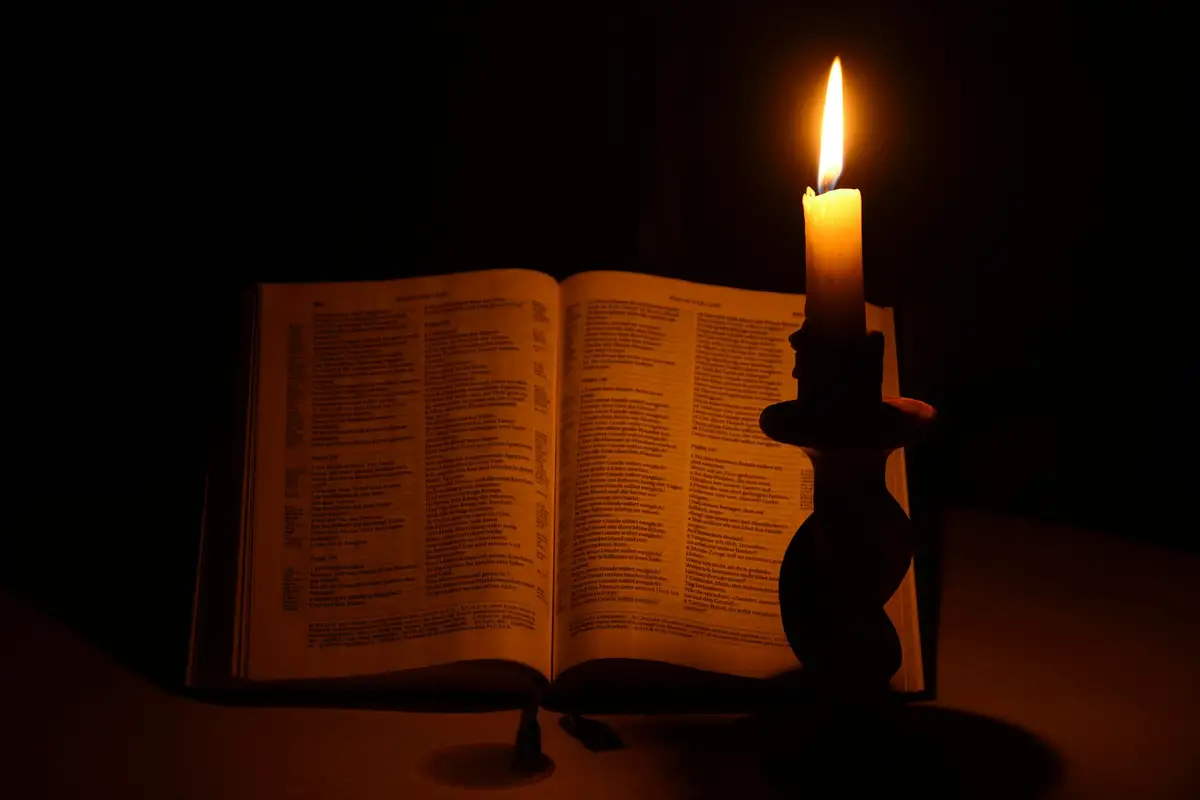
Every verse below is quoted word for word from the King James Version, with the reference under each passage.
But thou, when thou prayest, enter into thy closet, and when thou hast shut thy door, pray to thy Father which is in secret; and thy Father which seeth in secret shall reward thee openly.
Matthew 6:6 (KJV)
Jesus contrasts showy public piety with private prayer. Among the Bible verses about prayer, this one stresses that God values sincerity over an audience.
After this manner therefore pray ye: Our Father which art in heaven, Hallowed be thy name. Thy kingdom come. Thy will be done in earth, as it is in heaven. Give us this day our daily bread. And forgive us our debts, as we forgive our debtors. And lead us not into temptation, but deliver us from evil: For thine is the kingdom, and the power, and the glory, for ever. Amen.
Matthew 6:9-13 (KJV)
The Lord’s Prayer moves from God’s name and kingdom to daily bread, forgiveness and protection, giving disciples a pattern rather than a spell.
The Lord is nigh unto all them that call upon him, to all that call upon him in truth.
Psalms 145:18 (KJV)
David’s psalm of praise ties God’s nearness to calling on him “in truth.” Bible verses about prayer like this one stress honesty rather than perfection.
Call unto me, and I will answer thee, and shew thee great and mighty things, which thou knowest not.
Jeremiah 33:3 (KJV)
Spoken to Jeremiah while he was shut up in prison, this is one of the best-loved Bible verses about prayer, promising that God answers and reveals what people could not discover alone.
For this child I prayed; and the Lord hath given me my petition which I asked of him:
1 Samuel 1:27 (KJV)
Hannah’s words at Shiloh close a story of tearful, persistent prayer. Her example of pouring out the soul before the LORD (1 Samuel 1:15) runs through many Bible verses about prayer, especially the Psalms.
If my people, which are called by my name, shall humble themselves, and pray, and seek my face, and turn from their wicked ways; then will I hear from heaven, and will forgive their sin, and will heal their land.
2 Chronicles 7:14 (KJV)
God’s reply to Solomon’s temple dedication links prayer with humility and turning from sin. It was addressed to Israel, yet it shows a lasting principle about repentant prayer.
Now when Daniel knew that the writing was signed, he went into his house; and his windows being open in his chamber toward Jerusalem, he kneeled upon his knees three times a day, and prayed, and gave thanks before his God, as he did aforetime.
Daniel 6:10 (KJV)
Daniel kept his habit of praying three times a day even when a royal decree made it dangerous. Bible verses about prayer rarely picture a more settled rhythm than this.
If I regard iniquity in my heart, the Lord will not hear me: But verily God hath heard me; he hath attended to the voice of my prayer.
Psalms 66:18-19 (KJV)
The psalmist admits that cherished sin blocks fellowship with God, then rejoices that God has heard him anyway. Honesty and grace stand side by side.
And he spake a parable unto them to this end, that men ought always to pray, and not to faint;
Luke 18:1 (KJV)
Luke states the purpose of the parable of the persistent widow before he tells it: Jesus wanted his followers to keep praying and not lose heart.
Saying, Father, if thou be willing, remove this cup from me: nevertheless not my will, but thine, be done.
Luke 22:42 (KJV)
In Gethsemane Jesus asks for the cup to pass yet surrenders to the Father’s will. Few Bible verses about prayer show honesty and trust so clearly together.
Neither pray I for these alone, but for them also which shall believe on me through their word; That they all may be one; as thou, Father, art in me, and I in thee, that they also may be one in us: that the world may believe that thou hast sent me.
John 17:20-21 (KJV)
Jesus prays for believers who would come later, asking that they be one. It is his longest recorded prayer, and it includes readers today.
Peter therefore was kept in prison: but prayer was made without ceasing of the church unto God for him.
Acts 12:5 (KJV)
While Peter sat chained in prison, the church prayed “without ceasing” for him. The chapter shows a community praying together and God acting.
Likewise the Spirit also helpeth our infirmities: for we know not what we should pray for as we ought: but the Spirit itself maketh intercession for us with groanings which cannot be uttered.
Romans 8:26 (KJV)
Paul admits that believers often do not know what to pray. This is one of the most comforting Bible verses about prayer, because the Spirit intercedes in that weakness.
Be careful for nothing; but in every thing by prayer and supplication with thanksgiving let your requests be made known unto God. And the peace of God, which passeth all understanding, shall keep your hearts and minds through Christ Jesus.
Philippians 4:6-7 (KJV)
Paul, writing while in custody, pairs requests with thanksgiving and promises God’s peace as a guard over heart and mind.
Rejoice evermore. Pray without ceasing. In every thing give thanks: for this is the will of God in Christ Jesus concerning you.
1 Thessalonians 5:16-18 (KJV)
These short commands frame prayer as a continual posture of the heart. Among Bible verses about prayer, they are some of the most quoted.
Let us therefore come boldly unto the throne of grace, that we may obtain mercy, and find grace to help in time of need.
Hebrews 4:16 (KJV)
Because Jesus is a sympathetic high priest, believers can come “boldly” to God’s throne. Many Bible verses about prayer rest on this access through Christ.
Confess your faults one to another, and pray one for another, that ye may be healed. The effectual fervent prayer of a righteous man availeth much.
James 5:16 (KJV)
James ties confession, mutual prayer and healing together. Among Bible verses about prayer, it is a key text on the effect of a righteous person’s earnest prayer.
And this is the confidence that we have in him, that, if we ask any thing according to his will, he heareth us: And if we know that he hear us, whatsoever we ask, we know that we have the petitions that we desired of him.
1 John 5:14-15 (KJV)
John grounds confidence on asking “according to his will.” These Bible verses about prayer balance bold asking with humble trust.
English has one common word for prayer, but the Bible uses several. In Hebrew, tephillah often names a prayer or plea, while other expressions describe crying out, calling on the name of the LORD, or pouring out the heart. The Psalms add words for praise and thanksgiving, showing that prayer is far broader than asking for things. Any study of Bible verses about prayer has to begin with that wider range of vocabulary.
The main New Testament verb is proseuchomai, which you can study in the Blue Letter Bible lexicon entry for proseuchomai. Other terms describe petition, supplication and giving thanks. Read together, the Bible verses about prayer describe a relationship: creatures speaking to their Creator, and children speaking to a Father who already knows what they need (Matthew 6:8).
Prayer appears early. Genesis 4:26 says that in the days of Seth “began men to call upon the name of the LORD.” Abraham later pleads for Sodom in Genesis 18, asking whether the Judge of all the earth will do right. His boldness is striking, yet he speaks with humility, calling himself “dust and ashes.”
Moses intercedes for Israel after the golden calf in Exodus 32, and Hannah’s silent, tearful prayer in 1 Samuel 1 is so intense that Eli mistakes her for drunk. Solomon’s long prayer at the temple dedication in 1 Kings 8 asks God to hear his people wherever they turn toward him. These Old Testament passages show intercession, lament and worship growing side by side.
The Book of Psalms is prayer set to poetry. It holds hymns of praise, songs of thanksgiving, confessions of sin such as Psalm 51, and many laments. Laments form one of the largest groups: prayers in which the writer complains, questions, and still turns toward God rather than away from him.
This matters because the Psalms give permission to be honest. Psalm 13 asks, “How long wilt thou forget me, O LORD?” before ending in trust. Psalm 145 praises a God who is “nigh unto all them that call upon him.” For many readers, the prayers in the Psalms become words to borrow when their own run dry, much as Jesus prayed Psalm 22 from the cross.
The Gospels show Jesus praying often and in many settings. Mark 1:35 says he rose “a great while before day” and went to a solitary place to pray. Luke 5:16 notes that he withdrew into the wilderness and prayed, and Luke 6:12 records a whole night of prayer before he chose the twelve apostles. Those passages reveal a steady rhythm of withdrawal and return.
His prayers were not all private. At Lazarus’s tomb he thanked the Father aloud for the sake of the crowd (John 11:41-42). In Gethsemane he prayed in agony, and on the cross he prayed for those crucifying him (Luke 23:34). The Gospel accounts suggest that if the Son of God valued time with the Father, his followers need it even more.
When a disciple asked, “Lord, teach us to pray” (Luke 11:1), Jesus gave a short model prayer. Of all the prayers on this page, it is probably the best known. Matthew places it in the Sermon on the Mount, which you can read in full in Matthew 6 on Bible Gateway. Just before it, Jesus warns against “vain repetitions” and prayers performed to be seen by others.
The prayer begins with God: his name, his kingdom and his will. Only then does it turn to human needs: bread for today, forgiveness that flows outward to others, and deliverance from evil. Many churches recite it word for word, while others use it mainly as an outline. Both approaches have deep roots, and our study of the Lord’s Prayer line by line explores each petition.
Acts describes a praying church from its first chapter. The believers “continued with one accord in prayer and supplication” while waiting for the Spirit (Acts 1:14), and the first converts devoted themselves to the apostles’ teaching, fellowship, breaking of bread and prayers (Acts 2:42). When threatened, they prayed for boldness and the place was shaken (Acts 4:31).
Acts 12 is a vivid example. Herod had killed James and imprisoned Peter, yet the church kept praying, and an angel led Peter out. When he knocked at the door, the praying believers at first refused to believe it was him. Luke’s honesty is comforting: these passages show real people whose faith was genuine but not flawless. That theme continues in Scripture on prayer and faith.
Paul’s letters are full of prayer. He tells the Thessalonians to “pray without ceasing,” which does not mean doing nothing else but keeping an ongoing, God-ward awareness through the day. He urges the Ephesians to pray “always with all prayer and supplication in the Spirit” (Ephesians 6:18) and tells the Philippians to replace anxiety with thankful requests. Across his letters, these passages treat it as the atmosphere of Christian life, not an occasional task.
Paul also models intercession. His letters include recorded prayers, such as Ephesians 1:16-19 and Colossians 1:9-11, asking for wisdom, understanding and strength rather than comfort alone. Romans 8:26 adds that the Spirit helps when believers do not know what to pray. For more, read what Scripture links between prayer and inner peace, or explore passages on asking God for wisdom.
Reading the Bible verses about prayer side by side reveals several distinct kinds of prayer, each with clear examples.
Most biblical prayers mix these together. Hannah’s song in 1 Samuel 2 moves from praise to confident trust, and Nehemiah 1 combines confession with a bold request for favor with the king. Collections of verses about bringing requests to God and verses on confession and forgiveness in prayer go deeper into two of these strands.
Scripture does not hide this hard question. Paul asked three times for his “thorn in the flesh” to be removed, and the Lord replied, “My grace is sufficient for thee” (2 Corinthians 12:8-9). Jesus himself asked that the cup might pass, yet it did not. The Bible verses about prayer never promise that every request will be granted as asked.
The Bible offers several angles on the problem. James 4:3 warns that some ask “amiss,” seeking only their own pleasures. Psalm 66:18 says cherished sin hinders prayer. First John 5:14 links confident prayer to God’s will, and many prayers in Scripture involve long waiting, as Hannah’s did. None of these explanations fits every case, and Christians have long admitted mystery here. Still, the Bible verses about prayer consistently call people to keep asking. Our page on how God answers prayer in Scripture looks at the other side.
One misunderstanding treats prayer like a formula: say the right words and the result is guaranteed. Jesus rejected that idea when he warned against “vain repetitions,” noting that some “think that they shall be heard for their much speaking” (Matthew 6:7). Length and eloquence do not earn a hearing with God. Read carefully, the Bible verses about prayer point to a relationship rather than a technique.
Another assumes prayer requires a special posture or place. In Scripture people pray standing, kneeling, falling on their faces, lifting their hands, in a temple, a prison or even a fish’s belly (Jonah 2). A third sees prayer only as a crisis tool, yet Daniel’s steady habit and the daily praise of the Psalms suggest otherwise. For how bold, believing prayer is described, see Scripture on powerful prayer.
Every Christian tradition treats prayer as essential, though practice varies. Orthodox, Catholic and Anglican churches use set liturgical prayers and the rhythm of daily offices, while many evangelical and Pentecostal churches emphasize spontaneous prayer. Traditions also differ on whether to ask departed saints for their prayers. The Britannica overview of prayer offers a helpful wider view.
Despite these differences, the shared core is clear from the Bible verses about prayer themselves: prayer is addressed to God, made possible through Christ (John 14:13-14; Hebrews 4:14-16), helped by the Spirit, and offered in faith. Written and spontaneous prayers both appear in Scripture, since the Psalms were set texts that Israel sang together in worship.
Scripture expects believers to pray when life is hardest. James 5:13-16 tells the afflicted to pray, the sick to call for the elders, and everyone to confess and pray for one another. The Bible does not promise that every illness will be healed on request, but it does invite people to bring sickness to God and to one another.
Job, Jeremiah and many psalmists prayed through seasons of loss, and in Job 42:7 God says Job spoke what was right, unlike his friends. You can study this further in what Scripture says about praying for healing and prayer during difficult times. Prayer also sits comfortably alongside medical care; Luke himself was called “the beloved physician” (Colossians 4:14).
Picture the doorway of the tabernacle at Shiloh, year after year, with a childless woman standing in it. Hannah had been taunted for her empty arms, and one festival day she could not eat. She went to pray instead. The text says she was in bitterness of soul, and that “she spake in her heart; only her lips moved, but her voice was not heard” (1 Samuel 1:13). Eli the priest, watching from his seat, decided she was drunk and told her to put the wine away.
Her answer is worth reading slowly. She was “a woman of a sorrowful spirit” who had “poured out my soul before the LORD” (1 Samuel 1:15). Nobody else in the building understood what was happening, and it did not matter. Prayer that stays silent and nearly invisible still counts. Among the Bible verses about prayer, this scene gives permission to the person who cannot find fine words, the one sitting in the back row with trembling lips. Eli eventually blessed her, and she went her way and ate, and her face was no more sad (1 Samuel 1:18). Notice that nothing about her circumstances had changed yet. What shifted was that she had finally said it all to someone who would carry it. The child Samuel came later, and Hannah’s song in chapter 2 shows that her prayer had grown into worship long before the nursery was ready.
Daniel was an old man by the time the decree came, and the law was aimed squarely at him. For thirty days nobody could petition any god or man except the king, on pain of the lions’ den. His rivals had studied his habits well enough to know where to set the trap. They knew he prayed, and they knew when. So he did what he had always done: “he went into his house; and his windows being open in his chamber toward Jerusalem, he kneeled upon his knees three times a day, and prayed, and gave thanks before his God, as he did aforetime” (Daniel 6:10).
Two phrases carry the weight. “As he did aforetime” tells us this was no show of defiance cooked up for the occasion; the habit was already worn smooth, like a path across a field. And the open window faced Jerusalem, the city of the temple, where Solomon had once asked God to hear the prayers of exiles turned toward it (1 Kings 8:48-49). Daniel was sending a long-standing request back to its source. Many of us suspect we would pray harder in a crisis. Daniel suggests the opposite, that a crisis mostly reveals what we were already doing at breakfast. If you want a steady prayer life when pressure arrives, build the ordinary rhythm now, even three short minutes at the same window each day. The lions’ den came after the praying, and the rescue came after the den. The order matters.
Acts 12 is one of the funniest and most honest chapters on prayer anywhere in Scripture. Herod had killed James and arrested Peter, planning to bring him out after Passover. Luke gives the situation in one line: “Peter therefore was kept in prison: but prayer was made without ceasing of the church unto God for him” (Acts 12:5). Four squads of soldiers, chains, a locked gate. And a house full of people on their knees, the home of Mary, the mother of John Mark.
Then the answer arrives and nobody trusts it. Peter walks out, knocks at the gate, and a servant girl named Rhoda is so thrilled she forgets to open it and runs back inside to report. The praying believers tell her she is mad. Peter keeps knocking. I find this strangely encouraging. These were sincere people who had asked for exactly this, and they were still astonished when it came. Their faith was real and also wobbly, and God answered anyway. Notice, too, that the prayer was shared and ongoing, a church holding the line night after night. If you are praying for someone who feels out of reach, this chapter does not promise that a chain will fall off on your schedule. It does show that the persistent prayers of ordinary, slightly doubtful people are taken seriously, sometimes answered while they are still arguing about whether it could be true.
Two ideas sit side by side in Scripture and can feel as if they pull in opposite directions. One invites confidence: “Let us therefore come boldly unto the throne of grace, that we may obtain mercy, and find grace to help in time of need” (Hebrews 4:16). The other raises a caution: “If I regard iniquity in my heart, the Lord will not hear me” (Psalm 66:18). A tired reader may wonder which one wins on a bad day.
The psalmist’s very next lines settle the tension: “But verily God hath heard me; he hath attended to the voice of my prayer” (Psalm 66:19). The warning is about clinging to a known wrong while expecting God to bless it, not about being imperfect. Hebrews says the way in is a high priest who understands weakness, so boldness is borrowed from him and not earned by a clean record. In practice, that means you can pray honestly with a sin still on your conscience if you are willing to name it and let it go. What you cannot do is cradle a grudge and ask God to overlook it. Many of the Bible verses about prayer assume that kind of honesty. A short, plain sentence works: “Lord, I am angry at her and I do not want to stop. Help me.” That is a real prayer, and it has a better chance of changing something than a polished one that hides the thing.
Many readers start with the Lord’s Prayer in Matthew 6:9-13, Philippians 4:6-7, 1 Thessalonians 5:17 and James 5:16. Together they teach a pattern for prayer, freedom from anxiety, constant communion with God and the value of praying for one another.
Scripture presents God as always hearing the prayers of his people, though his answer may be yes, no or wait. Paul’s thorn and Jesus in Gethsemane show that a faithful prayer can receive a different answer than the one requested, along with sustaining grace. Bible verses about prayer such as 1 John 5:14-15 anchor that trust in God’s will.
Jesus told his disciples, “whatsoever ye shall ask in my name, that will I do” (John 14:13). Praying in his name is not a closing password but asking in line with his character and purposes, trusting him as the one who gives access to the Father.
Daniel prayed three times a day, the psalmist speaks of evening, morning and noon (Psalm 55:17), and Paul says to pray without ceasing. The Bible sets no fixed number; it describes a steady relationship. For direction in specific decisions, see verses on seeking God’s guidance.
No. Jesus prayed the same words three times in Gethsemane (Matthew 26:44), and the parable in Luke 18 commends persistence. What Jesus criticized was empty repetition meant to impress or manipulate, not sincere, repeated asking. Bible verses about prayer like Luke 18:1 actually encourage returning to God with the same need.
Taken together, these Bible verses about prayer trace a single thread from Genesis to Revelation: God invites people to speak with him, and he listens. Patriarchs, prophets, psalmists, apostles and Jesus himself show that prayer can be joyful, desperate, quiet or bold, but it is always personal.
As you return to these passages, let them shape both what you ask and how you trust. For encouragement when you feel weak, explore Scripture on prayer and strength, and read Luke 18 on Bible Hub to see Jesus’ parables on persistent, humble prayer.
More verse collections related to this page: Bible Verses For Prayer For A Family Member, Bible Verses About Powerful Prayer, Bible Verses For Prayer For Direction, Bible Verses For Prayer For Travel and Bible Verses For Prayer.
If you want to dig further, Blue Letter Bible, Bible Gateway and Bible Hub are good places to start.
English has one common word for prayer, but the Bible uses several. In Hebrew, tephillah often names a prayer or plea, while other expressions describe crying out, calling on the name of the LORD, or pouring out the heart.
This page brings together 61 King James Version references about prayer, drawn from 24 different books of the Bible.
Matthew 6:8 is one of the verses about prayer referenced in this collection, alongside Genesis 4:26.
Yes, the verses referenced on this page, including Matthew 6:8, are quoted according to the King James Version (KJV), and are suitable for daily reading, memorization, or devotional use.
Beyond the references highlighted on this page, prayer appears throughout Scripture in books such as Matthew, Genesis, Mark, Luke, John; this collection focuses on some of the clearest examples.