
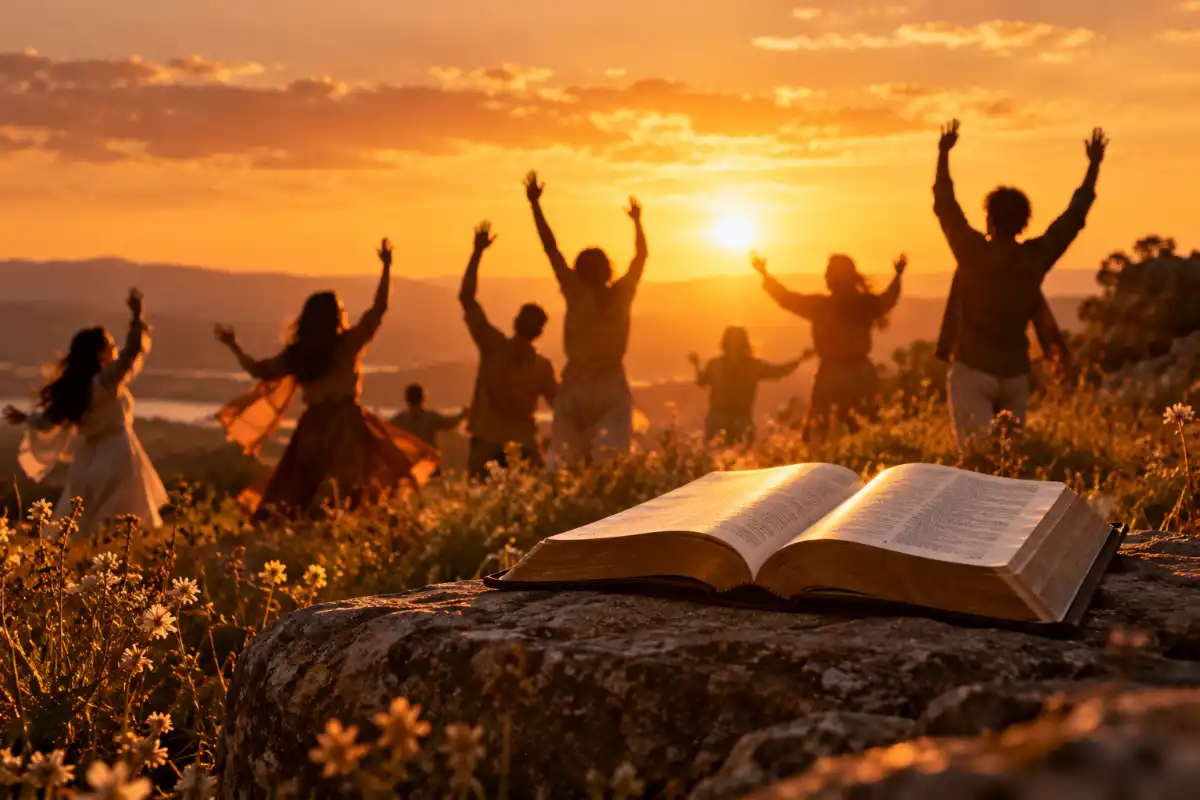
Each of these Bible verses about dancing is quoted word for word from the King James Version, followed by a brief note on what it means.
A time to weep, and a time to laugh; a time to mourn, and a time to dance;
Ecclesiastes 3:4 (KJV)
Among Bible verses about dancing, this one has the Preacher placing dancing beside laughter as part of life’s rhythm. Grief and gladness both have their season, and wisdom lies in recognising which one has arrived. Dancing is not frivolous here; it is simply what a joyful season looks like when the body joins in.
Thou hast turned for me my mourning into dancing: thou hast put off my sackcloth, and girded me with gladness;
Psalms 30:11 (KJV)
In one of the best-loved Bible verses about dancing, David describes a complete reversal. Sackcloth, the clothing of sorrow, is taken off and gladness is put on. Dancing becomes the sign that God has answered, which is why many readers treat this verse as a promise of restoration after a hard season.
Let them praise his name in the dance: let them sing praises unto him with the timbrel and harp.
Psalms 149:3 (KJV)
This is one of the Bible verses about dancing that names dance as a way to praise God, together with singing and instruments. The worship it describes is physical and communal, not silent and still. It gives believers permission to let gratitude move through the whole body and not only the lips.
Praise him with the timbrel and dance: praise him with stringed instruments and organs.
Psalms 150:4 (KJV)
The final psalm, with its Bible verses about dancing, calls every kind of music and movement into worship. Dance sits in the middle of a list of instruments, treated as one more tool for honoring God. Nothing is held back, and everything with breath or rhythm is invited to join.
And Miriam the prophetess, the sister of Aaron, took a timbrel in her hand; and all the women went out after her with timbrels and with dances.
Exodus 15:20 (KJV)
These Bible verses about dancing show Miriam, after the Red Sea crossing, leading the women in dance and song. It is one of the earliest recorded acts of worship through movement, and it shows deliverance releasing a joy too large to contain. A leader models gratitude and the community follows.
And David danced before the LORD with all his might; and David was girded with a linen ephod.
2 Samuel 6:14 (KJV)
In this scene from the Bible verses about dancing, the king of Israel sets aside dignity to celebrate the ark coming home. Wearing simple priestly linen, David dances with total abandon. The verse shows worship that is wholehearted rather than polished, offered to God without concern for how it looks to others.
So David and all the house of Israel brought up the ark of the LORD with shouting, and with the sound of the trumpet.
2 Samuel 6:15 (KJV)
In these Bible verses about dancing, David was not dancing alone. The whole house of Israel joined with shouting and trumpets, so the celebration was public and shared. Joy in the Bible is rarely private; it spills into the community and becomes a festival everyone can enter.
Then shall the virgin rejoice in the dance, both young men and old together: for I will turn their mourning into joy, and will comfort them, and make them rejoice from their sorrow.
Jeremiah 31:13 (KJV)
This is one of the Bible verses about dancing in which God promises a restored people dancing across every age group, young and old together. The comfort he offers turns sorrow into rejoicing. It is a picture of healing that reaches the whole community, and dancing is how that healing becomes visible.
Now his elder son was in the field: and as he came and drew nigh to the house, he heard musick and dancing.
Luke 15:25 (KJV)
Among Bible verses about dancing, the parable of the prodigal son shows a welcome home that is marked by music and dancing. Jesus uses the sound of celebration to show how heaven responds when the lost return. The older brother’s reaction invites us to ask whether we share the Father’s joy.
Then was our mouth filled with laughter, and our tongue with singing: then said they among the heathen, The LORD hath done great things for them.
Psalms 126:2 (KJV)
In these Bible verses about dancing, laughter and singing overflow when God restores his people, and even outsiders notice. Joy that comes from real deliverance becomes a quiet witness. Dancing belongs to the same family of expressions, showing outwardly what gratitude has done inwardly.
And saying, We have piped unto you, and ye have not danced; we have mourned unto you, and ye have not lamented.
Matthew 11:17 (KJV)
In one of the more surprising Bible verses about dancing, Jesus uses a children’s game of dancing and mourning to rebuke a generation that would respond to nothing. The image assumes that dancing at a happy occasion is normal. The failure is not the dance but a heart that refuses to respond to what God is doing.
The joy of our heart is ceased; our dance is turned into mourning.
Lamentations 5:15 (KJV)
This is the sorrowful mirror of Psalm 30, and among Bible verses about dancing it is the saddest. When disaster fell, the dance stopped. The verse shows that dancing had been an ordinary expression of joy in Israel, and its absence is the measure of the community’s grief and its longing for restoration.
They send forth their little ones like a flock, and their children dance.
Job 21:11 (KJV)
In this unusual entry among Bible verses about dancing, Job observes that some prosper without seeming to think of God, and their children dance. The verse is a reminder that dancing alone is not proof of righteousness. Joy must be rooted in God, not only in comfort, to be the kind Scripture celebrates.
This is the day which the LORD hath made; we will rejoice and be glad in it.
Psalms 118:24 (KJV)
A short verse among the Bible verses about dancing that fits any celebration, from a wedding to a Sunday morning. It places gladness in the present day as a gift from God. Many people read it as a call to rejoice fully, with song, movement and gratitude, rather than waiting for a better day.
Then he said unto them, Go your way, eat the fat, and drink the sweet, and send portions unto them for whom nothing is prepared: for this day is holy unto our Lord: neither be ye sorry; for the joy of the LORD is your strength.
Nehemiah 8:10 (KJV)
Among Bible verses about dancing and feasting, the people wept as they heard the law, yet Nehemiah told them to feast and share. Holy days include rejoicing and generosity. The joy of the LORD is described as strength, which explains why joyful gatherings, dancing included, can renew a weary people.
For the LORD taketh pleasure in his people: he will beautify the meek with salvation.
Psalms 149:4 (KJV)
Right after the call to dance in these Bible verses about dancing, the psalm gives the reason: God takes pleasure in his people. Worship is not only what we offer but a response to being delighted in. Dancing before such a God is a joyful reply to a love already given.
The LORD thy God in the midst of thee is mighty; he will save, he will rejoice over thee with joy; he will rest in his love, he will joy over thee with singing.
Zephaniah 3:17 (KJV)
Here, in one of the Bible verses about dancing and singing, God himself sings with joy over his people. If the Creator rejoices with singing, then human gladness is a natural echo. The verse reassures anyone who feels unworthy of celebration that joy begins with God, not with our performance.
Make a joyful noise unto the LORD, all the earth: make loud, and rejoice, and sing praise.
Psalms 98:4 (KJV)
In these Bible verses about dancing and praise, the invitation is wide, addressed to all the earth. Praise is loud, glad and energetic rather than hushed. Whether through singing, clapping or dancing, the psalm encourages worship that is full of life and not only quiet reflection.
Serve the LORD with gladness: come before his presence with singing.
Psalms 100:2 (KJV)
Serving God is paired with gladness, not duty alone, a thread in many Bible verses about dancing. Coming before his presence with singing sets the tone for approach. Dancing fits this spirit when it is an honest expression of thankfulness and a joyful way to come into worship.
To every thing there is a season, and a time to every purpose under the heaven:
Ecclesiastes 3:1 (KJV)
The opening line of the famous poem frames every experience as seasonal, including the Bible verses about dancing that follow. There is a season for stillness and a season for dancing. Reading it first helps us receive both without guilt, trusting that God works in each one and brings joy back in due time.
The Bible speaks about dancing more often than many readers expect. Across the Old and New Testaments, people dance at victories, weddings, festivals, homecomings and acts of worship. Bible verses about dancing appear in the law, the histories, the Psalms, the prophets and the Gospels, and almost every time the setting is joy. Dancing is presented as a natural human response to God’s goodness, not as something suspicious.
At the same time, Bible verses about dancing never treat dancing as a stand-alone act. It is always attached to something: a rescue, a return, a covenant, a festival, a blessing. The dance means something because of what it celebrates. That is the key to reading these passages well, because the question the Bible asks is not only whether people danced but why and before whom.
This page walks through those passages one at a time. We will look at the best known Bible verses about dancing, the people who danced, the Hebrew words involved, the parts of the Bible where dancing stops because of grief, and how modern readers can apply it. The goal is a clear, balanced picture drawn from the text itself.
In the Old Testament, dancing is woven into community life, and many Bible verses about dancing come from that setting. Women greeted returning armies with timbrels and dances, families celebrated harvests, and the great festivals of Israel were occasions for joyful gathering. Dancing was not reserved for professionals or priests. It belonged to ordinary people marking extraordinary moments, which is part of why the Psalms can call on the whole congregation to praise God in the dance.
The Hebrew language has several words connected to dancing, including terms for circling, leaping and rejoicing. They suggest movement that was energetic and often communal, sometimes in lines or circles. While we cannot reconstruct the exact steps, the vocabulary shows that dance was a recognised part of Israel’s culture, and it was drawn into worship rather than kept apart from it.
Importantly, the Old Testament shows dancing in both sacred and everyday settings. A wedding feast, a victory song and a procession with the ark all included it. Reading Bible verses about dancing in the Old Testament, we see a people for whom faith and joy were not separate compartments but one lived experience.
The first named dancer in the Bible verses about dancing is Miriam. After Israel crossed the Red Sea on dry ground and the Egyptian army was swept away, she took a timbrel and the women followed her out with timbrels and with dances. The scene in Exodus 15 is one of the oldest descriptions of worship through movement in the Bible.
Notice the order of events. God acts first, delivering his people, and the dance follows as a response. Miriam does not invent a ritual; she gives shape to a gratitude that was already overflowing. The song she leads repeats the praise of Moses, so music, words and movement all carry one message about the faithfulness of God.
For readers today, this passage suggests that celebration is a proper answer to answered prayer. When something has truly been delivered, whether a recovery, a reconciliation or a rescue, it is fitting to give thanks in ways that involve the whole person. Miriam shows that leading others in joy is also a form of ministry.
No story among the Bible verses about dancing is better known than David bringing the ark to Jerusalem. Second Samuel 6 says he danced before the LORD with all his might. The king wore a simple linen ephod, set aside royal dignity, and joined a procession filled with shouting and trumpets. It was a moment of unrestrained worship.
Michal, his wife, watched from a window and despised him in her heart. David answered that he would become even more undignified if it honored God. The exchange raises an old question: should worship be controlled by appearances or by devotion? David chose devotion, and the text does not rebuke him for it.
The lesson is not that everyone must dance, but that the heart behind worship matters more than the polish. David’s dance was a response to the presence of God coming near. Anyone who has felt the relief of a long-awaited answer can understand why he could not stand still. His example frees believers from worrying about what others think.
The Psalms contain some of the clearest Bible verses about dancing. Psalm 149:3 says to praise his name in the dance, and Psalm 150:4 says to praise him with the timbrel and dance. Psalm 30:11 describes mourning turned into dancing. Together they show that dance was a recognised part of Israel’s songbook, not an embarrassing exception.
These psalms, full of Bible verses about dancing, were written to be sung by the community. When they mention dancing, they invite the whole assembly to take part, not merely to watch. The mention of timbrels, harps and stringed instruments suggests a lively atmosphere in which music and movement supported one another. Worship was meant to engage every sense and every capacity.
It is also worth noticing how the Psalms hold joy and sorrow together. The same book that celebrates dancing also contains laments. That balance teaches us that joyful expression is not a denial of pain but a testimony that God meets people in it. The dancing psalms are most powerful when read next to the weeping ones.
Psalm 30:11 may be the most loved of all Bible verses about dancing: Thou hast turned for me my mourning into dancing. David writes after a time of serious distress, and he credits God with the change. The sackcloth of grief is removed and gladness is put on like a new garment. It is a promise that sorrow is not the final word.
This favorite among Bible verses about dancing does not promise instant relief. Earlier in the same psalm David says weeping may endure for a night, but joy cometh in the morning. The turn happens in God’s time, and the psalm is written looking back on it. Readers in the middle of grief can hold the verse as hope without pretending the night is already over.
Many people have turned to this passage after loss, illness or years of struggle. It reminds them that God is able to bring unexpected joy, and that when it comes it can be as visible as a dance. If you are still waiting, the psalm is a reminder to keep praying and to watch for the morning.
Among Bible verses about dancing, Ecclesiastes 3:4 places dancing in a famous list: a time to weep, and a time to laugh; a time to mourn, and a time to dance. The poem teaches that human experience moves in seasons, and that wise people learn to recognise which one they are in. The verse is often quoted at weddings, funerals and new beginnings alike.
What stands out is the pairing. Dancing is set against mourning, and laughing against weeping. The Preacher does not choose one side as holy and the other as shameful. Both are part of life under heaven, and both are given by God. That balance makes this one of the more honest Bible verses about dancing.
A practical application follows. When joy arrives, we can accept it without guilt, even if we have known hard seasons. And when sorrow comes, we need not force a dance. Recognising the season lets us respond truthfully, trusting that the time to dance will come again. The poem asks for discernment, not for constant celebration.
Dancing in the Bible is often connected to feasting and public celebration, and many Bible verses about dancing reflect that. The prodigal son’s return in Luke 15 is welcomed with music and dancing. Jeremiah’s vision of restoration includes young men and old rejoicing together in the dance. These scenes treat dancing as a natural part of a good party held in God’s presence.
This matters because some believers have wondered whether any celebration is too worldly. The Bible suggests otherwise. Feasts were commanded in the law, and joy was part of obedience. When celebration honors God and includes the whole community, including the old and the young, it fits the pattern Scripture sets out.
There is a connected theme of hospitality. The father in the parable does not wait for the son to prove himself before calling for music. Joy comes first, as grace comes first. Churches and families can learn from this by making room for gladness, shared meals and gatherings that remind everyone they belong. Celebration is one way God’s welcome is made visible.
In Luke 15:25, one of the quieter Bible verses about dancing, the older brother approaches the house and hears musick and dancing. His reaction shows how easy it is to stand outside a celebration. The father had called for the best robe, a ring and a feast, and the whole household had joined in. Yet the older brother stayed in the field, resentful of the party.
Jesus uses this detail to expose a spiritual problem. Dancing and music were signs that someone lost had been found. To refuse to enter the celebration was to refuse the father’s joy. The older brother had worked faithfully but had not understood grace. His distance from the dancing mirrors a distance from the father’s heart.
The story asks every reader a quiet question: when God welcomes someone back, do we dance or do we stand in the field? Bible verses about dancing are not only invitations to move; they are tests of our attitude toward mercy. The father keeps the door open for both sons, and the music keeps playing.
Not every one of the Bible verses about dancing is cheerful. Lamentations 5:15 says the joy of our heart is ceased; our dance is turned into mourning. The writer is describing a city in ruins, and the end of dancing is a sign of deep loss. Honest grief is allowed in Scripture, and this verse is part of that honest record.
Jesus alludes to the same idea in Matthew 11:17, rebuking those who would neither dance when he piped nor mourn when he lamented. The point there is not that dancing is wrong but that some hearts refuse to respond to God at all. Together, these verses show that appropriate response, whether joy or sorrow, is what God desires.
If you cannot dance right now, you are not failing spiritually. Lamentations stands in the Bible to show that God does not demand pretended joy. The same God who hears the lament also promised, in Jeremiah 31, to turn mourning into joy. The silence of the dance is a season, not a verdict, and prayer is still welcome.
Nehemiah 8:10 says the joy of the LORD is your strength. The people had gathered to hear the law and were weeping, yet their leaders told them this was a day for rejoicing, feasting and sharing with those in need. The joy described is not a mood but a source of spiritual energy that comes from knowing God.
This helps explain why dancing and gladness appear so often together in Bible verses about dancing and throughout Scripture. Joy is not an optional extra to faith. It is part of its strength. When believers rejoice, whether by singing, shouting or dancing, they are drawing on the same well Nehemiah pointed to. The movement is an outward sign of an inner reality.
To cultivate this joy, readers can look at related themes such as rejoicing always, where Paul encourages constant gladness in the Lord. Both passages treat joy as something grounded in God rather than circumstances, and both suggest that regular, deliberate thankfulness can renew a tired heart.
Almost every biblical mention of dancing includes music. Miriam used a timbrel, the psalmist adds harps and stringed instruments, and the prodigal son’s household had musick and dancing. Song, instrument and movement formed one expression. Reading Bible verses about dancing alongside Bible verses about singing shows how closely these gifts belong together.
Among Bible verses about dancing and music, Zephaniah 3:17 gives a striking image: God himself will joy over his people with singing. If the Lord sings, then human song is a reflection of his own joy. Dancing, in turn, is a way of letting that song move through the body. The same Creator who gave the voice also gave the limbs and the sense of rhythm.
In practice, many churches and families have rediscovered this unity through worship music that invites movement, clapping or simple gestures. There is no single required form. The aim is to engage the whole person in thankfulness. Where the music is sincere and the focus stays on God, movement can deepen rather than distract from worship.
Among Bible verses about dancing, Psalm 149:3 states plainly: Let them praise his name in the dance. Psalm 150:4 repeats the call. On the evidence of these verses alone, dancing can be an act of worship when it is directed toward God. Miriam and David both danced as an expression of praise, and neither text apologises for it.
The answer, however, depends on the heart and the setting. Worship is defined less by the form than by the focus. A dance offered in gratitude to God, in a context that honors him, fits the biblical pattern. A performance meant to draw attention to oneself would not. The same principle applies to singing, preaching and every other act of worship.
Many Christians today practice expressive worship in various ways, from raising hands to joyful movement to choreographed praise. Others prefer quiet reverence. Scripture seems to make room for both, and Paul’s advice that all things be done decently and in order offers a balance. What matters is that the worship be sincere and loving toward others.
Readers of Bible verses about dancing often ask whether the Bible allows dancing at weddings or social gatherings. Jeremiah 31:13 imagines young men and old rejoicing in the dance, and Luke 15 shows a family feast with music and dancing. There is no passage that condemns dancing as such, and several that treat it as a normal part of celebration.
What Scripture does warn against is excess and moral compromise. The Bible cautions against drunkenness, lust and revelry that dishonors God, and any activity can become sinful when it leads toward those things. The concern is the heart and the conduct, not the movement itself. A wedding dance that celebrates love and community is quite different from a setting designed to tempt.
Christians therefore often treat dancing as a matter of wisdom and conscience. Some families are comfortable with it, others choose differently, and Romans 14 encourages mutual respect between them. A good test is whether the occasion allows you to honor God, love your neighbour and keep a clear conscience. If it does, there is ample biblical room for gladness.
David’s dance in 2 Samuel 6 raises the matter of shame, a theme in Bible verses about dancing. Michal criticised him for making himself undignified, and David replied that he would be even more lowly in his own sight if it honored the LORD. The story gives a model for worshippers who feel self-conscious about expressing joy openly.
Many people hold back from dancing, singing or clapping because they fear looking foolish. The Bible suggests that the opinion of the crowd should not govern our worship. At the same time, it does not demand that everyone move in the same way. The freedom David displays is the freedom to be honest before God, whatever that looks like for you.
A gentle application: start with what is natural. Perhaps it is a smile, a lifted hand, a quiet sway or a step in your own kitchen while a hymn plays. Dancing without shame does not mean performing for others. It means letting gratitude be seen when it is genuine, trusting that God receives it gladly.
Job 21:11 mentions children dancing, and the Psalms invite every generation to praise. Children are naturally expressive, and many learn about God through songs with actions and movement. Parents and teachers can draw on Bible verses about dancing to show that joy in God is not just for adults or for quiet moments.
A simple approach to teaching Bible verses about dancing is to tell the story of Miriam and the Red Sea, then let children act it out with a homemade tambourine. Or read Psalm 150 aloud and let them add rhythm with clapping. Such activities connect Scripture with the body and the imagination, making the story memorable and the praise sincere.
It is also helpful to explain why we celebrate. Children should understand that the dancing in the Bible follows something God has done. Teaching gratitude along with movement keeps joy anchored. Linking the stories with topics such as joy in the Bible helps them see that gladness is a gift they can receive from God every day.
Several Bible verses about dancing are tied to healing. Jeremiah 31:13 promises to turn mourning into joy and comfort the people, and Psalm 30:11 describes sackcloth exchanged for gladness. In both, dancing marks the arrival of restoration. It is not a way of ignoring pain but the visible fruit of having been helped by God.
For people carrying long grief, these Bible verses about dancing offer hope without hurry. Healing often arrives in small steps: a laugh, a good meal, a moment of peace. These early signs can be received as the first notes of a dance yet to come. You can pair this hope with the comfort of Bible verses about peace while you wait.
Practically, gentle movement can support emotional recovery, and many people find that a walk, a hymn or a simple dance lifts the spirit. Scripture does not make medical claims, but it does show that God cares for the whole person. Joy and restoration are meant to be embodied, and dancing is one way to celebrate that.
If you are living in a season of weeping, the Bible verses about dancing can seem distant. Yet they were written for people who knew sorrow well. The same David who danced also wrote psalms of anguish. The prophets who promised dancing spoke to a nation in exile. Hope in these passages is hard-won and honest, not shallow cheer.
One helpful practice is to read Psalm 30 slowly, noting each step: the cry for help, the healing, and then the turning of mourning into dancing. The psalm does not hide the first part. It teaches that the road to joy often passes through prayer. Pair it with Bible verses about hope to strengthen your trust in God’s timing.
Another practice is to remember past mercies. Looking back at times God has already turned things around builds confidence for the present. Even if the dance is not here yet, you can prepare your heart to receive it. Ecclesiastes reminds us that the season will change, and God is faithful through every part of the cycle.
Among Bible verses about dancing and joy, Nehemiah 8:10 links joy and strength, and the psalms show people drawing courage from celebration. Dancing, in this light, can be more than leisure; it can be a spiritual discipline that renews energy and focus. Joyful worship has often fortified believers who faced opposition, poverty or exhaustion.
This connection is worth exploring alongside Bible verses about strength. Both themes insist that God supplies what we lack. Where strength fails, joy can lift us; where joy feels hard, God’s strength carries us. The two work together, and the Bible never presents them as rivals.
In daily life, this might mean building rhythms of gratitude: singing in the morning, playing a favorite hymn, or marking small victories with a thankful pause. These habits do not remove difficulty, but they keep the heart soft and the spirit strong. Joy is not a luxury; it is part of how God sustains his people.
Applying Bible verses about dancing begins with understanding their purpose: they celebrate what God has done. Before moving, pause to name the blessings you have received. Gratitude is the root, and any outward expression, whether a dance, a song or a shout, grows from it. This keeps joy from becoming empty performance.
Next, find a setting that suits you for living out Bible verses about dancing. That could be a church service with expressive music, a family celebration, or a private moment at home. Respect your own conscience and the conscience of others. If dancing is not natural for you, find another way to express gladness, such as singing, clapping or writing a psalm of thanks.
Finally, let the Bible verses about dancing lead joy to overflow into love. The dance of David included shared food for the people, and Nehemiah told them to send portions to those with nothing. True celebration blesses others. Look for ways to include the lonely and to count your blessings in ways that serve your community. That keeps the spirit of these verses alive.
If these Bible verses about dancing have encouraged you, these related pages can take you further into joy, praise and thanksgiving: Bible Verses About Singing, Bible Verses About Joy, Bible Verses About Worship, Bible Verses About Praise, Bible Verses About Happiness, Bible Verses About Laughter, Bible Verses About Rejoice, Bible Verses About Worship Music, Bible Verses About Gratitude, Bible Verses About Praise and Worship.
To study these verses in more depth, try Bible Gateway, Bible Hub, Bible Study Tools, Blue Letter Bible.
Yes. Bible verses about dancing show that dancing is welcome in worship and celebration. Scripture records dancing in worship and celebration, including Miriam at the Red Sea, David before the ark, and the feast in the parable of the prodigal son. Psalms 149 and 150 call on God’s people to praise him in the dance. The Bible warns against sin, not against joyful movement itself.
Psalm 30:11 is among the best loved: Thou hast turned for me my mourning into dancing. Ecclesiastes 3:4, which speaks of a time to mourn and a time to dance, is also widely quoted. Both show that dancing marks joy and restoration in Scripture.
Among Bible verses about dancing, Miriam led the women in dance after the Red Sea crossing, and David danced with all his might before the LORD when the ark came to Jerusalem. Jeremiah also pictures young and old dancing together, and Luke 15 describes music and dancing at the prodigal son’s welcome home.
It can be, according to Bible verses about dancing such as Psalm 149:3 and Psalm 150:4. Psalm 149:3 says to praise his name in the dance, and Psalm 150:4 repeats the call. What matters is the heart behind it. Dancing that honors God, expresses gratitude and respects others fits the biblical pattern, while dancing for self display would miss it.
In the Bible verses about dancing, David danced to celebrate the ark of the LORD entering Jerusalem, a moment of national joy and worship. Second Samuel 6 says he danced with all his might, wearing a simple linen ephod. His wholehearted joy showed that honoring God mattered more to him than royal dignity.
It describes God’s power to replace grief with joy. In Psalm 30:11 David says sackcloth was removed and gladness put on. The phrase does not deny sorrow; it celebrates the moment of healing. Many readers take it as a promise that painful seasons can end in restoration.
None of the Bible verses about dancing forbids dancing as such. Jeremiah 31:13 and Luke 15 treat dancing as part of celebration. The Bible does caution against drunkenness, lust and anything that dishonors God, so believers are encouraged to use wisdom and conscience in choosing settings and in how they celebrate.