
The Bible verses about prayer and healing tell one long story: people in pain speak to God, and God shows Himself as the Healer who listens. From Abraham praying for a foreign king’s household to James instructing church elders, Scripture treats asking God for healing as a normal part of faith rather than a last resort.
This page studies that story. It walks through the key passages in their setting, looks at the Hebrew and Greek words behind “heal” and “whole,” and faces the hard question of why some prayers for healing receive a different answer than the one we hoped for.
These Bible verses about prayer and healing are arranged from the Old Testament to the New, so you can watch the theme grow, reach its fullness in Jesus, and point toward its final answer in the new creation.
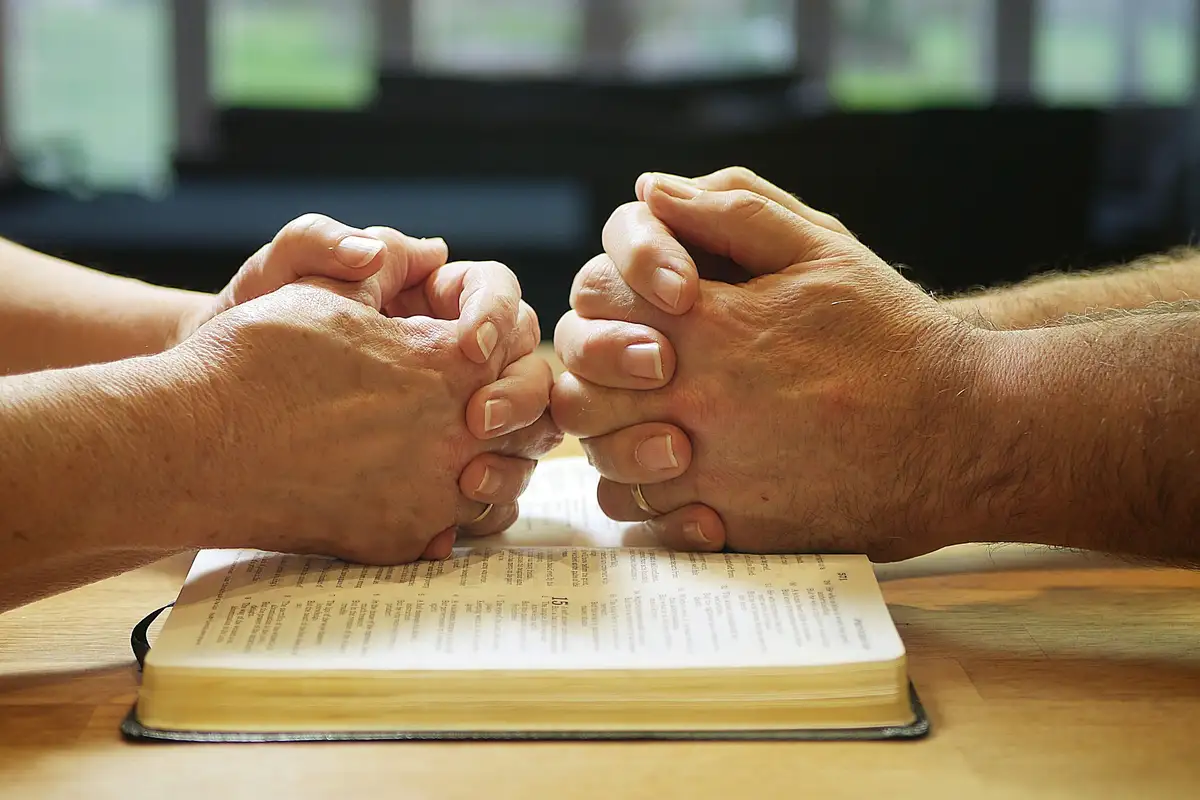
Every verse below is quoted word for word from the King James Version, with the reference under each passage.
Is any sick among you? let him call for the elders of the church; and let them pray over him, anointing him with oil in the name of the Lord: And the prayer of faith shall save the sick, and the Lord shall raise him up; and if he have committed sins, they shall be forgiven him. Confess your faults one to another, and pray one for another, that ye may be healed. The effectual fervent prayer of a righteous man availeth much.
James 5:14-16 (KJV)
Among all the Bible verses about prayer and healing, this is the clearest instruction to the church: call the elders, pray, anoint, and confess sins to one another.
Turn again, and tell Hezekiah the captain of my people, Thus saith the Lord, the God of David thy father, I have heard thy prayer, I have seen thy tears: behold, I will heal thee: on the third day thou shalt go up unto the house of the Lord.
2 Kings 20:5 (KJV)
God’s reply to Hezekiah joins prayer, tears, and healing in a single sentence, showing that the Lord notices both the request and the grief behind it.
And said, If thou wilt diligently hearken to the voice of the Lord thy God, and wilt do that which is right in his sight, and wilt give ear to his commandments, and keep all his statutes, I will put none of these diseases upon thee, which I have brought upon the Egyptians: for I am the Lord that healeth thee.
Exodus 15:26 (KJV)
Many Bible verses about prayer and healing rest on this one, where God names Himself “the LORD that healeth thee” after sweetening the bitter water at Marah.
So Abraham prayed unto God: and God healed Abimelech, and his wife, and his maidservants; and they bare children.
Genesis 20:17 (KJV)
The first time Scripture uses the word “healed,” it follows a prayer, making Abraham’s intercession the starting point for Bible verses about prayer and healing.
And Moses cried unto the Lord, saying, Heal her now, O God, I beseech thee.
Numbers 12:13 (KJV)
Moses pleads for his sister Miriam even though she had just spoken against him, a brief and urgent prayer of mercy.
O Lord my God, I cried unto thee, and thou hast healed me.
Psalms 30:2 (KJV)
Among the Bible verses about prayer and healing, David’s testimony is the simplest: he cried, and God healed.
Bless the Lord, O my soul, and forget not all his benefits: Who forgiveth all thine iniquities; who healeth all thy diseases;
Psalms 103:2-3 (KJV)
David lists forgiveness and healing side by side as benefits to remember, tying the health of the soul to the mercy of God.
Then they cry unto the Lord in their trouble, and he saveth them out of their distresses. He sent his word, and healed them, and delivered them from their destructions.
Psalms 107:19-20 (KJV)
Those who cried to the Lord in trouble found that He “sent his word, and healed them,” a phrase Christians hear as a pointer to Christ, the living Word.
He healeth the broken in heart, and bindeth up their wounds.
Psalms 147:3 (KJV)
Healing in Scripture includes the inner life; the God who numbers the stars in the next verse also binds up the brokenhearted.
Heal me, O Lord, and I shall be healed; save me, and I shall be saved: for thou art my praise.
Jeremiah 17:14 (KJV)
Jeremiah’s short prayer places all confidence in God: if the Lord heals, the healing is real, and if He saves, the saving is sure.
But he was wounded for our transgressions, he was bruised for our iniquities: the chastisement of our peace was upon him; and with his stripes we are healed.
Isaiah 53:5 (KJV)
Christians count this among the central Bible verses about prayer and healing, reading the Servant’s wounds as fulfilled in Jesus.
The centurion answered and said, Lord, I am not worthy that thou shouldest come under my roof: but speak the word only, and my servant shall be healed.
Matthew 8:8 (KJV)
The centurion believed a word from Jesus could heal at a distance, and Jesus marveled at a faith He had not found even in Israel.
And there came a leper to him, beseeching him, and kneeling down to him, and saying unto him, If thou wilt, thou canst make me clean. And Jesus, moved with compassion, put forth his hand, and touched him, and saith unto him, I will; be thou clean.
Mark 1:40-41 (KJV)
The leper did not doubt Jesus’ power, only His willingness, and Jesus answered with compassion, a touch, and the words “be thou clean.”
And he said unto her, Daughter, thy faith hath made thee whole; go in peace, and be whole of thy plague.
Mark 5:34 (KJV)
The woman who touched His garment was called “Daughter,” and her healing included peace and restored standing as well as a cured body.
Jesus said unto him, If thou canst believe, all things are possible to him that believeth. And straightway the father of the child cried out, and said with tears, Lord, I believe; help thou mine unbelief.
Mark 9:23-24 (KJV)
Bible verses about prayer and healing like this one show that God receives the honest cry of mixed faith: “help thou mine unbelief.”
And it came to pass, that the father of Publius lay sick of a fever and of a bloody flux: to whom Paul entered in, and prayed, and laid his hands on him, and healed him.
Acts 28:8 (KJV)
Paul prayed before he laid hands on the father of Publius, a reminder that the apostles healed in dependence on God rather than by their own power.
For this thing I besought the Lord thrice, that it might depart from me. And he said unto me, My grace is sufficient for thee: for my strength is made perfect in weakness. Most gladly therefore will I rather glory in my infirmities, that the power of Christ may rest upon me.
2 Corinthians 12:8-9 (KJV)
Paul asked three times for relief and received sufficient grace instead of removal, one of the most honest Bible verses about prayer and healing.
And God shall wipe away all tears from their eyes; and there shall be no more death, neither sorrow, nor crying, neither shall there be any more pain: for the former things are passed away.
Revelation 21:4 (KJV)
The Bible verses about prayer and healing end here, in a world with no more death, sorrow, crying, or pain.
Before reading these verses one by one, it helps to know what the biblical writers meant by “heal.” The main Hebrew verb is rapha, defined in the Blue Letter Bible lexicon as to mend, repair, or make whole. It describes bodies, but also bitter water (2 Kings 2:21-22), a wounded land, and a wandering heart: “I will heal your backslidings” (Jeremiah 3:22).
The New Testament uses several Greek words. One gives us the English “therapy,” another stresses cure, and a third, sozo, means both “save” and “make whole.” When Jesus tells the woman in Mark 5:34 that her faith has made her whole, that is the word He uses. Biblical healing therefore reaches past symptoms to the whole person, which is why this site also has separate studies of what Scripture says about spiritual healing and verses on emotional healing.
The theme begins early. In Genesis 20:17, Abraham prays for Abimelech, and God heals the king, his wife, and his servants. It is the first time the Bible uses the word “healed,” and it arrives on the back of intercession. Healing and prayer are linked from the first page they share.
At Marah, just days after the Red Sea, Israel found water too bitter to drink. Moses cried to the Lord, a tree was cast into the water, and it became sweet. Then God gave Himself a name: Jehovah Rapha, “the LORD that healeth thee” (Exodus 15:26). Healing was not a technique Israel mastered; it was part of who their God is.
Numbers adds two scenes. Moses prays, “Heal her now, O God,” for Miriam, who had just criticized him. Later, bitten Israelites look to a bronze serpent on a pole and live (Numbers 21:8-9), an image Jesus applies to Himself in John 3:14. These stories show mercy flowing even to people who had failed. For a wider look at bodily recovery, see Bible verses about physical healing.
No Old Testament passage on this subject is more vivid than King Hezekiah’s story. In 2 Kings 20, the prophet Isaiah tells him to set his house in order, because he will die. Hezekiah turns his face to the wall, reminds God of his faithful walk, and weeps bitterly. Before Isaiah has even left the middle court, God sends him back with a new message: “I have heard thy prayer, I have seen thy tears: behold, I will heal thee.”
Two details deserve attention. First, God added fifteen years to Hezekiah’s life, a specific and generous answer. Second, Isaiah then told servants to lay a lump of figs on the boil (2 Kings 20:7). The healing came from God, yet God used an ordinary remedy. Read the chapter at Bible Hub’s KJV text of 2 Kings 20, and a parallel account appears in Isaiah 38, where Hezekiah writes a poem of thanks.
The story belongs here because it shows God changing a stated outcome in response to prayer. Related stories are gathered on our page of Bible verses about answered prayer.
The Psalms supply many verses, giving believers words for both the plea and the praise. Psalm 6:2 is a raw request: “O LORD, heal me; for my bones are vexed.” Psalm 41:4 links healing to repentance: “heal my soul; for I have sinned against thee.” These prayers are not polite. They are honest.
Then come the psalms of thanks. Psalm 30:2 remembers, “I cried unto thee, and thou hast healed me.” Psalm 103 tells the soul to forget none of God’s benefits and lists healing right beside forgiveness.
Psalm 147:3 widens the circle: God “healeth the broken in heart, and bindeth up their wounds.” In the Psalms, grief and sickness are both brought into God’s presence without shame. If you are praying through a hard season, our collection of Bible verses about prayer in difficult times continues this thread.
Several passages connect sickness with sin. Psalm 103:3 pairs forgiveness and healing. James 5:15-16 tells the sick to confess their faults. When a paralyzed man was lowered through a roof, Jesus first said, “Son, thy sins be forgiven thee” (Mark 2:5), and only afterward told him to walk.
Scripture is just as clear that sickness is not always a sign of personal sin. When the disciples asked whose sin had caused a man’s blindness, Jesus answered, “Neither hath this man sinned, nor his parents” (John 9:3). The whole book of Job argues against the friends who assumed suffering must be punishment.
The balanced reading is this: all sickness belongs to a world broken by sin, some sickness is tied to specific wrongdoing, and much of it is simply part of living in a fallen world. Confession heals relationships and consciences whether or not the body recovers. That is why these passages so often place forgiveness first. Our page on Bible verses about forgiveness and healing explores this link further.
The Gospels are full of people asking Jesus for healing, and the way He answered teaches as much as the miracles themselves. A leper knelt and said, “If thou wilt, thou canst make me clean” (Mark 1:40). Jesus, moved with compassion, touched a man no one else would touch. A centurion asked only for a word, trusting authority rather than proximity. Blind Bartimaeus was asked directly, “What wilt thou that I should do unto thee?” (Mark 10:51).
Read side by side, the Gospels’ Bible verses about prayer and healing record requests that were short, humble, and personal, never a formula. Some people came for themselves, others for a servant, a daughter, or a friend. Matthew 8:16-17 summarizes a whole evening of healing and says it fulfilled Isaiah’s words: “Himself took our infirmities, and bare our sicknesses.”
Jesus also healed people who had not asked, such as the man at the pool of Bethesda (John 5:6). More of these accounts are gathered in our study of Bible verses about healing the sick, and the role of trust is examined in Bible verses about healing and faith.
Mark 9:23-24 is one of the most comforting Bible verses about prayer and healing because it features a person whose faith was not strong. A father brought his tormented son to the disciples, who could not help. When he came to Jesus, he said, “if thou canst do any thing.” Jesus turned the words back to him: “If thou canst believe, all things are possible to him that believeth.”
The father’s reply is a prayer anyone can pray: “Lord, I believe; help thou mine unbelief.” Jesus healed the boy. He did not wait for the father’s faith to become flawless. In the Bible verses about prayer and healing, faith is not a force we generate to unlock results; it is trust placed in a Person who is able.
Afterward the disciples asked privately why they had failed. In the KJV, Jesus answers that “this kind can come forth by nothing, but by prayer and fasting” (Mark 9:29). Some ancient manuscripts omit “and fasting,” so modern translations differ, but every version keeps the emphasis on prayer. See also Bible verses about prayer and faith.
After the resurrection, prayer for healing became part of church life. Peter told a lame man, “Silver and gold have I none; but such as I have give I thee” (Acts 3:6), and made clear that the power came from Jesus’ name, not his own holiness. On Malta, Paul prayed, laid hands on the father of Publius, and healed him (Acts 28:8).
James 5, the most quoted of all Bible verses about prayer and healing, turns these stories into ordinary pastoral practice. The sick person calls for the elders, who pray and anoint with oil “in the name of the Lord.” You can read the full passage on Bible Gateway’s KJV text of James 5. James then points to Elijah, “a man subject to like passions as we are,” whose prayers were heard, to show that effective prayer belongs to ordinary believers.
Christian traditions apply James 5 differently. Catholic and Orthodox churches practice the anointing of the sick, described by Britannica as a sacrament. Many Protestant churches anoint as a symbolic act of prayer. All agree the healing comes from the Lord.
Honest study of the Bible verses about prayer and healing must include the prayers that were answered differently. Paul, who healed others, asked three times for his “thorn in the flesh” to be removed. God’s reply was, “My grace is sufficient for thee: for my strength is made perfect in weakness” (2 Corinthians 12:9). The thorn stayed, and Paul learned to glory in weakness.
Paul’s letters mention other believers who stayed ill. He advised Timothy to use a little wine “for thy stomach’s sake and thine often infirmities” (1 Timothy 5:23). He left Trophimus “at Miletum sick” (2 Timothy 4:20). Epaphroditus was “sick nigh unto death: but God had mercy on him” (Philippians 2:27), and Paul speaks of that recovery as mercy, not as something owed.
Christians hold different views on how often God heals miraculously today, and sincere believers disagree. Yet all can agree that an unanswered request is not proof of weak faith or divine indifference. For strength in long seasons, see Bible verses about healing and strength.
Isaiah 53:5, one of the best-known Bible verses about prayer and healing, says of the suffering Servant, “with his stripes we are healed.” Matthew 8:17 applies nearby words to Jesus’ healing ministry, while 1 Peter 2:24 applies the “stripes” line to forgiveness, so that believers, “being dead to sins, should live unto righteousness.” Together they show that the cross deals with sin at the root and makes every other healing possible.
That root healing is not always seen fully now. The New Testament places complete healing in the future: bodies raised imperishable (1 Corinthians 15:42-44) and a city where “there shall be no more death, neither sorrow, nor crying” (Revelation 21:4).
So the Bible verses about prayer and healing end in hope rather than in a formula. Every healing in this life is a preview, and every prayer that seems unanswered will be answered in full on that day. Our page of Bible verses about hope and healing follows this promise further.
A few misunderstandings often grow up around these passages. Watching for them keeps the Bible verses about prayer and healing in their proper setting:
Studying the text is one step; praying it is another. For practical help using these passages in daily life, visit the companion page, Bible verses for prayer and healing, or read about prayer for healing in Scripture. If you are facing illness, please also stay in close contact with qualified medical professionals.
From Abraham’s intercession to the tree of life, the Bible verses about prayer and healing reveal a God who hears, who cares about bodies and hearts alike, and who keeps His final promise of wholeness. Bring your requests to Him honestly, as the psalmists did, and hold His answers with trust.
Whatever you are carrying today, the same Lord who said “I have heard thy prayer” to Hezekiah still invites His people to pray.
Anyone who has stood at a hospital bed knows the awkward silence that wants to be filled. The Bible gives a simple model in Numbers 12:13. Miriam had been struck with a skin disease, and her brother Moses, the very man she had spoken against, “cried unto the LORD, saying, Heal her now, O God, I beseech thee.” Eight words in English. No speech, no theory about why it happened, no lecture on what she should have learned. He simply asked, aloud, with the whole camp watching.
That pattern is worth copying when you visit someone who is sick. Short beats long. Name the person, name the need, ask God for mercy, and stop. Avoid explaining their illness to them, and avoid promising an outcome you cannot see. Sometimes the best thing you offer is to sit down, hold a hand and say very little. Then pray briefly before you leave, and mean it. People remember who showed up far longer than they remember what was said.
Jeremiah is often called the weeping prophet, and for good reason. He was mocked, thrown into a cistern and ignored by kings. Out of that bruised life comes one of the plainest healing prayers in Scripture: “Heal me, O LORD, and I shall be healed; save me, and I shall be saved: for thou art my praise” (Jeremiah 17:14). Notice that he asks for healing and rescue in the same sentence. For Jeremiah the wound was partly physical, but it was also loneliness, fear and a heart tired of being the only one telling the truth.
That matters for people whose hurt does not show on any scan. Grief, a broken friendship, and years of carrying a secret all count as things worth bringing to the Healer. Jeremiah’s last phrase is the anchor: thou art my praise. He is saying that the Lord, not the outcome, is what he will boast in. If you are praying about a body, a marriage or a memory, you can pray those same words. And if the hurt feels heavy enough to frighten you, please also talk to a counselor or a pastor who can sit with you through it.
Some people worry that calling a doctor means a lack of trust. Scripture does not set them against each other. In Luke 10:34 the Samaritan “went to him, and bound up his wounds, pouring in oil and wine, and set him on his own beast, and brought him to an inn, and took care of him.” That was the best medical care of the day, and Jesus presents it as the very picture of loving a neighbor. Paul, too, told Timothy to “use a little wine for thy stomach’s sake and thine often infirmities” (1 Timothy 5:23), practical advice offered without any hint of embarrassment.
So pray, and also make the appointment. Take the prescribed medicine, ask the second question, and let nurses and therapists do the work they trained for. Many believers have found that prayer steadies the heart while treatment works on the body, and neither cancels the other. Gratitude is a fitting response either way. When someone recovers, whether through a miracle that surprises everyone or through months of careful care, the right words are the same: thank You, Lord, for hearing us and for the hands You used.
Keep exploring with these related pages: Bible Verses About Prayer for Healing, Bible Verses For Prayer and Healing, Bible Verses For Prayer for Healing, Bible Verses About Prayer and Strength and Bible Verses For Powerful Prayer.
For deeper study, Bible Gateway, Bible Hub and Bible Study Tools are all free to use.
Start with James 5:14-16 for the church’s practice, 2 Kings 20:5 for Hezekiah’s answered prayer, Exodus 15:26 for God’s name as Healer, and 2 Corinthians 12:9 for grace when healing is delayed. Together these Bible verses about prayer and healing give a balanced picture of what God promises and how He works.
No single verse promises physical healing every time. Scripture shows God healing often and generously, but it also records Paul’s thorn, Trophimus left sick, and Timothy’s frequent illnesses. The Bible’s full promise is that God always hears, always gives grace, and will one day heal completely in the resurrection.
Not at all. Isaiah had figs applied to Hezekiah’s boil, Paul recommended wine for Timothy’s stomach, and Luke was a physician. Many Christians see medical care as one of the ways God answers prayer, and nothing in the Bible verses about prayer and healing forbids it. Praying and seeking treatment belong together.
In James 5:15 the word “save” is the same Greek word often used for healing and wholeness. James teaches that God responds to trusting prayer, and he adds that sins committed will be forgiven. Like other Bible verses about prayer and healing, it is best read as a strong encouragement to pray, not as a mechanical guarantee that ignores God’s will.
Because Scripture treats people as whole persons. Guilt and broken relationships weigh on body and soul, and confession brings forgiveness and restored fellowship (James 5:16). This does not mean every illness comes from sin; Jesus rejected that idea in John 9:3.