
Bible verses about sunset trace the close of each day from the very first evening in Genesis to the promise of a light that never goes down. Scripture uses the setting sun to teach about rest, prayer, settling conflict and trusting God through the night. These passages invite a thoughtful pause as daylight fades.
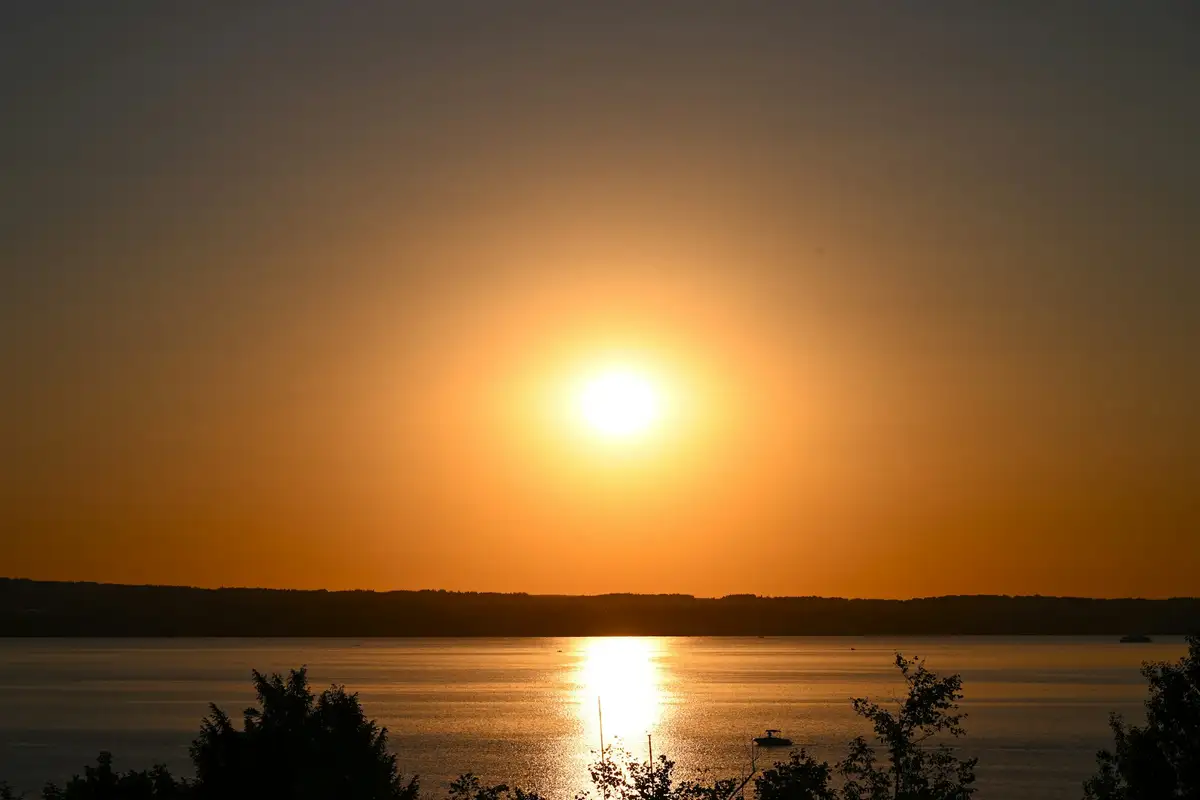
And God called the light Day, and the darkness he called Night. And the evening and the morning were the first day.
Genesis 1:5 (KJV)
From the first day of creation, evening and morning together mark the rhythm God built into time.
He appointed the moon for seasons: the sun knoweth his going down. Thou makest darkness, and it is night: wherein all the beasts of the forest do creep forth. The young lions roar after their prey, and seek their meat from God. The sun ariseth, they gather themselves together, and lay them down in their dens. Man goeth forth unto his work and to his labour until the evening.
Psalms 104:19-23 (KJV)
God appointed the moon for seasons and the sun knows when to set, as people end their labour until evening.
From the rising of the sun unto the going down of the same the Lord’s name is to be praised.
Psalms 113:3 (KJV)
Praise to the Lord is meant to fill the whole day, from sunrise until the sun goes down.
The mighty God, even the Lord, hath spoken, and called the earth from the rising of the sun unto the going down thereof.
Psalms 50:1 (KJV)
God calls the whole earth, from the rising of the sun to the place where it sets.
For from the rising of the sun even unto the going down of the same my name shall be great among the Gentiles; and in every place incense shall be offered unto my name, and a pure offering: for my name shall be great among the heathen, saith the Lord of hosts.
Malachi 1:11 (KJV)
God’s name will be great among the nations from the rising of the sun to its going down.
Be ye angry, and sin not: let not the sun go down upon your wrath:
Ephesians 4:26 (KJV)
Paul teaches that anger must not be carried past sunset, so conflicts should be settled promptly.
At his day thou shalt give him his hire, neither shall the sun go down upon it; for he is poor, and setteth his heart upon it: lest he cry against thee unto the Lord, and it be sin unto thee.
Deuteronomy 24:15 (KJV)
A poor worker must be paid before the sun goes down, showing God’s concern for fairness.
Now when the sun was setting, all they that had any sick with divers diseases brought them unto him; and he laid his hands on every one of them, and healed them.
Luke 4:40 (KJV)
When the sun was setting, crowds brought the sick to Jesus and He laid hands on each one and healed them.
Let my prayer be set forth before thee as incense; and the lifting up of my hands as the evening sacrifice.
Psalms 141:2 (KJV)
David asks that his lifted hands be received like the evening sacrifice.
Evening, and morning, and at noon, will I pray, and cry aloud: and he shall hear my voice.
Psalms 55:17 (KJV)
Evening, morning and noon, David prays and trusts that God hears his voice.
And Isaac went out to meditate in the field at the eventide: and he lifted up his eyes, and saw, and, behold, the camels were coming.
Genesis 24:63 (KJV)
Isaac went out into the field at eventide to meditate, a quiet end to the day.
They also that dwell in the uttermost parts are afraid at thy tokens: thou makest the outgoings of the morning and evening to rejoice.
Psalms 65:8 (KJV)
God makes the outgoings of the morning and evening rejoice.
But they constrained him, saying, Abide with us: for it is toward evening, and the day is far spent. And he went in to tarry with them.
Luke 24:29 (KJV)
As the day was far spent, the two travellers urged Jesus to stay with them.
But it shall be one day which shall be known to the Lord, not day, nor night: but it shall come to pass, that at evening time it shall be light.
Zechariah 14:7 (KJV)
God promises a day when at evening time it shall be light.
Thy sun shall no more go down; neither shall thy moon withdraw itself: for the Lord shall be thine everlasting light, and the days of thy mourning shall be ended.
Isaiah 60:20 (KJV)
In God’s promised future, your sun will no more go down because the Lord will be your everlasting light.
I will both lay me down in peace, and sleep: for thou, Lord, only makest me dwell in safety.
Psalms 4:8 (KJV)
David lies down in peace and sleeps, because the Lord alone keeps him safe.
The Bible treats sunset as part of God’s good design. Genesis 1:5 marks each day with evening and morning, and Psalms 104:19-23 notes that the sun knows its going down, signalling people to finish their work. The rhythm of day and night is a gift that invites rest and reminds us we are creatures who depend on God.
Sunset also carries practical instruction. Ephesians 4:26 tells believers not to let the sun go down on their anger, encouraging quick reconciliation. Deuteronomy 24:15 required employers to pay poor workers before sundown, showing that God cares about justice in everyday life. Evening was a time of worship too: Psalms 141:2 compares prayer to the evening sacrifice, and Isaac went out to meditate in the field at eventide in Genesis 24:63.
Some of the Gospels’ tender scenes happen at dusk. In Luke 4:40 people brought the sick to Jesus as the sun was setting, and He healed them. In Luke 24:29 the travellers to Emmaus asked Him to stay with them because the day was far spent. Looking ahead, Isaiah 60:20 and Zechariah 14:7 promise a time when God Himself will be an everlasting light.
Psalm 104:23s man goeth forth unto his work until the evening ties sunset to the natural completion of a days labor.
These Bible Verses About Sunset open with one of Scripture’s most solemn covenants, and Genesis 15 describes God making a formal covenant with Abraham, confirming the promise of descendants and land through an ancient ceremony involving sacrificed animals. As the sun goes down, a deep sleep falls on Abraham along with a horror of great darkness, and in that unsettling dusk God reveals that his descendants will suffer centuries of slavery before being delivered. Then, after the sun had gone down and it was dark, a smoking furnace and a burning lamp pass between the pieces of the sacrifice, sealing the covenant. The entire scene unfolds in the specific window between sunset and full darkness, as if the dimming light itself frames a promise too large to fully grasp in daylight.
Among these Bible Verses About Sunset, this one unfolds the gentlest, and Genesis 24 follows Abraham’s servant on a long journey to find a wife for Isaac, and the chapter closes with a quiet, almost cinematic detail: Isaac goes out to meditate in the field at eventide, the time of the evening. Looking up, he sees camels approaching, and Rebekah, seeing him, gets down from hers and eventually becomes his wife. It is one of Scripture’s gentler love stories, framed entirely within the soft light of a single evening, after years of family prayer and a servant’s careful, faithful search finally come together.
These Bible Verses About Sunset also touch the aftermath of battle, and Joshua 8 and Joshua 10 both include a specific detail about timing after a battle: the bodies of defeated kings are not left hanging overnight. At Ai, the king’s body is taken down from the tree at sunset and cast at the gate of the city. Later, after five Amorite kings are hanged on trees following a dramatic victory, their bodies are likewise taken down as the sun goes down, in keeping with the law’s instruction not to let a hanged body remain past sundown. Even in the harsh context of ancient warfare, the specific attention to sunset reflects a concern for order and dignity that governs even the treatment of defeated enemies.
One of the most moving of these Bible Verses About Sunset happens on this road, and Luke 24 follows two disciples walking to Emmaus on the same day Jesus rose, discussing their confusion and grief without recognizing that the risen Jesus himself has joined their conversation. As evening approaches and the day is far spent, they urge him to stay with them rather than continue on, and it is only when he breaks bread at the table that their eyes are opened and they recognize him. He vanishes immediately afterward, and they rush back to Jerusalem that same evening to tell the others what happened. The fading light of that first Easter evening becomes the setting for one of the most moving recognition scenes in the Gospels.
Among these Bible Verses About Sunset, mercy gets a deadline here, and Deuteronomy 24 includes a specific protection for the poor within Israel’s law code: if a man takes his neighbor’s garment as security for a loan, he must return it before the sun goes down, since it may be the only covering that person has to sleep in at night. The law frames this not as mere courtesy but as something the poor man will bless the lender for, and something God himself takes note of as righteousness. Sunset becomes a built-in deadline for compassion, a daily reminder that even legitimate financial arrangements cannot be allowed to leave someone cold and uncovered once darkness falls.
These Bible Verses About Sunset close with a warning about readiness, and Matthew 25 tells of ten virgins waiting with lamps for a bridegroom’s arrival at a wedding, five who bring extra oil and five who do not plan ahead. The bridegroom is delayed long past sunset, and all ten grow drowsy and fall asleep waiting through the evening and into the night. When he finally arrives at midnight, the five without enough oil scramble to find more and are shut out of the feast by the time they return. The parable, set entirely within the stretch from evening to midnight, warns that readiness cannot be borrowed at the last minute once the light is already gone.
These Bible Verses About Sunset show evening carrying real weight in Scripture, a covenant sealed, a love story settled, a law of mercy enforced, a day of readiness tested. The fading light rarely signals an ending only. More often, it marks the hour something important is finally decided.
Lord, like Isaac in the field, let me meet you in the quiet of the evening rather than rushing past it. Like the lender in Deuteronomy, make me mindful of what someone else needs before this day is fully done. Whatever is unfinished tonight, let me trust it to you rather than the dark. Amen.
Read one verse from this page tonight before turning off the lights and let it be the last thing you think about rather than a screen. Check whether there is a kindness, like the returned garment in Deuteronomy, that you can extend before today ends. Sit outside for a few minutes at actual sunset this week and simply notice what the day is closing on. Talk with your family about the Emmaus story and ask where you have recognized God only after the fact, in hindsight, once the day was already fading.
Which of these sunset accounts matches your evenings most often, a quiet meeting, an unresolved debt, a readiness you have let slip, or a recognition that comes late? Do you tend to rush through the end of the day, or does it still feel sacred to you the way it clearly did to figures like Isaac and Abraham? What would it look like to let today’s sunset actually mark something finished, rather than just more hours gone?
Paul’s advice to the Ephesians makes the sun a deadline. Be ye angry, and sin not: let not the sun go down upon your wrath (Ephesians 4:26). He is applying the spirit of Psalm 4:4 to a church where new believers still carried old grudges between tribes and households. Notice he does not forbid anger. He permits it, then puts a clock on it.
Why sunset? In the ancient world dusk meant the end of working light and the start of the long dark. Lamps were costly, people gathered indoors, and a household that went to bed furious shared one room with the person it was furious at. There was no second bedroom to retreat to and no phone to carry into another room. Leaving things unsettled meant lying in the dark beside them.
You can still use the verse without turning it into a rigid rule. Some wounds are too deep to settle by bedtime, and a spouse who needs a cooler head and a night’s rest is not breaking Paul’s command. What the verse asks is that anger not be allowed to move in, harden and make itself at home. At the very least, say out loud before the lights go out that you are not finished, you are not leaving, and you will talk tomorrow. Where there is abuse or fear, safety comes before reconciliation, and a pastor or counselor should be brought in.
Luke tells us about one particular Sabbath evening in Capernaum. Jesus had taught in the synagogue that morning, quieted a man troubled by an unclean spirit, and gone to Simon’s house, where he healed Simon’s mother-in-law of a high fever. Then comes the line: Now when the sun was setting, all they that had any sick with divers diseases brought them unto him; and he laid his hands on every one of them, and healed them (Luke 4:40).
The timing is the story. Carrying a stretcher through the streets on the Sabbath would have counted as work, so the town waited, and I picture the whole street watching the western sky. The moment the day ended, the lanes filled. Sunset was a door opening. People who had held their sick relatives for hours, maybe for years, were finally free to move.
Two details stand out. First, he laid his hands on every one of them. Not a wave across the crowd, not a speech from a doorway; each person was touched. Second, he did this after a long day, when most teachers would have been finished. If you are a caregiver whose real work starts after dark, with a sick parent or a feverish child, this scene does not shame your tiredness. Keep seeking medical help as well. Luke, who wrote the scene down, was himself a physician.
Let my prayer be set forth before thee as incense; and the lifting up of my hands as the evening sacrifice (Psalm 141:2). David’s picture comes straight from the worship routine of Israel. Under the law a lamb was offered every morning and a second at twilight, with flour, oil and wine, so that the smoke of worship was rising at both ends of every day (Exodus 29:38-41). The evening offering was among the last public acts before the gates closed.
By asking that his prayer be counted like that offering, David turns a private moment into a priestly one. He is not at the altar, perhaps because he is in a cave or in the middle of a conflict, yet he asks God to treat his raised hands as if he were standing there. Centuries later Luke records that the people prayed outside at the hour of incense when the angel appeared to Zechariah (Luke 1:10-11), so the habit was still alive.
Hands lifted at dusk is a simple practice anyone can adopt. Stand at the kitchen window after the dishes, open your palms, and name aloud what the day produced, the good and the leftover. No special words are needed. The psalm asks only that what rises from the day be offered up rather than hoarded.
Two verses use the sun’s whole track as a measuring tape for praise. The LORD’S name is to be praised, says Psalm 113:3, From the rising of the sun unto the going down of the same. Malachi 1:11 widens it: For from the rising of the sun even unto the going down of the same my name shall be great among the Gentiles. Malachi was speaking to priests in post-exile Jerusalem who were offering blind and lame animals and complaining that worship was a bore. God’s answer was pointed. Somewhere in the world, he says, people are doing it properly.
Among the Bible Verses About Sunset, these two are the widest in scope. Dusk in this frame is not the end of worship. It is the baton changing hands. When the sun drops below your horizon it is climbing over somebody else’s, and a different set of voices is starting the morning psalm. That should shrink the pressure we put on one tired evening. If you can barely whisper a prayer tonight, a believer in another time zone is singing one.
There is a quiet challenge in Malachi too. God cared about the quality of what was brought, not merely its existence. An evening prayer mumbled from the pillow is not wasted, but some nights are for giving the Lord something better than leftover attention, perhaps ten minutes with the phone in another room.
The prophets save their strangest sunset promises for the end of the story. Zechariah 14:7 reads, But it shall be one day which shall be known to the LORD, not day, nor night: but it shall come to pass, that at evening time it shall be light. Anyone who has watched dusk knows the opposite is normal. Light fades in the evening. Zechariah says a day is coming when the usual order flips, and the hour when you would reach for a lamp is the hour that glows.
Isaiah 60:20 pushes in the same direction: Thy sun shall no more go down; neither shall thy moon withdraw itself: for the LORD shall be thine everlasting light, and the days of thy mourning shall be ended. The last phrase matters most. The point is not astronomy but grief. The going down of the sun has always been tied in human minds to endings, the loss of a person or a season or a job. Isaiah says an arrangement is coming where nothing has to set.
For someone sitting at a deathbed or standing at a graveside, that carries real weight. Revelation 21:23 takes up this language and says the city has no need of the sun, because the glory of God lights it. Until then we live with real sunsets, and these verses let us watch them honestly, grieving what is going while holding a promise that evening is not the last word.
I will both lay me down in peace, and sleep: for thou, LORD, only makest me dwell in safety (Psalm 4:8). The psalm is an evening song, and the verses before it show the writer was not in a calm position. People were turning his honor into shame. Many readers link it to the time of Absalom’s revolt, though the psalm itself does not say so. Either way it ends on sleep.
The grammar helps. He says he will lay down and sleep, as two acts. Lying down is the choice; sleep is what God gives. A lot of us lie down and run a nightly review: the bills, the email, the thing a coworker said. This verse suggests handing the review over before the pillow, because safety is something the LORD makes, not something we maintain by staying on guard.
Some sleeplessness has physical causes, and persistent insomnia is worth taking to a doctor. A bad night is not a failure of faith. But for ordinary worry, the dusk habit of naming each concern to God, one at a time, and then physically setting the phone down is a faithful way of saying only thou. Psalm 4:8 does not ask for a strong person. It describes a trusting one.
Psalm 65:8 is an odd one: thou makest the outgoings of the morning and evening to rejoice. The poet imagines the two ends of the day as gates the sun passes through, with God stationed at both, making each of them glad. Dusk here is not a gloomy sign. It is a gate with joy standing at it.
Nearby the psalmist lists what God’s care looks like on earth: visiting the land, watering the furrows, crowning the year with goodness, pastures of the wilderness overflowing (verses 9-12). A farmer in David’s day would hear the evening rejoicing as the sound of a field after rain, with sheep bleating and the hills settling. The Hebrew verb behind rejoice is the one used for ringing shouts of joy, closer to a shout than to polite gladness.
Compare Psalm 55:17: Evening, and morning, and at noon, will I pray, and cry aloud: and he shall hear my voice. Here a man in trouble lists evening first. Together the two verses give a double pattern, one where God gives joy to the evening and one where a person gives prayer to it. If tonight feels flat, take a short walk at dusk, listen for what is already singing, and then speak up yourself. Crying aloud is permitted.
More verse collections related to sunset: Bible Verses For Prayer and Faith, Bible Verses For Family Relationships, Bible Verses About Grief, Bible Verses For Wives, Bible Verses For Husbands, Bible Verses About Faith Over Fear, Bible Verses For Prayer in Difficult Times, Bible Verses For Marriage, Bible Verses For Peace in Difficult Times, Bible Verses For Trusting God and Bible Verses For Communion.
Free tools for studying these passages further: Bible Gateway, Bible Hub and Bible Study Tools.
The Bible treats sunset as part of God's good design. Genesis 1:5 marks each day with evening and morning, and Psalms 104:19-23 notes that the sun knows its going down, signalling people to finish their work.
This page brings together 11 King James Version references about sunset, drawn from 8 different books of the Bible.
Yes. The verses about sunset gathered here include passages from both the Old Testament and the New Testament, such as Genesis 1:5 and Ephesians 4:26.
Genesis 1:5 is one of the verses about sunset referenced in this collection, alongside Psalms 104:19.
Yes, the verses referenced on this page, including Genesis 1:5, are quoted according to the King James Version (KJV), and are suitable for daily reading, memorization, or devotional use.