
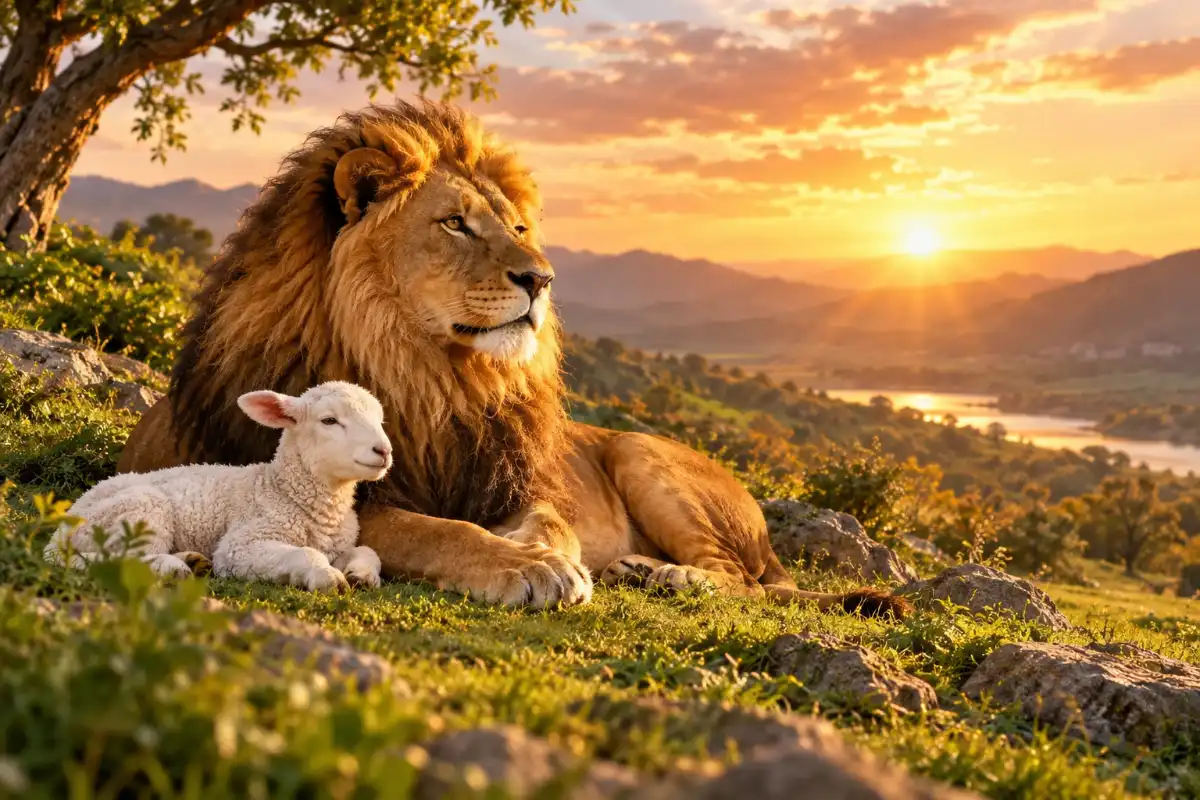
Each lion and the lamb Bible verse below is quoted word for word from the King James Version, followed by a short original note.
The wolf also shall dwell with the lamb, and the leopard shall lie down with the kid; and the calf and the young lion and the fatling together; and a little child shall lead them.
Isaiah 11:6 (KJV)
This is the passage most people have in mind when they search for the lion and the lamb Bible verse. Isaiah describes a coming kingdom where natural enemies live side by side, led gently by a child, a picture of peace under the promised King.
And one of the elders saith unto me, Weep not: behold, the Lion of the tribe of Juda, the Root of David, hath prevailed to open the book, and to loose the seven seals thereof.
Revelation 5:5 (KJV)
John is told to stop weeping because the Lion of Judah has won the victory. In this lion and the lamb Bible verse, the title carries royal strength and promise, and it answers John’s grief with news that the one worthy to open God’s plan has already prevailed.
And I beheld, and, lo, in the midst of the throne and of the four beasts, and in the midst of the elders, stood a Lamb as it had been slain, having seven horns and seven eyes, which are the seven Spirits of God sent forth into all the earth.
Revelation 5:6 (KJV)
In this lion and the lamb Bible verse, John hears about a Lion but turns and sees a Lamb. The surprise is the point: the victory of the Lion is carried out through the wounded Lamb, still bearing the marks of sacrifice yet standing in complete power and insight.
The next day John seeth Jesus coming unto him, and saith, Behold the Lamb of God, which taketh away the sin of the world.
John 1:29 (KJV)
This lion and the lamb Bible verse has John the Baptist introduce Jesus with the Lamb title. It tells us the mission before the ministry begins: this is the sacrifice who removes sin, not for one nation or one era, but for the whole world.
Judah is a lion’s whelp: from the prey, my son, thou art gone up: he stooped down, he couched as a lion, and as an old lion; who shall rouse him up?
Genesis 49:9 (KJV)
In this lion and the lamb Bible verse, Jacob blesses his son Judah with lion imagery centuries before Revelation. The tribe is pictured as strong, settled and fearless, which prepares the way for the later title Lion of the tribe of Juda.
He was oppressed, and he was afflicted, yet he opened not his mouth: he is brought as a lamb to the slaughter, and as a sheep before her shearers is dumb, so he openeth not his mouth.
Isaiah 53:7 (KJV)
Isaiah’s Suffering Servant is silent and gentle like a lamb. Christians read this as a portrait of Jesus, who accepted unjust suffering willingly, which is why the Lamb side of the lion and the lamb Bible verse pairing is so tender.
Forasmuch as ye know that ye were not redeemed with corruptible things, as silver and gold, from your vain conversation received by tradition from your fathers; But with the precious blood of Christ, as of a lamb without blemish and without spot:
1 Peter 1:18-19 (KJV)
In this lion and the lamb Bible verse, Peter explains what the Lamb image costs and gives. Redemption is not purchased with money but with the spotless life of Christ, a reminder that forgiveness is a priceless gift and never something to treat lightly.
For the Lamb which is in the midst of the throne shall feed them, and shall lead them unto living fountains of waters: and God shall wipe away all tears from their eyes.
Revelation 7:17 (KJV)
In this lion and the lamb Bible verse, strangely, the Lamb acts as a shepherd. He feeds, guides and comforts, wiping away every tear. The royal Lamb is not a distant ruler; he is personally caring, and that mix of authority and tenderness is the heart of the picture.
These shall make war with the Lamb, and the Lamb shall overcome them: for he is Lord of lords, and King of kings: and they that are with him, called, and chosen, and faithful.
Revelation 17:14 (KJV)
The Lamb is also a warrior king in this lion and the lamb Bible verse. He overcomes opposition not by cruelty but by right and truth, and his followers are called faithful. It shows that gentleness and sovereign power belong together in him.
And they overcame him by the blood of the Lamb, and by the word of their testimony; and they loved not their lives unto the death.
Revelation 12:11 (KJV)
In this lion and the lamb Bible verse, believers overcome through the Lamb’s sacrifice and their own honest witness. Victory does not come from clinging to comfort but from trusting what Christ has done, and it gives courage to anyone who feels outmatched by evil.
Be sober, be vigilant; because your adversary the devil, as a roaring lion, walketh about, seeking whom he may devour:
1 Peter 5:8 (KJV)
Not every lion in the Bible is good. Peter uses the roaring lion as a warning about spiritual danger, which helps us tell the false lion from the true Lion of Judah, and reminds us to stay alert and steady in faith.
The wicked flee when no man pursueth: but the righteous are bold as a lion.
Proverbs 28:1 (KJV)
Proverbs borrows the lion as a picture of honest courage, a different angle on the lion and the lamb Bible verse theme. A clear conscience gives a steadiness that guilt cannot imitate, so this verse links the lion image to everyday integrity rather than only to battles and kings.
And Abraham said, My son, God will provide himself a lamb for a burnt offering: so they went both of them together.
Genesis 22:8 (KJV)
Abraham’s answer to Isaac is an early hint behind the lion and the lamb Bible verse and its Lamb story. God would provide the offering himself. Many readers see in these words a trust that looks forward to the day when God supplies the Lamb of God.
My God hath sent his angel, and hath shut the lions’ mouths, that they have not hurt me: forasmuch as before him innocency was found in me; and also before him, O king, I was found no hurt.
Daniel 6:22 (KJV)
Daniel’s rescue shows a lion kept in check by a greater power. It is a comfort for anyone facing real danger, because the same God who shuts the mouths of lions is able to guard his people.
And the city had no need of the sun, neither of the moon, to shine in it: for the glory of God did lighten it, and the Lamb is the light thereof.
Revelation 21:23 (KJV)
In the final city the Lamb is the lamp. The image that began with sacrifice ends with radiance, so what once looked like weakness becomes the source of light for all of God’s people forever.
And he saith unto me, Write, Blessed are they which are called unto the supper of the Lamb. And he saith unto me, These are the true sayings of God.
Revelation 19:9 (KJV)
The Lamb hosts a feast, and the guests are blessed. It turns the sacrifice into a celebration, inviting readers to see the end of the story as joyful fellowship rather than only judgment.
The wolf and the lamb shall feed together, and the lion shall eat straw like the bullock: and dust shall be the serpent’s meat. They shall not hurt nor destroy in all my holy mountain, saith the LORD.
Isaiah 65:25 (KJV)
Isaiah returns to the peaceful kingdom with a vivid detail: the lion eating straw. It is one more lion and the lamb Bible verse that promises a world where nothing hurts or destroys on God’s holy mountain.
Saying with a loud voice, Worthy is the Lamb that was slain to receive power, and riches, and wisdom, and strength, and honour, and glory, and blessing.
Revelation 5:12 (KJV)
In this lion and the lamb Bible verse, heaven’s song gathers every kind of greatness and gives it to the slain Lamb. Strength and honour are not set against sacrifice here; they are its reward, and worship becomes the natural answer to what he has done.
When people search for the lion and the lamb Bible verse, they usually mean one of two things. Some are thinking of Isaiah 11:6, the vision of a peaceful world where predators and prey rest together. Others are thinking of Revelation 5, where the Lion of Judah is announced and a Lamb appears instead. Both are valid, and they belong to the same larger story. The phrase has become a shorthand for a God whose power and gentleness are never in conflict.
That shorthand is useful because it corrects a common mistake. We often assume strength and meekness are opposites, so we pick one and lose the other. Scripture refuses to choose. It gives us a King who is called a Lion and a Savior who is called a Lamb, and it gives them as one person. Understanding the lion and the lamb Bible verse begins with accepting that both pictures are needed to describe him fully.
Many readers find it helpful to read the whole chapter around each lion and the lamb Bible verse. Context shows who is speaking, who is listening and what problem is being answered, and that keeps a favorite line from drifting away from its meaning. A few quiet minutes with the surrounding verses often changes how a familiar phrase sounds.
The images behind the lion and the lamb Bible verse are scattered across the whole Bible, not just two famous chapters. Lions appear in Genesis, where Jacob blesses Judah, and in the stories of Samson, David and Daniel. Lambs appear from the very first offerings and the Passover night through the prophets and into the Gospels. By the time we reach Revelation, both symbols have been carrying meaning for centuries, which is why the book can place them side by side so naturally.
Reading widely around the lion and the lamb Bible verse helps. A single lion and the lamb Bible verse can feel like a pretty poster, but the full picture is built passage by passage. If you enjoy following a theme through Scripture, verses about the cross and verses about redemption trace the Lamb thread, while the prophetic pages show how the promise of a peaceful kingdom grows from Isaiah onward.
It also helps to remember that Scripture was first heard aloud by communities, not read silently by individuals. The listeners knew shepherds, sacrifices and kings from daily life, so the images landed immediately. Imagining their reaction can make an old verse feel fresh, and it reminds us that these pictures were meant to be lived with, not only analysed.
The title Lion of the tribe of Juda, central to the lion and the lamb Bible verse, begins with Jacob’s blessing of his fourth son in Genesis 49. Judah is described as a lion’s whelp who crouches like an old lion, and the tribe later produces King David and the royal line. The image points to rule, courage and a settled authority that nobody dares to provoke. When Revelation 5:5 uses the title, it quietly reminds readers that the promise made long ago has not been forgotten.
There is comfort inside this lion language. John has been weeping because no one seems worthy to open the scroll, and the elder tells him to stop. The Lion has already prevailed. For anyone who feels the world is running out of control, that line is a gift: the outcome is not undecided. The lion and the lamb Bible verse, read from the Lion’s side, is a promise of victory that is already won.
If you are reading this with a heavy heart, take the Lion’s promise slowly. You do not have to feel brave for it to be true. Faith often begins as a simple willingness to lean on what God has said, and strength tends to arrive afterward, one small and ordinary step at a time.
John the Baptist’s words in John 1:29 are some of the clearest in the Gospels, and they anchor the Lamb side of the lion and the lamb Bible verse. He points at Jesus and calls him the Lamb of God who takes away the sin of the world. His listeners knew sacrificial lambs very well, so the title would have sounded both familiar and startling. This was not another animal; this was a person who would carry what the sacrifices could only picture.
For readers today, the Lamb title answers the problem of guilt. We can try to forget it, outwork it or explain it away, but only forgiveness truly removes it. Calling Jesus the Lamb says that he stands in our place and carries what we cannot. Anyone who needs to feel that weight lifted will find that this half of the lion and the lamb Bible verse speaks straight to the conscience, and verses about forgiveness continue the thought.
Take a moment to ask what this says about the character of Jesus. Every title in the Bible is a window into who he is, and the Lamb window shows humility, love and cost. Letting that picture settle can change how we respond when someone wrongs us or when we feel overlooked.
It would be simpler if the Bible gave us a Lion for the strong and a Lamb for the weak. Instead it gives one Savior who is both. Revelation 5 shows the pattern of the lion and the lamb Bible verse clearly: John hears of a Lion and sees a Lamb, as though the two words describe a single reality from different sides. The victory is real, and the way of victory is sacrifice.
This pairing protects us from two errors. If we only see the Lion, faith can turn harsh and proud, forgetting mercy. If we only see the Lamb, faith can turn soft and uncertain, forgetting that evil will be answered. The lion and the lamb Bible verse holds both truths at once, so the Savior can be trusted with our fear and with our failures, and we can bring him both.
A simple exercise is to write the two words Lion and Lamb at the top of a page and list what each means for you this week. The list will not be long, but it turns an abstract idea into a plan. Many people find the balance becomes clearer once it is written down.
Isaiah 11, home of the lion and the lamb Bible verse, begins with a shoot coming from the stump of Jesse, a ruler on whom the Spirit rests, who judges the poor with righteousness. Only after that portrait does the famous line appear: the wolf shall dwell with the lamb. The order matters. Peace in the animal world follows justice in the human one. The peaceable kingdom is the fruit of a just king, not a decoration added to an unjust world.
Notice also that the verse says a little child shall lead them. In a world of predators, the leader is the smallest. This is a quiet hint of the incarnation and of the upside-down nature of God’s kingdom. When we read this lion and the lamb Bible verse, we should hear a promise that the gentle one will guide the strong, and that strength can learn to follow.
Teachers sometimes point out that Scripture rarely gives a single image the whole job. It layers pictures so that each corrects the others. Here the layering protects us from thinking of God too narrowly, and invites us to keep exploring rather than settling for a slogan.
Isaiah 65:25 repeats the lion and the lamb Bible verse vision with a fresh detail: the lion shall eat straw like the bullock. The fierce animal changes its very nature. That is a significant statement, because it implies that peace is not only the absence of attack but a transformation of what a creature is. God does not merely chain the lion; he makes the lion safe.
This gives hope to anyone who has been hurt by someone dangerous, or who fears their own anger. If creation itself can be remade, so can a heart. People often ask whether this lion and the lamb Bible verse is literal or symbolic. Many readers hold that it is both: a picture of spiritual peace now and a promise of renewed creation later. Either way, it teaches that God intends harm to end, as verses about God’s promises also affirm.
Children often grasp this picture faster than adults. They love both the brave lion and the gentle lamb, and they see no problem in having both. Reading these passages aloud with a family can be a surprisingly deep experience, since the simplest questions often uncover the most important truths.
The Lamb side of the lion and the lamb Bible verse starts early. In Genesis 22, Isaac asks where the lamb for the offering is, and Abraham answers that God will provide himself a lamb. The sentence is easy to pass over, yet it frames everything that follows. Later, in Exodus, each household in Israel takes a lamb on the night they are delivered from Egypt, and its blood marks the door.
These scenes build a pattern: deliverance comes through a substitute, and God is the one who provides it. By the time John the Baptist speaks, the pattern has been rehearsed for over a thousand years. This is why the Lamb half of the lion and the lamb Bible verse feels rooted rather than sudden. It is the fulfilment of a promise that was told in small pictures long before it was told in full.
Whatever your background, you can come to this theme with honest questions. The Bible does not hide the hard parts of the story, such as suffering, danger and judgment, but it always places them inside a larger hope. That honesty is part of why these passages have comforted so many readers for so long.
Isaiah 53 gives one of the most moving lamb pictures behind the lion and the lamb Bible verse in the Old Testament. The servant is oppressed and afflicted, yet he does not answer back, and he is led like a lamb to the slaughter. The verse is not about weakness for its own sake; it is about willing, voluntary silence. Early Christians recognised Jesus in these lines, and the New Testament quotes them in that spirit.
When we place this next to the Lion of Judah, something deep appears. The Lion is mighty enough to fight, yet he chooses the Lamb’s path. Power that can be held back for love is the greatest power of all. That is the secret inside every lion and the lamb Bible verse, and it invites us to ask what strength we are choosing not to use for the sake of others.
Some people like to sing or hum a hymn that mentions the Lamb while they reflect on these lines. Music helps memory and settles the mind. Even a single line of worship can turn a study session into a moment of gratitude, which is exactly where the Revelation scenes are heading.
Revelation 5 is the center of the lion and the lamb Bible verse theme. John sees a Lamb standing as though it had been slain, in the midst of the throne. The scene is deliberately odd: a wounded animal in the place of highest honour. Its seven horns and seven eyes speak of complete power and complete knowledge, so the Lamb is not frail at all. The marks of death remain because they are the source of his authority.
The chapter ends with creatures and elders singing that the Lamb is worthy, and then all creation joins in. Worship here is a response to sacrifice. Readers who revisit this lion and the lamb Bible verse before a hard week often find that it reorders their priorities. If the throne of the universe holds a Lamb, then humility and love are not losing strategies, and verses about the life of Jesus show how he lived it out.
Consider sharing what you learn with someone else. Explaining a passage out loud exposes the gaps in our understanding and builds confidence. A short conversation over coffee about the Lion and the Lamb may encourage a friend, and it will almost certainly deepen your own grasp of the text.
We usually think of strength as volume, speed or force. The lion and the lamb pairing offers a different measure. The Lamb is shown as the one with the greatest power in heaven, precisely because he gave himself. Real strength is the ability to serve without needing to win, to forgive without being forced to, and to stay quiet when defending ourselves would be easy.
This has everyday consequences. A parent who stays patient with a tired child, a worker who refuses to gossip, and a friend who listens instead of arguing are all practising the Lamb’s kind of strength. The lion and the lamb Bible verse tells us this is not defeat but discipleship. You can be firm about truth and still be gentle in manner, because the Savior himself is both.
Pay attention to the verbs in these passages, because they reveal what God is doing. He gathers, leads, feeds, shuts, takes away and wipes away. Scripture is not describing an idle symbol but an active Savior, and noticing the verbs turns reading into encounter. Underline a few in your own Bible and see how many describe care.
Because a lion and the lamb Bible verse can use lions in different roles, a careful reader must notice who the lion is. In 1 Peter 5:8 the roaring lion is the adversary, seeking whom he may devour. In Revelation 5:5 the Lion is Christ. The word is the same, but the character is opposite. One lion hunts; the other protects. Context, not vocabulary, decides the meaning.
Peter’s warning is practical. Be sober and watchful, he says, because danger is real and often quiet. Yet the Lion of Judah is stronger than the roaring one, and that changes how we handle fear. When we come across a lion and the lamb Bible verse that mentions the threatening kind, we can use it for watchfulness without losing hope. Many readers combine it with verses about spiritual protection for exactly that reason.
Sometimes the best response to a rich passage is silence. After reading, sit for a minute without adding words, and let the picture remain in your mind. People who practise this often notice that a single phrase rises and stays with them through the day, which is usually the one God intends them to carry.
Proverbs 28:1, a companion to the lion and the lamb Bible verse, says the righteous are bold as a lion, while the wicked flee when nobody is chasing them. The point is psychological as much as moral. A person with nothing to hide can stand in the open, and a person with a guilty secret often jumps at shadows. Boldness grows from a clean conscience before God and people.
This gives a gentle correction to the idea that courage means being loud. Proverbs ties it to honesty. If you want the courage associated with the lion and the lamb Bible verse, begin with small acts of integrity: telling the truth when it costs you, repaying what you owe, apologising first. Courage built this way lasts longer than adrenaline, and it fits neatly beside the Lamb’s humility.
Cross references can deepen the study. Follow a footnote or a concordance entry from lion to lamb and back again, and the web of connections becomes plain. The same few images carry the whole story from beginning to end, which is a quiet sign that Scripture was shaped by one purpose.
Daniel 6 is the most famous lion story in the Bible and sits beside any lion and the lamb Bible verse study. Daniel is thrown to the lions for praying openly to God, and in the morning he is found unharmed because God sent an angel to shut the lions’ mouths. The king, who had spent a sleepless night, rejoices. Nothing in the story suggests that the lions were weaker than normal; their mouths were closed by a greater hand.
For modern readers this story adds a third angle to the lion theme. Beyond the king-lion and the enemy-lion, there are real dangers God can restrain. Daniel’s calm came from consistent prayer, not sudden bravery. It shows that the lion and the lamb Bible verse is not only for study but for situations where we feel surrounded, and it connects well with verses about protection for anyone seeking safety.
For anyone who leads a small group, these verses make an excellent discussion starter. Ask which image feels closer to your experience this season, the Lion or the Lamb, and why. The answers are usually honest and varied, and they open room for encouragement that a lecture rarely achieves.
Revelation 12:11, which belongs with the lion and the lamb Bible verse, describes believers who overcame the accuser by the blood of the Lamb and by the word of their testimony. Two things are named: what Christ did and what they said. Their victory rests on his sacrifice, yet it is expressed through their honest witness. They loved not their lives unto the death, which means they were willing to lose everything because they trusted the Lamb.
It is a hard verse, but a freeing one. If victory is secured by the Lamb, we do not need to earn standing before God by performance. We simply testify to what is true. When guilt or accusation presses in, the lion and the lamb Bible verse tells us to answer it with the Lamb’s work, not with our own record. That answer is always sufficient and always available.
Do not be discouraged if some details remain puzzling, such as the seven horns or the sequence of the scroll. Careful readers have debated them for centuries. What matters most is clear enough: the Lamb is worthy, the Lion has prevailed, and God’s people are safe in the end.
One of the loveliest turns in the lion and the lamb Bible verse of Revelation 7:17 is that the Lamb becomes a shepherd. He feeds his people, leads them to living fountains of waters and wipes away every tear. The image blends two Bible traditions that usually stand apart, the sacrificial lamb and the caring shepherd, and merges them in one person.
This is where the theme touches grief most directly. People who have lost someone, or who carry a long sorrow, can read this lion and the lamb Bible verse as a promise of personal comfort rather than distant doctrine. God’s final answer to tears is not an explanation but a gentle hand. It echoes the tenderness of verses about God’s love and gives sorrow a future.
Notice, too, how the passage treats time. Past sacrifice, present care and future victory are all held together in a single image. That is a gift for anxious minds, because it shows that the story is bigger than today’s problem, and that God is working across every season at once.
The ending of the lion and the lamb Bible verse story is not bleak. Revelation 19:9 pronounces a blessing on those called to the supper of the Lamb, and Revelation 21:23 says the Lamb is the light of the holy city. A feast and a lamp are home images: warmth, food, company and light. After all the battles and beasts, the story concludes at a table in a bright house.
This shapes how we read every lion and the lamb Bible verse. The roar and the sacrifice both lead somewhere good. The Lion defeats what threatens, the Lamb carries what burdens, and together they bring us to the table. Keeping that destination in view makes present struggles feel smaller, and it keeps our worship joyful rather than grim.
A journal can help here. Record a verse, the date and one sentence describing how it spoke to you. Months later, the entries become a map of how your faith has grown. Many readers are surprised how often the same two themes of courage and gentleness return in their own pages.
A frequent confusion is quoting the lion shall lie down with the lamb as if it were a Bible sentence. The King James Version does not say that. Isaiah 11:6 says the wolf shall dwell with the lamb, and the young lion appears with the calf and the fatling, while Isaiah 65:25 says the lion shall eat straw. The saying is a popular paraphrase, not a direct quote.
This does not make the idea wrong, only imprecise. If you want to cite Scripture accurately, use the actual references and read the surrounding verses. A careful approach to the lion and the lamb Bible verse also means separating Isaiah’s peaceable kingdom from Revelation’s Lion and Lamb, which are different passages that complement each other. Treat them as neighbours, not as one verse.
It is worth pausing to give thanks. Gratitude keeps study from becoming only academic, and it fits the tone of these passages, which end in worship. A short prayer of thanks for what the Lamb has done will usually warm a cold reading better than any amount of extra analysis.
Start with a simple question each morning about the lion and the lamb Bible verse: where do I need the Lion today, and where do I need the Lamb? Some days call for courage, such as speaking honestly or standing by a decision. Other days call for gentleness, such as listening or letting a slight go. Praying for both qualities keeps one from swallowing the other.
You can also let the pairing shape your relationships. Be firm about what is right without being harsh, and be kind without being a pushover. The lion and the lamb Bible verse offers a model for parents, leaders and friends who want to be strong and soft at once. Write a short note on your phone listing one situation for each quality, then revisit it at the end of the week.
When life feels loud, the quiet strength described here can be a refuge. You are not asked to fight every battle on your own. You are invited to trust a King who is both fierce on your behalf and tender toward you, and that invitation stands whether your day is easy or hard.
Memorizing even one lion and the lamb Bible verse can steady a whole day. Revelation 5:12 is a good choice for worship, Isaiah 11:6 for hope, and 1 Peter 1:18-19 for gratitude. Say a verse aloud in the morning, write it on a card, and repeat it during a walk or commute. Repetition moves Scripture from the page into the way you instinctively think.
You can also turn verses into prayers. Thank the Lamb for taking away sin, ask the Lion for courage in what scares you, and ask for the peaceful kingdom to grow in your home. A lion and the lamb Bible verse prayed this way becomes a conversation, not a recitation. Over time it shapes both what you trust and how you treat people.
Finally, remember that these images are an invitation, not a test. You do not need perfect understanding to benefit from them. Come as you are, read slowly, and let the Lion and the Lamb meet you where you are. The rest of understanding tends to follow along the road.
If you are studying the lion and the lamb Bible verse, these related collections are a natural next step:Bible verses about the cross, Bible verses about redemption, Bible verses about forgiveness, Bible verses about God’s promises, Bible verses about God’s love, Bible verses about protection, Bible verses about spiritual protection, Bible verses about the resurrection, Bible verses about peace, Bible verses about strength, Bible verses about Jesus Christ.
To study these verses in more depth, try Bible Gateway, Bible Hub, Bible Study Tools, Blue Letter Bible.
The lion and the lamb Bible verse usually refers to Isaiah 11:6, where the wolf dwells with the lamb and a little child leads, or to Revelation 5:5-6, where the Lion of Judah is announced and a Lamb appears. Both passages point to one Savior who is mighty and gentle.
Not in those exact words in the King James Version. Isaiah 11:6 says the wolf shall dwell with the lamb and mentions the young lion with the calf, while Isaiah 65:25 says the lion shall eat straw. The popular wording is a paraphrase of these passages.
In the lion and the lamb Bible verse of Revelation 5:5, the title is used for Jesus Christ. It draws on Jacob’s blessing of Judah in Genesis 49:9 and on the royal line of David, presenting Jesus as the promised King who has prevailed and is worthy to open the scroll.
In the Lamb half of the lion and the lamb Bible verse, John 1:29 calls Jesus the Lamb of God who takes away the sin of the world. The title recalls the sacrificial lambs of the Old Testament and teaches that Jesus gave himself willingly to bring forgiveness and reconciliation with God.
No. In 1 Peter 5:8 the roaring lion is the devil, who seeks to devour. In Revelation 5:5 the Lion is Christ, who protects his people. The same word is used for opposite characters, so context decides the meaning.
Readers differ about the peaceful lion and the lamb Bible verse. Some take Isaiah 11 and 65 as a literal promise of renewed creation, others as a symbolic picture of spiritual peace under Christ, and many hold both. Either way the passages promise an end to harm and a world ruled in justice.
Ask where you need courage and where you need gentleness. Practise honest boldness at work and home, and show patience and forgiveness toward others. Memorizing Revelation 5:12 or Isaiah 11:6 and praying them daily helps keep both qualities in view.