
Bible verses about communion begin in the upper room, where Jesus took bread and a cup and told His disciples to do this in remembrance of Him. Scripture connects the Lord’s Supper to the Passover, to Christ’s sacrifice on the cross, and to the fellowship believers share with God and one another.
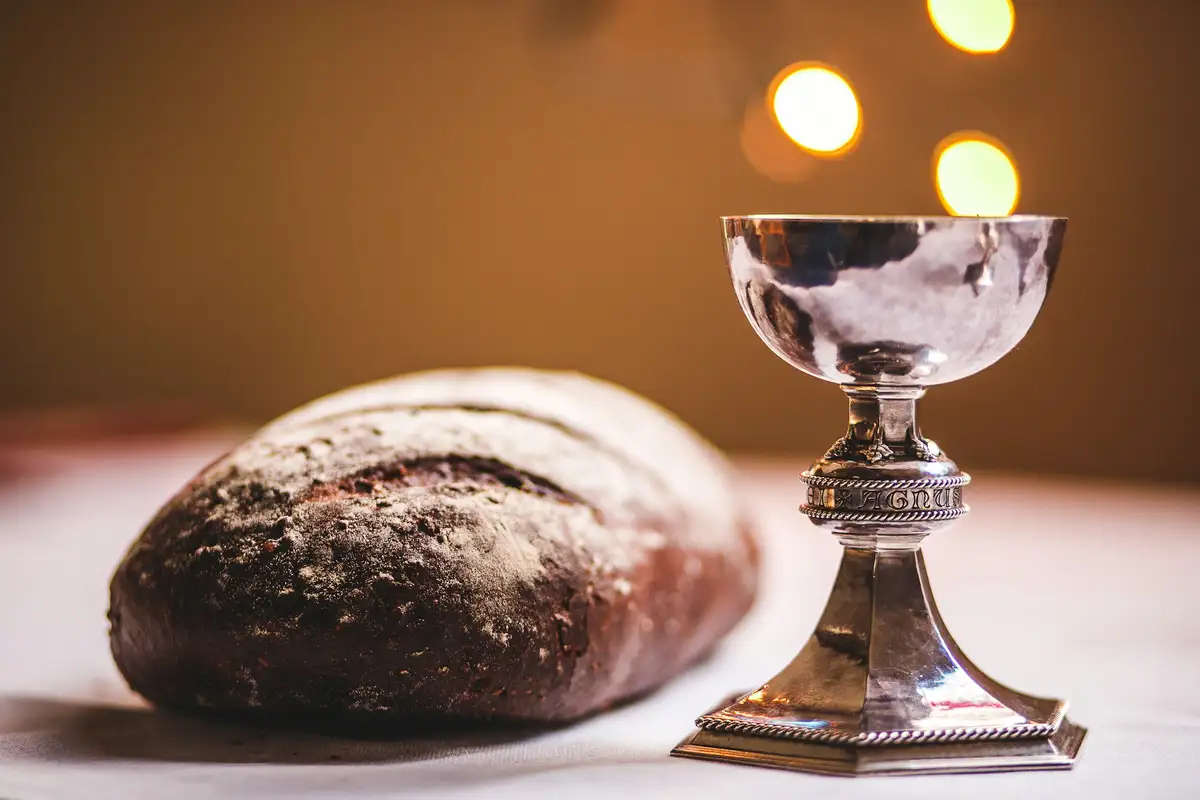
And he took bread, and gave thanks, and brake it, and gave unto them, saying, This is my body which is given for you: this do in remembrance of me. Likewise also the cup after supper, saying, This cup is the new testament in my blood, which is shed for you.
Luke 22:19-20 (KJV)
At the Last Supper Jesus gives the bread as His body and the cup as the new testament in His blood, saying do this in remembrance of me.
For I have received of the Lord that which also I delivered unto you, That the Lord Jesus the same night in which he was betrayed took bread: And when he had given thanks, he brake it, and said, Take, eat: this is my body, which is broken for you: this do in remembrance of me. After the same manner also he took the cup, when he had supped, saying, This cup is the new testament in my blood: this do ye, as oft as ye drink it, in remembrance of me. For as often as ye eat this bread, and drink this cup, ye do shew the Lord’s death till he come.
1 Corinthians 11:23-26 (KJV)
Paul passes on the words of institution and teaches that eating the bread and drinking the cup shows the Lord’s death till He comes.
Wherefore whosoever shall eat this bread, and drink this cup of the Lord, unworthily, shall be guilty of the body and blood of the Lord. But let a man examine himself, and so let him eat of that bread, and drink of that cup. For he that eateth and drinketh unworthily, eateth and drinketh damnation to himself, not discerning the Lord’s body.
1 Corinthians 11:27-29 (KJV)
Believers are urged to examine themselves and not take the Lord’s Supper in an unworthy manner.
The cup of blessing which we bless, is it not the communion of the blood of Christ? The bread which we break, is it not the communion of the body of Christ? For we being many are one bread, and one body: for we are all partakers of that one bread.
1 Corinthians 10:16-17 (KJV)
The cup and bread are called the communion of Christ’s blood and body, and sharing one bread makes believers one body.
And as they were eating, Jesus took bread, and blessed it, and brake it, and gave it to the disciples, and said, Take, eat; this is my body. And he took the cup, and gave thanks, and gave it to them, saying, Drink ye all of it; For this is my blood of the new testament, which is shed for many for the remission of sins.
Matthew 26:26-28 (KJV)
Matthew records Jesus blessing the bread and cup, and describing His blood as shed for many for the remission of sins.
And as they did eat, Jesus took bread, and blessed, and brake it, and gave to them, and said, Take, eat: this is my body. And he took the cup, and when he had given thanks, he gave it to them: and they all drank of it. And he said unto them, This is my blood of the new testament, which is shed for many.
Mark 14:22-24 (KJV)
Mark’s account of the Last Supper shows Jesus giving thanks and sharing the cup with all His disciples.
But I say unto you, I will not drink henceforth of this fruit of the vine, until that day when I drink it new with you in my Father’s kingdom.
Matthew 26:29 (KJV)
Jesus says He will not drink the fruit of the vine again until He drinks it new in His Father’s kingdom.
And Jesus said unto them, I am the bread of life: he that cometh to me shall never hunger; and he that believeth on me shall never thirst.
John 6:35 (KJV)
Jesus declares that He is the bread of life and that whoever comes to Him will never hunger.
I am the living bread which came down from heaven: if any man eat of this bread, he shall live for ever: and the bread that I will give is my flesh, which I will give for the life of the world.
John 6:51 (KJV)
Christ calls Himself the living bread from heaven, whose flesh He gives for the life of the world.
And they continued stedfastly in the apostles’ doctrine and fellowship, and in breaking of bread, and in prayers.
Acts 2:42 (KJV)
The first believers continued steadfastly in teaching, fellowship, the breaking of bread and prayers.
And upon the first day of the week, when the disciples came together to break bread, Paul preached unto them, ready to depart on the morrow; and continued his speech until midnight.
Acts 20:7 (KJV)
On the first day of the week the disciples gathered to break bread, and Paul preached to them.
And the blood shall be to you for a token upon the houses where ye are: and when I see the blood, I will pass over you, and the plague shall not be upon you to destroy you, when I smite the land of Egypt. And this day shall be unto you for a memorial; and ye shall keep it a feast to the Lord throughout your generations; ye shall keep it a feast by an ordinance for ever.
Exodus 12:13-14 (KJV)
The Passover blood marked the houses God passed over, and the day was kept as a lasting memorial.
Purge out therefore the old leaven, that ye may be a new lump, as ye are unleavened. For even Christ our passover is sacrificed for us:
1 Corinthians 5:7 (KJV)
Paul names Christ as our passover, sacrificed for us, linking the Lord’s Supper to the Passover meal.
By the which will we are sanctified through the offering of the body of Jesus Christ once for all.
Hebrews 10:10 (KJV)
Believers are sanctified through the offering of the body of Jesus Christ once for all.
But he was wounded for our transgressions, he was bruised for our iniquities: the chastisement of our peace was upon him; and with his stripes we are healed.
Isaiah 53:5 (KJV)
The prophet foretells that the servant would be wounded for our transgressions and bruised for our iniquities.
That which we have seen and heard declare we unto you, that ye also may have fellowship with us: and truly our fellowship is with the Father, and with his Son Jesus Christ.
1 John 1:3 (KJV)
John writes so that readers may share fellowship with the apostles and with the Father and His Son.
And he said unto them, With desire I have desired to eat this passover with you before I suffer:
Luke 22:15 (KJV)
Jesus tells His disciples how deeply He desired to eat this Passover with them before He suffered.
Communion, also called the Lord’s Supper, was given by Jesus on the night He was betrayed. During the Passover meal He took bread, gave thanks and said it was His body given for His disciples, then took the cup and called it the new testament in His blood. He told them to keep doing this in remembrance of Him.
The meal looks back and forward at the same time. It looks back to the cross, where Christ our passover was sacrificed, just as the lamb’s blood in Exodus marked the homes God passed over. Paul says that each time believers eat the bread and drink the cup they show the Lord’s death till He comes, so it also looks ahead to Christ’s return and the feast in His Father’s kingdom.
The word communion speaks of sharing. Paul calls the cup and bread the communion of Christ’s blood and body, and because believers share one bread they are one body. For that reason he urges each person to examine himself before taking part, not to stay away, but to come with a humble, honest heart. Churches understand some details differently, yet all see the table as a gift that draws believers close to Christ and to one another.
1 Corinthians 11:24’s instruction, “this do in remembrance of me,” directly institutes communion as an act of deliberate remembrance.
Two nearby collections worth opening next are Bible Verses For Obedience and Bible Verses For Wealth.
Scripture quotations follow the King James Version; Blue Letter Bible lets you read each one alongside its chapter.
You might also turn to Bible Verses About Courage and Strength and Bible Verses About Prayer and Forgiveness.
This subject overlaps with Bible Verses About Family Unity and with Bible Verses About True Love.
If you want to keep reading, Bible Verses About Stress and Bible Verses About Protection sit close to this topic.
Some of the same ground is covered in Bible Verses For Motivation and Bible Verses For Communion.
To see how other translations render these lines, look them up on Bible Gateway.
To trace a verse through the rest of Scripture, the cross-references on Bible Hub are useful.
Communion, biblically, is a direct act of remembrance, instituted by Jesus himself, not a later addition.
These verses were never meant to sit on a page as decoration \u2014 they’re meant to shape how you actually respond the next time taking communion has started to feel routine.
You don’t need polished or formal language for it \u2014 an honest, plainly worded sentence is enough, something as simple as telling God directly to remember freshly what Christ’s sacrifice means for you.
Few people show the grace of the Lord’s table as clearly as Simon Peter. He was present in the upper room when Jesus first broke the bread. That same evening Jesus knelt to wash his feet, and Peter protested, “Thou shalt never wash my feet,” until Jesus answered, “If I wash thee not, thou hast no part with me” (John 13:8). Peter then asked to be washed completely.
Later at the meal Peter promised he would never deny Jesus, even if it meant death. Within hours he denied Him three times. Luke 22:61-62 records that the Lord turned and looked at Peter, and Peter went out and wept bitterly. The man who had just received the bread and the cup had failed badly. His story is a sobering companion to the Bible verses about communion, because it shows that sitting at the table does not make anyone immune to weakness.
Yet Jesus had already said to him, “I have prayed for thee, that thy faith fail not” (Luke 22:32). After the resurrection, Jesus prepared another meal for Peter by the Sea of Galilee, inviting the disciples to “come and dine” (John 21:12). There He gently restored Peter with three questions: “Lovest thou me?”
Read alongside the Bible verses about communion, Peter’s journey from the upper room to the lakeshore shows that the table speaks of mercy for the fallen as much as remembrance of the cross.
Luke gives special attention to meals. Jesus eats with tax collectors, is anointed at a Pharisee’s dinner, feeds five thousand and tells parables about banquets. By the time Luke reaches the upper room, readers have seen again and again that sharing food with Jesus means welcome, forgiveness and a place in God’s kingdom.
In Luke 9:16 Jesus “took the five loaves and the two fishes, and looking up to heaven, he blessed them, and brake, and gave to the disciples.” The same four actions—taking, blessing, breaking and giving—appear again at the Last Supper. Luke seems to want readers to connect the two scenes.
After the resurrection two disciples walked with a stranger who explained the Scriptures to them. At supper “he took bread, and blessed it, and brake, and gave to them. And their eyes were opened, and they knew him” (Luke 24:30-31). Later they told the others how Jesus “was known of them in breaking of bread” (Luke 24:35).
This story adds depth to the Bible verses about communion. The risen Christ makes Himself known as His people gather, hear the word and break bread. Luke’s second book, Acts, then shows the early church continuing in the breaking of bread. Reading the Bible verses about communion through Luke’s eyes reminds us that the table is not only a memorial of a past event but a place where believers meet the living Lord by faith.
Churches hold different views on some aspects of the Lord’s Supper, including how Christ is present and how often it should be shared. Those questions are worth exploring with your own pastor. Still, a few misunderstandings appear across many settings, and a careful reading of the Bible verses about communion helps address them.
Paul’s call to “examine himself” (1 Corinthians 11:28) can make sensitive believers stay away. But the passage says to examine yourself “and so let him eat.” Self-examination leads to confession and then to the table, not away from it. The Supper was given to sinners saved by grace.
In context, Paul was correcting Corinthians who ate greedily while poorer members went hungry (1 Corinthians 11:20-22). Eating “unworthily” meant treating the meal and fellow believers with contempt. Humble awareness of your need is exactly the right posture.
Many of the Bible verses about communion stress unity. “We being many are one bread, and one body” (1 Corinthians 10:17). Personal reflection matters, yet the table also calls us to reconcile with others and to see the church as family.
Luke 22:15, where Jesus says He had “desired to eat this passover” with His disciples, reminds us that He wants our company. Remembering His desire can turn a familiar ritual into a fresh meeting. It can also help to choose one of the Bible verses about communion on Saturday evening and think about it again as the bread is passed.
These questions can be used privately in the minutes before a service, as a journaling exercise the evening before, or in a small group studying the Lord’s Supper. Take one or two at a time rather than rushing through them all.
Among the Bible verses about communion, the words “in remembrance of me” invite more than recalling facts. Biblical remembrance means bringing the past into the present with gratitude and trust. Reflection questions like these help that happen.
For passages chosen specifically for preparing your heart on a communion Sunday, see the companion collection of Bible verses for communion services. Families preparing a child for the table may also appreciate these Bible verses about first communion. Returning to the Bible verses about communion often keeps the Lord’s Supper rich and meaningful year after year.
Paul did not write about the Lord’s table to a polished congregation. The Corinthians were a divided church, and their shared meal had gone sour. In 1 Corinthians 11:20-22 he describes what was happening: when they came together, one person was hungry while another had already had too much wine. The wealthy arrived early with full baskets and the poor, who often worked until dark, found little left. Paul asks them bluntly whether they have houses to eat and drink in, or whether they despise the church of God and shame those who have nothing.
Only after that rebuke does he repeat what he had received from the Lord about the bread and the cup. That order matters. His warning about eating “unworthily” in verse 27 grows straight out of the way they were treating each other. It is a warning about careless, selfish behavior at a meal meant to proclaim one body broken for many, and not a trapdoor for the anxious believer who feels small.
His fix is practical, almost homely. “Wherefore, my brethren, when ye come together to eat, tarry one for another” (1 Corinthians 11:33). Wait for each other. Anyone who has watched a church potluck knows how much that single instruction asks. Reading the passages on this page with Corinth in mind keeps the table from becoming a private, inward moment only. It is also a question of who sits beside you and whether they have been noticed.
On the evening of the resurrection, two disciples were walking seven miles from Jerusalem to Emmaus, talking through the wreckage of their hopes. A stranger joined them and explained from Moses and the prophets why the Christ had to suffer. Luke says their hearts burned within them, yet they still did not know Him. They urged the stranger to stay because the day was nearly over.
What happened at the table is easy to read past. “And it came to pass, as he sat at meat with them, he took bread, and blessed it, and brake, and gave to them. And their eyes were opened, and they knew him” (Luke 24:30-31). Not the sermon on the road, though it warmed them. Not a miracle of light. It was the familiar motion of hands taking bread, giving thanks and breaking it. When they hurried back to the eleven, Luke 24:35 says they told how He was known to them in the breaking of bread.
The scene suggests that Jesus is not far from His people when they do this simple thing, even on days when faith feels thin and the road feels long. Plenty of us come to the table with unanswered questions and a heavy week behind us. Emmaus does not promise an instant answer to every one of them. It does show that recognition can arrive in an ordinary meal, long after our own explanations ran out.
When Paul asks in 1 Corinthians 10:16, “The cup of blessing which we bless, is it not the communion of the blood of Christ?”, the Greek word behind communion is koinonia. It carries the sense of sharing something in common, like business partners who hold a stake in the same venture. The old English word “fellowship” in other verses translates the same root, so the table is where the church practices that partnership with Christ and with one another.
That is why the apostle moves so quickly from the cup to the loaf and then to the people. “For we being many are one bread, and one body: for we are all partakers of that one bread” (1 Corinthians 10:17). One loaf, many mouths. It is a picture a village of the first century would have grasped at once, because families really did tear from a single round of bread.
There is also a gentle warning inside the word. Sharing something in common means you cannot hold a grudge against the person two pews over and treat the meal as a private matter. Jesus said something similar in Matthew 5:23-24 about leaving a gift at the altar to be reconciled with a brother first. Nobody gets this perfectly right. A short, quiet word of apology before the service starts often does more than an hour of pious thoughts about the bread.
John 6 begins with a hungry crowd that had just eaten fish and barley loaves on a hillside. They chased Jesus around the lake the next day, and He told them frankly that they were looking for Him because of the free lunch. They reminded Him that their ancestors had eaten manna in the wilderness, as if to ask what sign He could top that with.
His reply turned the whole conversation. Manna fed the body for a day and then spoiled, and every person who ate it eventually died. “I am the bread of life: he that cometh to me shall never hunger; and he that believeth on me shall never thirst” (John 6:35). Many in the crowd found this offensive, and John records that a lot of His followers walked away. Jesus did not run after them with a softer version.
It is worth being careful here. John 6 does not mention the Lord’s Supper by name, and sincere Christians have disagreed for centuries over how closely these words connect to the bread and cup. Readers from different traditions can still agree on the center of the chapter. Jesus Himself, given for the world, is the real food, and no ritual replaces trusting Him. A table without that trust is just a snack, and a trust without any table at all tends to drift into the abstract.
Not everyone who loves this meal can walk into a sanctuary. A woman recovering from surgery, a man in a care home whose memory has gone, a night-shift nurse who is asleep every Sunday morning. Many churches send elders or deacons to carry the bread and cup to such people, and the practice fits what the early believers did. Acts 2:46 says they were breaking bread from house to house, eating with gladness and simplicity of heart.
If you are the one visiting, keep it short and unhurried. Read a few lines, perhaps Luke 22:19-20, share the bread and cup, and let silence sit. If you are the one who cannot attend, do not assume the distance cancels your place at the table. The promise of Jesus was that He would drink the cup new with His people in the kingdom, and no sickbed cancels that promise.
One honest caution. Some people with illness or addiction in the family worry about the cup or the bread. Most churches gladly offer juice, gluten-free bread or individual portions, so ask rather than staying away. The same applies to those carrying grief or depression: the table is not a test of your emotions, and a pastor or counselor can walk with you when the heaviness will not lift. Among the Bible verses about communion, many speak to remembering, and remembering can be done quietly, in a chair, with one other person present.
Keep exploring with these related pages: Bible Verses For First Communion, Bible Verses About First Communion, Bible Verses For Communion, Bible Verses About Faith and Bible Verses About Hope.
For deeper study, Bible Gateway, Bible Hub and Bible Study Tools are all free to use.
Communion, also called the Lord's Supper, was given by Jesus on the night He was betrayed. During the Passover meal He took bread, gave thanks and said it was His body given for His disciples, then took the cup and called it the new testament in His blood.
This page brings together 15 King James Version references about communion, drawn from 5 different books of the Bible.
Beyond the references highlighted on this page, communion appears throughout Scripture in books such as 1 Corinthians, John, Luke, Exodus, Hebrews; this collection focuses on some of the clearest examples.
These communion verses are drawn from books including 1 Corinthians, John, Luke, Exodus, Hebrews.
Yes. The verses about communion gathered here include passages from both the Old Testament and the New Testament, such as Exodus 12:13 and 1 Corinthians 11:24.