
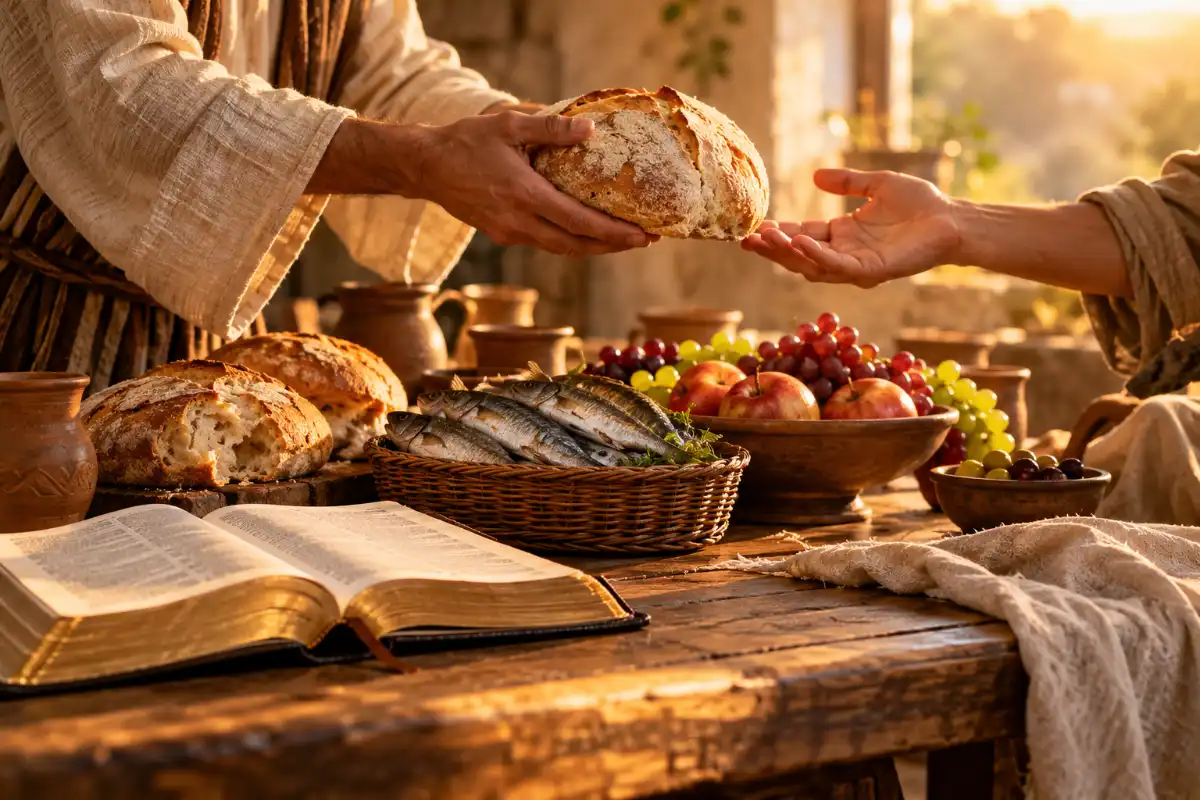
Each of these Bible verses about feeding the hungry is quoted word for word from the King James Version, followed by a short original reflection.
For I was an hungred, and ye gave me meat: I was thirsty, and ye gave me drink: I was a stranger, and ye took me in:
Matthew 25:35 (KJV)
Among Bible verses about feeding the hungry, Jesus names hunger first among the needs his followers are expected to meet. Notice that he does not say ye gave a donation to an agency; he says ye gave me meat. Every plate handed over is treated as handed to him.
And the King shall answer and say unto them, Verily I say unto you, Inasmuch as ye have done it unto one of the least of these my brethren, ye have done it unto me.
Matthew 25:40 (KJV)
In Bible verses about feeding the hungry, the King identifies himself with the least of these. This turns every food pantry line, school lunch program and shared meal into a place where Christ is quietly present, and it makes feeding people an act of worship, not merely charity.
Is it not to deal thy bread to the hungry, and that thou bring the poor that are cast out to thy house? when thou seest the naked, that thou cover him; and that thou hide not thyself from thine own flesh?
Isaiah 58:7 (KJV)
Isaiah answers the question of what true fasting looks like in Bible verses about feeding the hungry. God prefers bread shared over a ritual performed. The verse asks for three things: food, shelter and clothing, offered personally and without hiding from the need.
And if thou draw out thy soul to the hungry, and satisfy the afflicted soul; then shall thy light rise in obscurity, and thy darkness be as the noonday:
Isaiah 58:10 (KJV)
To draw out your soul means giving more than leftovers; it means giving yourself. The promise that follows in these Bible verses about feeding the hungry is striking: light rises in the dark places of your own life when you pour yourself out for someone who is hungry.
He that hath a bountiful eye shall be blessed; for he giveth of his bread to the poor.
Proverbs 22:9 (KJV)
A bountiful eye is a generous way of seeing: it notices need and does not look away. The proverb ties blessing to the habit of sharing your own bread, not surplus you will never miss, which makes this one of the most practical household Bible verses about feeding the hungry.
If thine enemy be hungry, give him bread to eat; and if he be thirsty, give him water to drink:
Proverbs 25:21 (KJV)
Hunger does not check anyone’s record before it hurts. This proverb, one of the Bible verses about feeding the hungry later quoted by Paul, tells us to feed even an enemy. Mercy of this kind disarms bitterness and shows that the kingdom of God does not run on grudges.
And Jesus said unto them, I am the bread of life: he that cometh to me shall never hunger; and he that believeth on me shall never thirst.
John 6:35 (KJV)
After feeding a crowd with loaves, Jesus points beyond the bread to himself. The meal on the hillside was real, but it pointed to a deeper hunger only he can satisfy. Those who live out Bible verses about feeding the hungry do both: hand over bread and point to the Bread.
He answereth and saith unto them, He that hath two coats, let him impart to him that hath none; and he that hath meat, let him do likewise.
Luke 3:11 (KJV)
In Bible verses about feeding the hungry, John the Baptist gives the crowd a simple rule: if you have two, share one. He asks for no special sacrifice, only that the extra be passed along. Repentance, he says, shows up in a pantry and a closet.
If a brother or sister be naked, and destitute of daily food, And one of you say unto them, Depart in peace, be ye warmed and filled; notwithstanding ye give them not those things which are needful to the body; what doth it profit?
James 2:15-16 (KJV)
James, in one of the Bible verses about feeding the hungry, has no patience for kind words that leave stomachs empty. Blessing someone and sending them away hungry is faith without works. The question what doth it profit is a gentle but firm call to turn good wishes into groceries.
But whoso hath this world’s good, and seeth his brother have need, and shutteth up his bowels of compassion from him, how dwelleth the love of God in him?
1 John 3:17 (KJV)
John links love for God, in Bible verses about feeding the hungry, with what we do when we see need. Seeing is the key word. Once we notice a brother hungry and have the means to help, the question is what our response says about the love we claim to carry.
Which executeth judgment for the oppressed: which giveth food to the hungry. The LORD looseth the prisoners:
Psalms 146:7 (KJV)
The psalmist lists feeding the hungry among the works of God himself, right beside justice for the oppressed and freedom for prisoners. When we live out Bible verses about feeding the hungry, we join work God already does, and that is a high honor.
For he satisfieth the longing soul, and filleth the hungry soul with goodness.
Psalms 107:9 (KJV)
This one of the Bible verses about feeding the hungry celebrates people God rescued from wandering and want. It holds both kinds of hunger together, the body’s and the soul’s, and reminds us that goodness from God can reach both through the hands of his people.
He that hath pity upon the poor lendeth unto the LORD; and that which he hath given will he pay him again.
Proverbs 19:17 (KJV)
What a thought in Bible verses about feeding the hungry: a meal given to a poor person is counted as a loan to the Lord. We should not give in order to get, but we can give without fear, knowing that God never forgets a kindness done in his name.
He that giveth unto the poor shall not lack: but he that hideth his eyes shall have many a curse.
Proverbs 28:27 (KJV)
The proverb sets generosity against willful blindness. Hiding our eyes is a choice, and so is looking. For anyone who worries that giving will leave them short, this one of the Bible verses about feeding the hungry offers reassurance that open hands are seldom empty for long.
Blessed are ye that hunger now: for ye shall be filled. Blessed are ye that weep now: for ye shall laugh.
Luke 6:21 (KJV)
Among Bible verses about feeding the hungry, Jesus speaks tenderly to people who go without. God has not forgotten them, and a day of filling is coming. Until then, his followers are his means of delivery, bringing a little of that future feast to the present table.
For the poor shall never cease out of the land: therefore I command thee, saying, Thou shalt open thine hand wide unto thy brother, to thy poor, and to thy needy, in thy land.
Deuteronomy 15:11 (KJV)
In Bible verses about feeding the hungry, Moses admits that need will always exist and uses that fact as a reason to give, not as an excuse for doing nothing. Open thine hand wide is a command to generosity that is wide, regular and close to home.
I will abundantly bless her provision: I will satisfy her poor with bread.
Psalms 132:15 (KJV)
God promises Zion that her poor will have bread. The vision in these Bible verses about feeding the hungry is a community where nobody goes to bed hungry. Churches and neighbors who run food ministries are helping make that ancient promise visible in their own streets.
But when thou makest a feast, call the poor, the maimed, the lame, the blind: And thou shalt be blessed; for they cannot recompense thee: for thou shalt be recompensed at the resurrection of the just.
Luke 14:13-14 (KJV)
Among Bible verses about feeding the hungry, Jesus rewrites the guest list. Instead of inviting people who can repay us, he tells us to seat the ones who cannot. A shared meal with someone who is hungry becomes a small picture of the great banquet to come.
But Jesus said unto them, They need not depart; give ye them to eat.
Matthew 14:16 (KJV)
In Bible verses about feeding the hungry, the disciples wanted to send the crowd away to find food. Jesus gave the task back to them. Often our resources look too small, but he asks us to start with what we have and trust him to multiply it.
I have shewed you all things, how that so labouring ye ought to support the weak, and to remember the words of the Lord Jesus, how he said, It is more blessed to give than to receive.
Acts 20:35 (KJV)
Paul closes his farewell with one of the Bible verses about feeding the hungry, recalling a saying of Jesus. Hard work is meant to fund generosity toward the weak. Giving, he says, carries a deeper blessing than receiving, which is a joy every volunteer in a soup kitchen quietly knows.
Hunger is one of the oldest human sorrows, and Scripture meets it head on. From the manna in the wilderness to the loaves on the hillside, the Bible keeps returning to food as a sign of God’s care. That is why Bible verses about feeding the hungry are not a side topic. They sit near the center of how God describes himself and what he asks of his people.
Reading these Bible verses about feeding the hungry together shows a pattern. The law of Moses protected the gleanings of the field for the poor. The prophets scolded nations that feasted while neighbors starved. Jesus fed crowds, taught about the sheep and the goats, and called himself the bread of life. When so many voices agree, the point is hard to miss: love that never reaches the table is incomplete.
This page walks through the testimony of Bible verses about feeding the hungry slowly. We will look at Matthew 25, Isaiah 58, the miracles of the loaves, the wisdom of Proverbs and the practical letters of James and John. Along the way we will ask how a modern family, small group or church can respond in simple, sustainable ways without guilt or showmanship. Bible verses about feeding the hungry deserve that kind of unhurried attention.
The twenty-fifth chapter of Matthew holds the most direct of all the Bible verses about feeding the hungry. Jesus describes the final judgment as a separation of sheep from goats, and the dividing line is not theology tested on paper but whether people fed him when he was hungry. Those on his right are surprised; they never realized they were serving the King.
The surprise matters in these Bible verses about feeding the hungry. Neither group knew when they had met Christ. The sheep simply saw a person in need and acted, while the goats saw the same person and kept walking. Jesus is not describing a rare heroic moment but ordinary opportunities that arrive at the grocery store, the church door and the street corner, easy to overlook and easy to answer.
The phrase the least of these deserves attention too in Bible verses about feeding the hungry. It points to those with the smallest voice and the least power to repay. Jesus says that whatever is done for them is done for him. So when we ask where Christ can be found today, one honest answer is in the person waiting for a meal, and in the hands that offer one.
Among Bible verses about feeding the hungry, Isaiah 58 begins with a complaint. The people were fasting, humbling themselves and asking God for answers, yet he seemed not to notice. God replies that their fast was a performance wrapped around business as usual. The fast he chose was to loose the bands of wickedness, break every yoke, and deal thy bread to the hungry. Here Scripture links devotion and food directly.
This does not cancel the practice of fasting in Bible verses about feeding the hungry. It redirects it. Skipping a meal can sharpen prayer, but God wants the hunger we feel to turn our attention toward people who feel it every day. Some families set aside the money saved from a skipped meal and give it to a food bank, which is a small, concrete way of letting Isaiah shape the habit.
The rewards in this chapter of Bible verses about feeding the hungry are generous. Light breaks forth like the morning, healing springs up speedily, and the Lord promises to guide continually. The Bible verses about feeding the hungry in Isaiah are not only commands; they are an invitation into a life where God’s presence feels near because our hands are busy with the things he loves.
In Bible verses about feeding the hungry, when Jesus fed the five thousand, the crowd followed him across the lake the next day looking for more bread. He gently told them they were chasing food that perishes and offered himself as the bread of life. That teaching in John 6 never dismisses physical hunger; he had just fed them. It reveals a deeper hunger that no meal can ever settle.
Bible verses about feeding the hungry are also a helpful guide for feeding ministries. A warm plate is a good in itself and needs no apology. Yet people we serve are also hungry for dignity, welcome and hope, and Christ is the one who supplies those. Serving a meal with eye contact and a name is a way of pointing toward the bread that feeds the whole person.
Bible verses about feeding the hungry also guard us from a mistaken idea that only the poor are hungry. All of us carry cravings for approval, security and meaning. When we hand a sandwich across a counter we are one hungry person sharing with another, both depending on the same Lord. That humility keeps charity from turning into superiority and keeps the table level.
All four Gospels record the feeding of the five thousand, which tells us how deeply the early church treasured the story. Among all the Bible verses about feeding the hungry, this account is the most vivid. The disciples saw a problem: a remote place, a late hour, a hungry crowd and almost no food. Their proposal was practical and sensible: send them away. Jesus answered with five words that still unsettle us: give ye them to eat.
He did not conjure a banquet from nothing. He asked for what the disciples had, five loaves and two fish from a boy, and he blessed it, broke it and handed it back to be distributed. Provision came through ordinary hands carrying ordinary food. Every pantry shelf stocked by a church family follows the same pattern of small offerings multiplied.
There is encouragement in Bible verses about feeding the hungry for anyone who feels their contribution is too small. A can of soup, an hour of volunteering or a pot of rice for a neighbor may seem like very little against the scale of hunger. The Gospel story invites us to bring it anyway. Our job is faithfulness with what is in our hands, and the multiplying is in his.
In Bible verses about feeding the hungry, the book of Proverbs treats generosity as plain wisdom. He that hath a bountiful eye shall be blessed, says Proverbs 22:9, because he giveth of his bread to the poor. The proverb does not ask for dramatic sacrifice. It speaks of bread, the most ordinary item on the table, and suggests that sharing it is what a wise person does without fuss.
Other proverbs sharpen the picture of Bible verses about feeding the hungry. Proverbs 19:17 describes kindness to the poor as a loan to the Lord, and Proverbs 28:27 warns that looking away has a cost. Taken together, these sayings treat the open hand as a mark of character and the closed eye as a quiet danger. You can learn more about this theme in our collection of Bible verses about generosity and the wider study of giving.
Bible verses about feeding the hungry also remind us that wisdom is practical. Plan a little extra when you shop, keep a few non-perishable items in the car, and learn which local ministries accept fresh produce. Wise generosity thinks ahead so that when need appears, you are ready to meet it calmly instead of scrambling or ignoring it.
Few Bible verses about feeding the hungry stretch the heart like Proverbs 25:21: If thine enemy be hungry, give him bread to eat. The command quietly dismantles the idea that charity is reserved for people we like. Hunger is a human need, and the one who answers it shows the character of the God who sends rain on the just and the unjust.
The apostle Paul quotes this proverb in Romans 12 as part of a larger call to overcome evil with good. Feeding an enemy is not weakness. It refuses to let hatred set the terms of the relationship, and it often opens a door that argument never could. Many reconciliations have begun with a plate shared at a table.
Applying Bible verses about feeding the hungry does not mean ignoring wisdom or safety. It does mean examining the quiet places where we have decided that someone does not deserve help. Is there a neighbor, a coworker or a relative whose need we have discounted because of an old wound? This proverb asks us to bring bread to that spot and let God handle the rest.
Long before there were food banks, the law of Moses built a safety net into agriculture. Farmers were told not to reap to the very edges of their fields or to strip their vineyards bare. The leftovers belonged to the poor, the stranger, the fatherless and the widow. Hungry people could gather food with dignity and effort instead of waiting for a handout.
The story of Ruth shows this law in action. A foreign widow named Ruth gleaned behind the reapers in the field of Boaz, who instructed his workers to leave extra grain for her. God used that generosity to carry Ruth into the family line of David and ultimately of Jesus. A field left unharvested at the edges changed the course of history.
Modern readers of Bible verses about feeding the hungry can learn from the design. The law mixed generosity with respect, leaving food within reach but not delivering it to the door. Today, gardens that donate produce, farmers who allow gleaning crews and churches with community pantries echo the same approach. Among the Bible verses about feeding the hungry, Deuteronomy 15:11 reminds us to open the hand wide.
Bible verses about feeding the hungry belong to a larger life of mercy that the Bible calls us to share. Many people find it helpful to read this theme alongside our study of Bible verses about giving to the poor, where the call to open-handed living is explored more broadly. Food is the most immediate form of giving because hunger cannot wait for a perfect plan.
Compassion in Scripture is never only a feeling. The Hebrew and Greek words behind it describe a stirring in the gut that moves a person to act. When Jesus saw the crowds, the Gospels say he was moved with compassion, and then he healed and fed them. Feelings that never lead to a loaf stay unfinished, and Scripture does not leave them there.
For many people the hard part is not caring but starting. Choose one small repeatable action: a monthly donation, a weekly extra bag of groceries, or a standing slot at a community meal. Consistent small giving usually does more good than occasional grand gestures, and it forms in us the kind of heart the Bible keeps describing.
The letter of James is blunt about faith without works. He pictures a hungry brother or sister at the door and a believer offering only blessings: be ye warmed and filled. Nothing changes except the pride of the speaker. James asks, what doth it profit? His point is that kind words are a poor substitute for the food that was actually needed.
John says something similar in his first letter. Whoso hath this world’s good, and seeth his brother have need, and shutteth up his bowels of compassion, how can God’s love live in him? John does not condemn people who lack resources. He is speaking to those who can help and choose not to. The test is what we do with our abundance when need is in front of us.
These two voices among Bible verses about feeding the hungry make a firm but gracious pair. They do not shame us into giving; they show us that love is meant to be seen. A casserole at the door, a gift card slipped into a hand or a regular grocery run for an elderly neighbor turns belief into something a hungry person can actually taste. That is the practical heart of Bible verses about feeding the hungry.
The Psalms often describe God as the one who feeds. Psalm 146:7 says he giveth food to the hungry. Psalm 107:9 says he filleth the hungry soul with goodness. Psalm 132:15 promises to satisfy her poor with bread. Hunger is not outside his concern; it is part of the world he promises to repair and one of the places where his people most reflect him.
These Bible verses about feeding the hungry show that feeding the hungry begins with God’s character, not our guilt. He is generous before we are, and he invites us to join the work he already does. Seeing generosity this way can free us from resentment or burnout, because we serve as participants in his ongoing provision and not as lone rescuers of a broken world.
The Psalms also give us words to pray over Bible verses about feeding the hungry when hunger overwhelms us. Whether the hunger is ours or belongs to people in a news report, we can bring it to God honestly. Prayer will not replace action, but it keeps action tender, and it reminds us who is ultimately able to fill the longing soul.
Throughout the Bible verses about feeding the hungry, a shared meal is a sign of welcome and peace. Abraham hurried to feed three strangers beneath the oaks of Mamre. The early church broke bread from house to house. Jesus ate with tax collectors and sinners and told his followers to invite the poor, the lame and the blind to their feasts. Hospitality turns feeding the hungry from a service into a relationship.
This is worth remembering because many of us find it easier to drop off a bag than to sit down with a person. Both have a place, but Luke 14 pushes toward the table: when thou makest a feast, call the poor. A meal at which the guest is known by name does something food alone cannot, because it says, you belong here.
Start where you are. Host a simple dinner in your home, join a church lunch where guests and volunteers eat together, or ask a lonely neighbor to share a plate. You do not need an impressive menu. Scripture shows that bread and a warm welcome are enough to make a table holy. Bible verses about feeding the hungry rarely ask for more.
Churches have carried out the command to feed the hungry in many ways: pantries, community meals, backpack programs for school children, meal deliveries for the homebound and holiday baskets. If you are looking for places to serve, our page of Bible verses about helping others can encourage you, and it fits well with these practical ministries.
Good ministries built on Bible verses about feeding the hungry share a few habits. They listen to the community before deciding what to offer. They treat guests with dignity, avoiding lectures or conditions. They coordinate with other local groups to avoid gaps and overlaps, and they care for volunteers so that service does not turn into exhaustion. These habits make generosity sustainable over years instead of weeks.
If you cannot volunteer on a schedule, there are still ways to take part. Donate staples the pantry actually requests, give money so the ministry can buy in bulk, or share what you know, from cooking to logistics. Every ministry needs a variety of gifts, and the Bible teaches that many members make one body, each doing a part.
How we feed people matters as much as whether we do. Isaiah 58:7 speaks of bringing the poor into your house, which is far more personal than handing a package through a window. The Bible consistently treats hungry people as image-bearers with names and stories, never as problems to be managed or audiences for our virtue.
Practical steps drawn from Bible verses about feeding the hungry can honor that dignity. Offer choices where possible instead of pre-packed bags, ask about allergies and cultural preferences, and let guests serve themselves when the setting allows. Greet people warmly and avoid questions that make them prove their need. A meal given with respect carries a message that is larger than the food itself.
Dignity also shapes how we think about ourselves. If we are ever on the receiving end of help, Scripture assures us there is no shame in it. The same Jesus who told us to feed the hungry also said he came to serve. Receiving and giving are two sides of one community that depends on God and on each other.
Hunger can feel like something that happens far away, yet it often hides near us. A child in the next classroom may rely on school lunches, an older neighbor may skip meals to afford medicine, and a young family may be one missed paycheck away from empty shelves. The command to open thine hand wide unto thy brother, in thy land, begins at home.
Noticing is the first step in living out Bible verses about feeding the hungry. Pay attention to who is quiet at church potlucks, who never seems to have a lunch, or who has stopped coming to gatherings. Ask gently, and offer help in ways that preserve privacy, such as a grocery gift card or a meal left at the door. The Bible values small acts of attention as much as large programs.
Learn what exists in your area, too. Many communities have pantries, free community meals and benefit programs that people do not know about. Becoming someone who can point a struggling person toward real resources is a form of generosity that costs little and can change a family’s week. It is one practical way to live out Bible verses about feeding the hungry.
Some readers feel they cannot give because their own budgets are tight. Bible verses about feeding the hungry meet that worry kindly. The widow of Zarephath fed Elijah from the last of her flour and oil, and the jar did not run dry. The poor widow in the temple gave two small coins and Jesus held her up as an example. Giving is measured by love, not by amount.
That does not mean everyone must give beyond their means, and wisdom matters. It does mean that generosity is open to all. You can share a meal, give an hour, cook extra for a neighbor, or pray for those in need. Our collection on Bible verses about provision offers reassurance that God sees the needs of those who give and those who receive.
Paul writes in 2 Corinthians that God loves a cheerful giver, and that the one who supplies seed to the sower will multiply it. The promise is not that we will become wealthy but that God will provide enough for every good work. Small, joyful giving, offered in faith, is never wasted in his economy.
Children learn generosity by watching and doing. When a family prays before a meal and then packs a bag of groceries for the pantry, a young child absorbs that hunger and thankfulness belong together. Bible stories such as the boy with the loaves make the lesson vivid because the hero is a child who shared his lunch.
Choose age-appropriate ways to teach Bible verses about feeding the hungry. Younger children can decorate cards for a meal program or help choose cans for a food drive. Older children can sort donations, help serve at a community meal or plan a fundraiser. Talk afterward about what they noticed and how it felt, and connect it to a verse such as Luke 3:11, where those with two coats share one.
Be honest that hunger is real without making it frightening. Children need to hear that God cares about hungry people and that we are invited to help. Over time, these small experiences shape a heart that sees need and responds, which may be one of the most lasting inheritances a family can pass on. Bible verses about feeding the hungry make wonderful family memory work.
Thanking God for food is among the oldest of Christian habits, and it is deeply tied to feeding others. Jesus gave thanks before breaking the loaves. A table that begins with gratitude naturally turns toward generosity, because thankfulness reminds us that every meal is a gift we did not earn and are not meant to hoard.
Gratitude also protects against waste, a theme in Bible verses about feeding the hungry. When we remember that food is a blessing, we plan meals more carefully, save leftovers and share what we cannot eat. Our study of Bible verses about thanksgiving can help you build that habit. A grateful household tends to be a generous one.
Try making your mealtime prayer include the hungry. Name a neighbor in need, a ministry you support or a region facing famine, and ask God to use you in some small way. The prayer may seem simple, but it keeps the question of who is not at the table before your family each day.
People often ask whether giving to a charity counts as obeying Bible verses about feeding the hungry. In most cases, yes. The Bible commends giving that is thoughtful and sincere, whether it is done in person or through a trustworthy organization. It also encourages us to go beyond writing checks occasionally and to build real relationships with neighbors in need when we can.
Another common question is how to handle people who ask for money on the street. Scripture does not give a single formula, and wise believers differ. Some carry fruit or gift cards for such moments, some give directly and others support local shelters. What matters is that we respond with kindness and do not harden our hearts. Prayer and prudence can walk together.
Many also wonder if feeding people physically is less important than sharing the gospel. The Bible does not set them against each other. Jesus fed bodies and taught the crowds, and the early church shared bread and the word. When done sincerely, meeting a physical need opens the door to trust, and words and deeds reinforce each other.
Reading about generosity is valuable, but Scripture asks for action. Pick one idea from this page and do it within seven days. You might buy two extra items on your next shopping trip for the pantry, invite someone to a meal, or sign up for a volunteer shift. A modest start taken now is worth more than a perfect plan postponed forever.
Pair your action with one of the Bible verses about feeding the hungry. Write Matthew 25:35 or Isaiah 58:10 on a card near your kitchen, and read it each time you cook. If you use our Bible verses about serving the poor page, you may find more passages that pair well with your plan. Verses on the refrigerator turn everyday routines into small reminders of mercy.
Finally, keep going. Hunger is a recurring need, not a one-time event, and God honors steady faithfulness. Review your efforts every few months, adjust where needed and share what you learn with others. Bible verses about feeding the hungry are meant to shape a way of life, and the Lord who fed the crowds will supply what you need to continue.
If these Bible verses about feeding the hungry spoke to you, these related collections continue the themeBible verses about giving to the poor, Bible verses about helping others, Bible verses about generosity, Bible verses about compassion, Bible verses about provision, Bible verses about serving the poor, Bible verses about fasting, Bible verses about justice, Bible verses about kindness, Bible verses about loving your neighbor.
To study these verses in more depth, try Bible Gateway, Bible Hub, Bible Study Tools, Blue Letter Bible.
The Bible treats feeding the hungry as a core expression of faith. Isaiah 58 links true fasting with sharing bread, Proverbs praises the generous, and Jesus says in Matthew 25 that feeding the hungry is feeding him. Bible verses about feeding the hungry present it as obedience and as worship together.
Many readers point to Matthew 25:35, where Jesus says, I was an hungred, and ye gave me meat. It is the clearest of the Bible verses about feeding the hungry that serving the hungry is serving Christ. Isaiah 58:7 and James 2:15-16 are also commonly quoted when people discuss practical charity.
You can share a meal with a neighbor, cook extra portions, volunteer time at a community kitchen, or give small amounts regularly. The Bible praises the widow who gave two coins, showing that sincere giving counts. Prayer, encouragement and time are also real gifts that help hungry people.
Isaiah 58 says God’s chosen fast is not mere ritual but loosing injustice and dealing thy bread to the hungry. Fasting that leaves us self-focused misses the point. When our abstaining leads to sharing food and shelter, God promises light, healing and his guiding presence.
It appears as a command throughout Bible verses about feeding the hungry. Deuteronomy 15:11 tells Israel to open thine hand wide to the needy, Jesus says give ye them to eat, and James rejects faith that does not feed those in need. The command is meant to be joyfully and consistently obeyed.
Involve them in simple, age-appropriate actions based on Bible verses about feeding the hungry: choosing items for a food drive, helping prepare a meal, or serving alongside the family. Tell stories like the boy who shared his loaves, and connect the actions to a verse. Children learn generosity best by seeing it modeled and practiced regularly.