
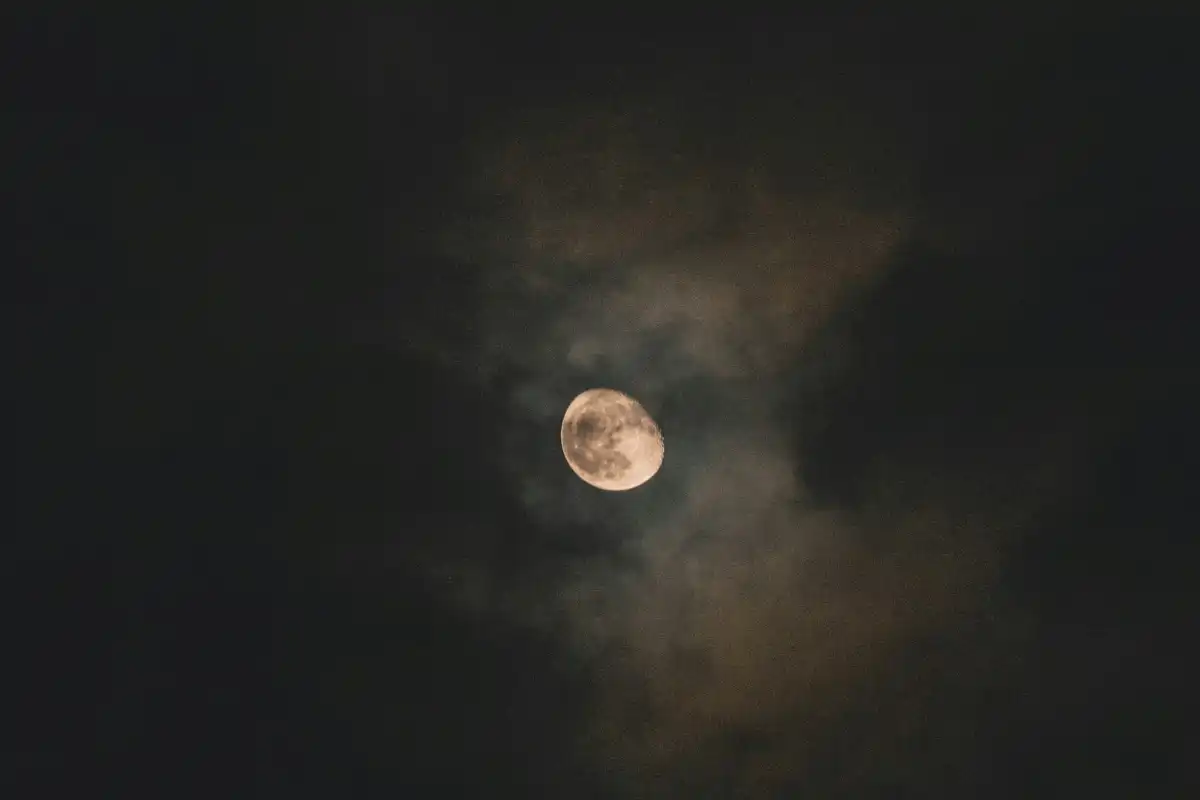
Each of these Bible verses about the moon is quoted word for word from the King James Version, followed by a brief note on what it teaches.
And God said, Let there be lights in the firmament of the heaven to divide the day from the night; and let them be for signs, and for seasons, and for days, and years:
Genesis 1:14 (KJV)
Among Bible verses about the moon, this is where on the fourth day God gives the heavens a job. The lights are not gods or omens but tools, set in place to mark days, seasons and years. The moon begins its story here as a servant of order and time.
And let them be for lights in the firmament of the heaven to give light upon the earth: and it was so.
Genesis 1:15 (KJV)
In these Bible verses about the moon, the purpose is plain: light for the earth. Whatever else the moon means in later pages of Scripture, it starts as a gift to the creatures below, and the closing words, and it was so, show how effortlessly God’s word accomplishes what it says.
And God made two great lights; the greater light to rule the day, and the lesser light to rule the night: he made the stars also.
Genesis 1:16 (KJV)
Among Bible verses about the moon, the moon is called the lesser light, yet it still rules the night. Rank is not the point; faithful service is. Notice how briefly the stars are mentioned, as though the God who made them spared no effort over any of it.
When I consider thy heavens, the work of thy fingers, the moon and the stars, which thou hast ordained;
Psalms 8:3 (KJV)
David looks up and sees craftsmanship, the work of thy fingers. The moon and stars are not impersonal machinery but something God shaped with care. This is one of the Bible verses about the moon that invites you to step outside on a clear night and let the sky teach humility.
What is man, that thou art mindful of him? and the son of man, that thou visitest him?
Psalms 8:4 (KJV)
Among Bible verses about the moon, the vastness of the night sky raises a question about our smallness. The astonishing answer of Scripture is that the Maker of the moon still remembers and visits human beings. Wonder at the heavens leads straight to wonder at grace.
He appointed the moon for seasons: the sun knoweth his going down.
Psalms 104:19 (KJV)
In this entry among Bible verses about the moon, the moon is appointed, given a post and a schedule. Ancient Israel kept its feasts by the lunar cycle, so this verse also reflects daily life. The reliable rhythm of the sky is presented as evidence of a reliable Creator.
The sun shall not smite thee by day, nor the moon by night.
Psalms 121:6 (KJV)
A psalm of travelers promises protection at every hour. Day and night, heat and the dangers people associated with darkness, are all within the Lord’s keeping. It is a gentle entry among Bible verses about the moon for anyone who worries after the lights go out.
To him that made great lights: for his mercy endureth for ever:
Psalms 136:7 (KJV)
Among Bible verses about the moon, the refrain of Psalm 136 ties creation to mercy. The great lights are not just beautiful; they are evidence that God’s steadfast love has been at work from the beginning. Every moonrise becomes a reminder of mercy that does not expire.
The moon and stars to rule by night: for his mercy endureth for ever.
Psalms 136:9 (KJV)
Read slowly, this line makes the moon part of a liturgy, one of the quietest Bible verses about the moon. The night is not abandoned territory; it has its own rulers, set by God, and his mercy covers it. People who find nights lonely can borrow this verse as a quiet prayer.
Praise ye him, sun and moon: praise him, all ye stars of light.
Psalms 148:3 (KJV)
Among Bible verses about the moon, the psalmist calls the moon to worship, which is poetry, not astronomy. Creation exists to give God glory, and humans are invited to join the chorus rather than merely observe it. Praise belongs to the night shift too.
It shall be established for ever as the moon, and as a faithful witness in heaven. Selah.
Psalms 89:37 (KJV)
In these Bible verses about the moon, God promises that David’s throne will endure like the moon, a faithful witness in heaven. The steady return of the moon becomes a guarantee that divine promises do not fail. Selah invites you to pause and let that settle in.
They shall fear thee as long as the sun and moon endure, throughout all generations.
Psalms 72:5 (KJV)
This prayer for the king, among Bible verses about the moon, uses the moon as a measure of time: as long as it endures, so may righteous reverence. It shows how naturally the biblical writers reached for the sky when they wanted to speak about permanence.
Who is she that looketh forth as the morning, fair as the moon, clear as the sun, and terrible as an army with banners?
Song of Solomon 6:10 (KJV)
In a love poem among Bible verses about the moon, the moon is a picture of beauty and quiet radiance. Scripture does not shy away from admiring created things, and here the comparison honors the moon’s gentle brightness as something worth celebrating.
Thy sun shall no more go down; neither shall thy moon withdraw itself: for the LORD shall be thine everlasting light, and the days of thy mourning shall be ended.
Isaiah 60:20 (KJV)
In Bible verses about the moon like this, Isaiah sees a day when God himself is the light and mourning ends. The moon is mentioned as something that will no longer wane, a picture of sorrow ended. It is a strong comfort for anyone whose nights feel long.
And the city had no need of the sun, neither of the moon, to shine in it: for the glory of God did lighten it, and the Lamb is the light thereof.
Revelation 21:23 (KJV)
At the close of the Bible, the last of the Bible verses about the moon says the created lights are no longer needed because the Creator’s glory fills the city. The moon is not scorned; it simply gives way to something greater, as a lamp yields when the day arrives.
And lest thou lift up thine eyes unto heaven, and when thou seest the sun, and the moon, and the stars, even all the host of heaven, shouldest be driven to worship them, and serve them, which the LORD thy God hath divided unto all nations under the whole heaven.
Deuteronomy 4:19 (KJV)
Among Bible verses about the moon, this one reminds us that because the moon is so striking, people have always been tempted to revere it. Moses warns against that. The right response to a beautiful creation is gratitude to the One who made it, never worship of the creature itself.
For the stars of heaven and the constellations thereof shall not give their light: the sun shall be darkened in his going forth, and the moon shall not cause her light to shine.
Isaiah 13:10 (KJV)
In Bible verses about the moon, prophets sometimes use cosmic language for the fall of nations and the day of the Lord. The dimming of moon and stars pictures judgment so complete that even the steadiest things seem shaken, a warning meant to sober readers.
The sun shall be turned into darkness, and the moon into blood, before the great and terrible day of the LORD come.
Joel 2:31 (KJV)
Among Bible verses about the moon, Joel speaks of a coming day of the Lord with striking imagery. Read in its setting, the verse is a call to repentance and trust, not a puzzle for predicting calendars. The promise nearby is that whoever calls on the Lord will be saved.
The sun shall be turned into darkness, and the moon into blood, before that great and notable day of the Lord come:
Acts 2:20 (KJV)
In Bible verses about the moon, Peter quotes Joel on the day of Pentecost to explain what the crowd had just witnessed. The point of the quotation is the outpouring of the Spirit and the offer of salvation, which the next verse makes explicit.
And I beheld when he had opened the sixth seal, and, lo, there was a great earthquake; and the sun became black as sackcloth of hair, and the moon became as blood;
Revelation 6:12 (KJV)
Among Bible verses about the moon, John’s vision uses the same family of images to portray the shaking of the old order. Symbolic language like this is best read with humility and with the rest of Revelation, which ends in hope and the light of God’s presence.
Bible verses about the moon begin at the very start of Scripture. On the fourth day of creation, God makes lights in the firmament, and the moon is one of them. The text calls it the lesser light, set to rule the night, and then says almost in passing that he made the stars also. There is no myth of a moon goddess and no drama between rival powers. The moon is simply made, placed and named by the word of God.
That plain account matters for how we read every later reference. Because the moon is created, it can be admired without being feared or worshiped. Because it was made on purpose, its steady light is a sign of intention rather than accident. Readers who come to Genesis wondering what Bible verses about the moon say will find the foundation here: it is God’s work, it serves the earth, and it belongs to a world he called good.
The phrase rule the night in Genesis 1:16 is among the most quoted Bible verses about the moon and deserves a closer look. The moon does not control human beings; it governs a portion of time, giving the night a character different from the day. For people without electric lights, that was a huge gift. A full moon meant safer travel, easier harvest work and a visible world after sunset. The writers of Scripture lived under that sky and noticed it.
Among Bible verses about the moon there is also a quiet lesson in the word lesser. The moon has no light of its own, and we now know it only reflects the sun, yet the Bible honors it with real authority over the night. Faithfulness in a smaller role is not despised in Scripture. Anyone who feels they only reflect light from someone else can take heart that a reflected light is still a light that God appointed and uses.
Genesis says the lights are for signs, and for seasons, and for days, and years. In the ancient world the moon was the most visible clock. Its phases gave people a month, and the cycle of months gave them festivals. Israel’s calendar of feasts followed the new moon, which is why Psalm 104:19 says the Lord appointed the moon for seasons. When we read Bible verses about the moon, we are often reading about how God’s people measured and sanctified time.
This is a useful reminder from Bible verses about the moon that time itself is not neutral. Days are gifts to be counted and used well, and the regular return of the moon teaches patience. A month passes whether we hurry or not. If you want a simple practice, pick a new moon or full moon as a monthly prompt to pause, thank God for the past weeks and ask for wisdom for the next ones, without attaching any superstition to the date.
Psalm 8 is perhaps the best loved of all the Bible verses about the moon. David, once a shepherd who spent many nights under open sky, writes about considering the heavens, the moon and the stars. The word considering suggests slow, deliberate attention, not a glance. He sees the work of God’s fingers, which is an intimate image, as if the whole sky were handcrafted.
The reaction is not fear but humility mixed with joy. David asks what a human being is that God would be mindful of him. The answer in the rest of the psalm is that humans are crowned with glory and honor and given care of creation. So the same sky that makes us feel small also tells us we are known. Next time the moon is bright, try reading this psalm, one of the Bible verses about the moon, aloud outdoors and let the contrast between vastness and care sink in.
Psalm 104, among Bible verses about the moon, is a long hymn about the way God sustains creation, and verse 19 tucks the moon into the picture: he appointed the moon for seasons. The verb appointed is the language of commissioning. The moon is not drifting; it has a task, and it performs that task on time. The very next phrase says the sun knows its going down, giving the heavenly bodies a kind of obedient intelligence in poetic speech.
Why does that matter to us? Because Bible verses about the moon often use creation as a teacher of faithfulness. If the moon keeps its appointed course without complaint, then our own seasons of waiting and working are also appointed. We may not see the whole plan, but we can trust the One who assigned the moon its path to have assigned ours with equal care. Readers looking for related reflections may also enjoy the page on Bible verses about creation.
Psalm 121, one of the best-loved Bible verses about the moon, is a song for pilgrims climbing toward Jerusalem, and its sixth verse promises that the sun shall not smite thee by day, nor the moon by night. Travelers faced real exposure: heat in the day and cold and unseen dangers in the dark. Some ancient people also associated moonlight with sickness or mischief. The psalm answers all such fears in one line: the Lord who keeps you does not clock out when the sun sets.
For modern readers, this is one of the gentlest Bible verses about the moon for the hours when worry grows louder. Nighttime has a way of magnifying fears that look smaller in daylight. A calm practice is to read Psalm 121 slowly before sleep and let the repeated word keeper settle the mind. If sleep is hard to find, our collection of Bible verses about sleepless nights offers more passages for those hours.
Bible verses about the moon in the Psalms regularly summon it to praise. Psalm 148:3 says praise ye him, sun and moon, and then adds all ye stars of light. This is poetic address, not a claim that the moon speaks, but it reveals a worldview in which everything that exists has a reason to honor its Maker. The silent light of the moon becomes a form of wordless worship, rising every night without being asked twice.
That vision invites us into the same posture. If the moon praises simply by shining as it was made to, then our praise can also be as simple as doing what God made us to do, faithfully and with thanks. Psalm 136 adds its refrain that his mercy endureth for ever after mentioning the moon and stars. You might pair these Bible verses about the moon with our page on Bible verses about praise for a fuller picture of worship.
Psalm 89, among Bible verses about the moon, uses the moon as a picture of a promise that cannot be broken. God swears that David’s line will be established for ever as the moon, and as a faithful witness in heaven. For people who lived by moonlight, the steady return of the moon after every dark phase was one of the most dependable things they knew. Even when it disappears for a night, it comes back.
There is real comfort in that image among Bible verses about the moon for anyone passing through a dark phase of their own. A waning moon does not mean the moon is gone, and a hard season does not mean God has withdrawn his promise. Psalm 72:5 echoes the idea when it prays for righteousness to last as long as the sun and moon endure. The permanence of the sky becomes a promise that God’s purposes outlast our short-term fears.
The Song of Solomon asks, who is she that looketh forth as the morning, fair as the moon, clear as the sun? Among Bible verses about the moon, a book devoted to human love uses the moon as a compliment. It stands for a soft, pure and luminous beauty that draws the eye without shouting. The Bible does not treat appreciating beauty as a distraction from faith but as a normal part of a life that honors creation.
This gives us permission to enjoy the moon for its own sake. A walk under a full moon, a quiet evening with someone you love, a photograph of a silver sky, these are simple pleasures that Scripture does not forbid. Gratitude is the key: each beautiful thing is a gift from the Giver. If you are interested in more verses where creation reflects God’s loveliness, see our page on Bible verses about nature.
Deuteronomy 4:19 is the other side of the Bible verses about the moon. Moses warns Israel not to lift up their eyes, see the sun, moon and stars, and be driven to worship them. Neighboring peoples did exactly that, giving moon deities names and temples. Israel’s confession was different: the moon is a created thing and God alone is worthy of worship.
Job 31 touches on the same temptation when Job insists he never secretly kissed his hand to the moon in admiration. The point for modern readers is not that stargazing is dangerous, but that reverence has a proper object. Today the temptation may take other forms, such as trusting horoscopes or lunar superstition to guide decisions. The Bible’s answer is steady: look up in wonder, and then let the wonder lead you to the Creator.
Some people search for Bible verses about the moon hoping to find guidance about lucky days, moon phases and personal destiny. The Bible does not offer that. It says the lights are for signs, seasons, days and years, which means practical timekeeping, not a map of your personality or fate. God’s guidance for individuals comes through his word, prayer, wise counsel and the Spirit, not through the phase of the moon.
This is freeing rather than restrictive. You do not need to check the sky before making a choice, signing a contract or beginning a project. Proverbs 3:5-6 invites us to trust the Lord with all our heart and to acknowledge him in all our ways. You can enjoy the moon, learn about its cycles and still hold your decisions before God in prayer. Our page on Bible verses about trust expands on that confidence.
In Bible verses about the moon, several prophets use its darkening as a symbol. Isaiah 13:10 says the stars shall not give their light and the moon shall not cause her light to shine. Joel 2:31 speaks of the moon turned into blood before the great and terrible day of the Lord. In these passages, the language is vivid because the subject is serious: God’s decisive action in history, whether in judgment on a nation or at the end of the age.
A careful reader will notice that these verses are rooted in real situations. Isaiah was speaking about the fall of Babylon, and Joel was calling a people to repent after a devastating plague of locusts. The imagery of cosmic darkness conveyed that the old order was being overturned. We study such Bible verses about the moon to learn reverence and readiness, not to calculate dates. Our page on Bible verses about end times discusses these themes with the same caution.
Acts 2:20, among Bible verses about the moon, repeats Joel’s words almost exactly: the sun shall be turned into darkness, and the moon into blood. Peter stands before a confused crowd after the Spirit has come on the believers and explains that what they see is the fulfillment of what Joel promised. The quotation is long, and the moon is only a small part of it. The focus is the pouring out of God’s Spirit on all flesh.
The next verse in Acts is the heart of the matter: whosoever shall call on the name of the Lord shall be saved. That is the message wrapped around the dramatic imagery. Whatever one concludes about the details, Peter uses the moon verse to point people to repentance and faith, not to speculation. When you meet this passage, ask first what it calls you to do today, and the answer is to turn to Christ and trust him.
Revelation 6:12, one of the Bible verses about the moon in the final book, says that when the sixth seal is opened, the sun becomes black as sackcloth of hair and the moon becomes as blood. Revelation is full of symbolic imagery drawn from the Old Testament, and these cosmic signs echo Isaiah and Joel. They describe the shaking of the world’s old powers and the arrival of God’s judgment. They are written to encourage persecuted believers that history is in God’s hand, not to frighten them.
Another reference appears in Revelation 12:1, where a woman is pictured with the moon under her feet, a symbol of glory and victory over a world of changing things. The moon, always waxing and waning, represents what is temporary. That picture suits the larger message of the book: the fleeting powers of the earth will pass, and the faithful God remains. Reading Revelation with that hope in mind keeps the focus where John placed it.
Revelation 21:23 gives one of the most beautiful of all Bible verses about the moon: the city had no need of the sun, neither of the moon, to shine in it: for the glory of God did lighten it, and the Lamb is the light thereof. Isaiah 60:19-20 holds a similar promise. The created lights, so valuable in this life, are not despised, but they are no longer needed because the source of all light is present.
For those who grieve or live through long dark seasons, this is a deep comfort. The final home of God’s people is not described as a place of dim light or fading beauty. It is filled with the glory of God himself. Reading Bible verses about the moon all the way to this point shows that the story that began with God making lights ends with God as the light. See also our page on Bible verses about heaven for more of this hope.
Bible verses about the moon teach several lessons that fit ordinary life. First, it reflects light it does not produce, which is a picture of the Christian life: we shine because Christ shines on us. Jesus said his followers are the light of the world, and the moon helps us understand that this light is borrowed and meant to be given away. Our page on Bible verses about being a light explores that calling.
Second, the moon is patient. It goes through phases, sometimes showing only a sliver, yet it remains the same moon. Believers also have fuller and thinner seasons. Third, it keeps its place. In a restless age, the moon’s faithfulness to its appointed orbit challenges us to be dependable in our own responsibilities. None of these lessons require seeing special meaning in a particular date, only attention and gratitude.
One of the simplest ways to use these Bible verses about the moon is to take them outside. A few minutes under the night sky, with a Bible or just a verse remembered, can shift your whole outlook. Read Psalm 8 or Psalm 121 aloud, notice the moon and thank God for specific things from the day. You do not need a full moon; even a thin crescent or a cloudy glow is enough to remind you that the sky keeps its course.
If evenings are stressful, make this a nightly pause rather than an occasional treat. Put away screens, step to a window and let the quiet do some of the work. Pair it with a prayer of release, handing the next day’s worries to the One who rules the night. For more help winding down, our collection of bedtime Bible verses and Bible verses for night can guide the final minutes before sleep.
Children are naturally curious about the moon, which makes it a wonderful way to introduce Scripture. Start with Genesis 1:16 and ask who made the moon and why. Then try Psalm 136:9 as a repeating chant: the refrain his mercy endureth for ever is easy for young voices. A short evening routine of finding the moon, saying one verse and thanking God for his care can become a memory a child carries for life.
Keep it simple and honest. Explain that the moon is a gift God made to light the night and mark time, and that we thank him rather than worship it. Older children can look up how the moon reflects the sun and connect that to being a light for Jesus. Parents may also enjoy sharing our page on Bible verses about stars, since the sky offers many chances to wonder together.
Readers of Bible verses about the moon often ask how many times the Bible mentions it and whether it means anything special. The word appears many times across the Old and New Testaments, mostly in contexts of creation, worship, the calendar and prophetic imagery. Other readers wonder if a blood moon is a message from God. The Bible uses that phrase symbolically in Joel, Acts and Revelation, and Jesus himself said that no one knows the day or hour, so we avoid setting dates.
Another common question is whether Christians may enjoy lunar events, such as eclipses or supermoons. Nothing in Scripture forbids appreciating them. They are wonders of God’s creation, and the right response is thanks. The wrong response would be fear, superstition or treating them as predictions. If you want to look at Scripture’s wider picture of light and dark, our page on light in the darkness is a useful companion to these Bible verses about the moon.
Taken together, Bible verses about the moon form a clear arc. In Genesis, the moon is made and given a task. In the Psalms, it praises, marks time and pictures faithfulness. In the law and prophets, it warns us against idolatry and speaks of judgment. In the New Testament, it appears in Peter’s sermon and John’s visions, and it finally gives way to the glory of God in the new Jerusalem. The moon is never the hero of the story, but it is always a witness.
What should that do to us? It should make us grateful, humble and hopeful. Grateful for the light given in the night, humble before a Creator who numbers the stars, and hopeful because the promises of God are as sure as the moon in the sky. The next time you see it rise, let it be a prompt to pray, to praise, and to trust the One who appointed it for seasons. You can continue with our Bible verses about the sun for the companion light.
If you found these Bible verses about the moon helpful, these related pages are a natural next step: Bible verses about stars, Bible verses about the sky, Bible verses about creation, Bible verses about nature, Bible verses about the sun, Bible verses about sunset, Bible verses about sunrise, Bible verses about long nights, There is a time for everything, God is light.
To study these verses in more depth, try Bible Gateway, Bible Hub, Bible Study Tools, Blue Letter Bible.
Bible verses about the moon say God made it on the fourth day of creation to give light on the earth, rule the night and help mark seasons, days and years. It also presents the moon as a witness to God’s faithfulness, calls it to praise him, and forbids worshiping it.
Yes. Genesis 1:14 says the lights in the heavens are for signs and for seasons. In Bible verses about the moon, this mainly refers to marking time and the festival calendar, and prophetic books use the darkened moon as symbolic language for God’s judgment, not as a tool for predicting personal events.
Among Bible verses about the moon, Joel 2:31, Acts 2:20 and Revelation 6:12 use the moon turning to blood as symbolic language about the day of the Lord. Peter links it to Pentecost and salvation, so the main message is to repent and call on the Lord, not to set dates.
Yes. Among Bible verses about the moon, Deuteronomy 4:19 warns against bowing to the sun, moon and stars, because they are created things. Enjoying the moon as a gift of God is fine, but relying on moon phases or astrology for guidance conflicts with trusting the Lord with all your heart.
Psalm 121:6 is a favorite among Bible verses about the moon, since it says the sun will not smite you by day nor the moon by night. Psalm 136:9 is another good choice, as it ties the moon and stars to the Lord’s mercy that endures forever.
Among Bible verses about the moon, Revelation 21:23 says the new Jerusalem has no need of the sun or the moon to shine, because the glory of God lights it and the Lamb is its lamp. The point is not that the moon is bad but that God himself is the full and final light.