
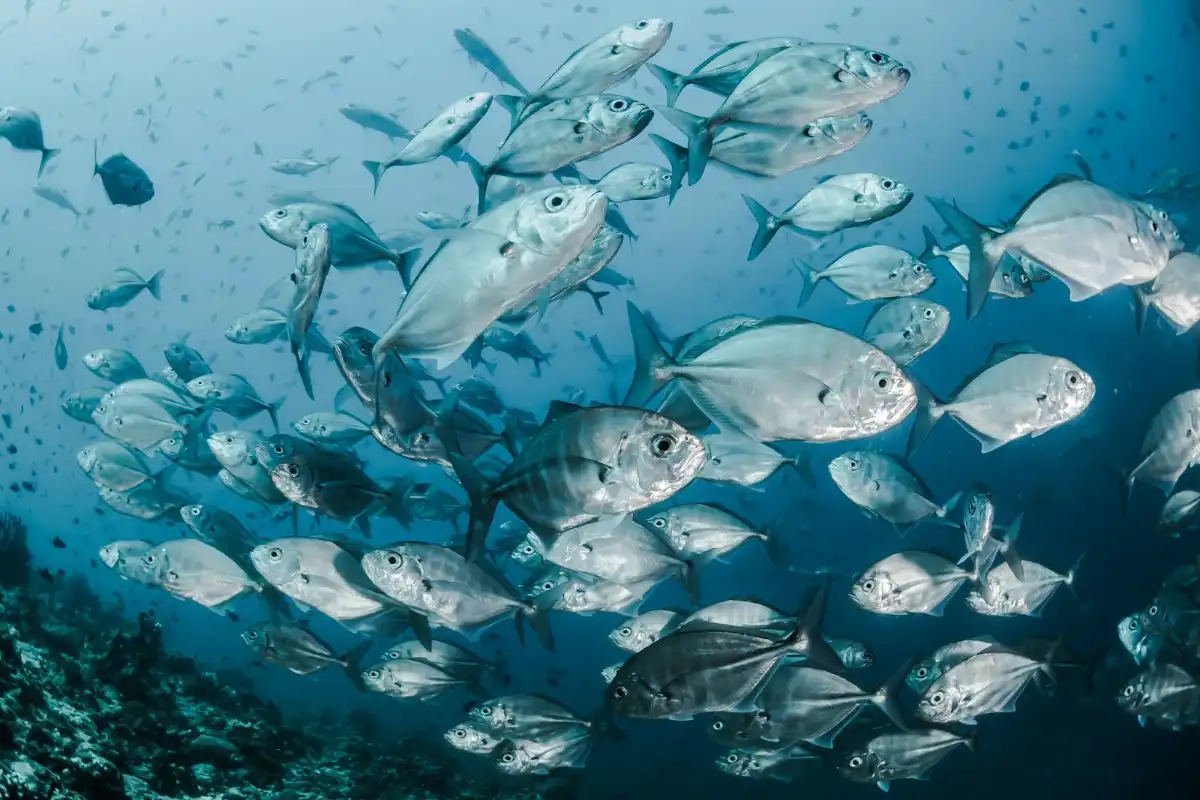
Each of these Bible verses about fish is quoted word for word from the King James Version, followed by a short original note.
And he saith unto them, Follow me, and I will make you fishers of men.
Matthew 4:19 (KJV)
Jesus speaks to working fishermen in the language of their own trade. He does not discard their skills but redirects them, turning patient net work into patient love for people. It remains the best known of all Bible verses about fish and calling.
And Jesus said unto them, Come ye after me, and I will make you to become fishers of men.
Mark 1:17 (KJV)
Mark records the same call, one of the Bible verses about fish, with a helpful emphasis: I will make you. The change is not self-made. Following comes first, and Christ shapes the fisher over time, which is encouraging for anyone who feels unqualified to share their faith.
And so was also James, and John, the sons of Zebedee, which were partners with Simon. And Jesus said unto Simon, Fear not; from henceforth thou shalt catch men.
Luke 5:10 (KJV)
After an astonishing catch, Peter is afraid, and Jesus answers with Fear not. In these Bible verses about fish, the miracle becomes a commission. Notice that the partners are named: calling to catch men is shared work, not a solitary burden.
Now when he had left speaking, he said unto Simon, Launch out into the deep, and let down your nets for a draught.
Luke 5:4 (KJV)
Among Bible verses about fish, this is where a carpenter-teacher gives professional fishermen advice about fishing. Jesus asks for deeper water after a failed night, which reminds us that obedience sometimes means trying again in the place we were ready to abandon.
And Simon answering said unto him, Master, we have toiled all the night, and have taken nothing: nevertheless at thy word I will let down the net.
Luke 5:5 (KJV)
Peter is honest about his exhaustion and still obedient. The word nevertheless is the hinge of the story. Faith in these Bible verses about fish is not a feeling of confidence but a decision to act on the word of Christ despite empty nets.
And he said unto them, Cast the net on the right side of the ship, and ye shall find. They cast therefore, and now they were not able to draw it for the multitude of fishes.
John 21:6 (KJV)
After the resurrection, the risen Lord stands on the shore and repeats the pattern of the first miracle among the Bible verses about fish. The disciples do not recognize him until the net fills, showing that Christ often meets us in ordinary work and then reveals himself.
Simon Peter went up, and drew the net to land full of great fishes, an hundred and fifty and three: and for all there were so many, yet was not the net broken.
John 21:11 (KJV)
The exact count shows an eyewitness memory, and the unbroken net shows that God can give abundance without breaking the vessel. Readers of these Bible verses about fish often take comfort that a blessing from God is not meant to tear us apart.
There is a lad here, which hath five barley loaves, and two small fishes: but what are they among so many?
John 6:9 (KJV)
Andrew asks the honest question of every limited person: what use is a little? In these Bible verses about fish, the boy offers all he has, and the answer shows that small gifts placed in Christ’s hands are never too small to matter.
And Jesus took the loaves; and when he had given thanks, he distributed to the disciples, and the disciples to them that were set down; and likewise of the fishes as much as they would.
John 6:11 (KJV)
In Bible verses about fish about loaves, gratitude comes before the multiplication. Jesus gives thanks over a meager lunch and the people eat as much as they want, a picture of how thankfulness often opens the door to provision that we did not expect.
And he commanded the multitude to sit down on the grass, and took the five loaves, and the two fishes, and looking up to heaven, he blessed, and brake, and gave the loaves to his disciples, and the disciples to the multitude.
Matthew 14:19 (KJV)
Matthew shows an order of actions: look up, bless, break, give. The pattern in these Bible verses about fish is a model for ministry. The disciples are the hands that pass the food along, so even the miracle depends on ordinary people serving.
Now the LORD had prepared a great fish to swallow up Jonah. And Jonah was in the belly of the fish three days and three nights.
Jonah 1:17 (KJV)
The word prepared tells us this fish was not an accident. God arranges even a sea creature to rescue a runaway prophet. The verse is central to Bible verses about fish because it shows mercy arriving in a strange, unwelcome form.
And the LORD spake unto the fish, and it vomited out Jonah upon the dry land.
Jonah 2:10 (KJV)
Among Bible verses about fish, even the fish obeys God, which is a quiet rebuke to a prophet who did not. The scene closes with Jonah on dry ground, given a second chance to do what he was first told to do.
And God said, Let us make man in our image, after our likeness: and let them have dominion over the fish of the sea, and over the fowl of the air, and over the cattle, and over all the earth, and over every creeping thing that creepeth upon the earth.
Genesis 1:26 (KJV)
Fish are the first creatures named in humanity’s job description. Dominion in this verse, one of the Bible verses about fish, is responsible stewardship under God, not careless use, so it still shapes how believers think about oceans, rivers and the living things in them.
And God blessed them, saying, Be fruitful, and multiply, and fill the waters in the seas, and let fowl multiply in the earth.
Genesis 1:22 (KJV)
God speaks a blessing over sea creatures before he speaks one over people. The waters in these Bible verses about fish are meant to teem with life, and that early blessing shows that fish have value in God’s eyes apart from any human use.
For as Jonas was three days and three nights in the whale’s belly; so shall the Son of man be three days and three nights in the heart of the earth.
Matthew 12:40 (KJV)
Jesus himself reads the story of Jonah as a sign pointing to his burial and resurrection. That choice treats the great fish episode among Bible verses about fish as history with meaning, not as a mere children’s tale.
Again, the kingdom of heaven is like unto a net, that was cast into the sea, and gathered of every kind:
Matthew 13:47 (KJV)
Among Bible verses about fish, this short parable pictures the kingdom as a wide net that gathers all sorts. Fishermen listening would grasp it at once, and modern readers can see that the church is meant to be broad in its welcome while God makes final judgments.
The fowl of the air, and the fish of the sea, and whatsoever passeth through the paths of the seas.
Psalms 8:8 (KJV)
David marvels that God set humanity over creatures that travel paths we cannot see. This entry in Bible verses about fish invites wonder: the ocean has roads of its own, and the Creator knows every one of them.
And they gave him a piece of a broiled fish, and of an honeycomb.
Luke 24:42 (KJV)
The risen Jesus asks for food and eats it in front of the disciples. Among Bible verses about fish, a piece of fish becomes evidence that the resurrection was bodily and real, not a ghost or a vision, which makes this humble meal very significant.
As soon then as they were come to land, they saw a fire of coals there, and fish laid thereon, and bread.
John 21:9 (KJV)
Before the disciples bring their catch, Jesus has already prepared breakfast. The detail in these Bible verses about fish reveals a Lord who serves, feeds and provides first, so that tired workers arrive on the shore to find their need already met.
Fish may seem like an odd subject for careful Bible study, yet the Scriptures return to them again and again. They show up in the creation account, in the Law, in the Psalms, in the story of a prophet, and then in the daily lives of the first disciples. Reading the Bible verses about fish together reveals a thread that connects creation, calling, miracle and resurrection in a way that few other single images can match.
Part of the reason is simple geography. Much of the New Testament takes place around the Sea of Galilee, where fishing was a major trade and a source of food for families and towns. Jesus taught people using the world they already knew, so nets, boats and catches became language for the kingdom. A reader who grasps this background will find the old stories feel less distant and more like a conversation among neighbors.
There is also a theological reason. Scripture treats the sea as a place of mystery and sometimes danger, and fish live inside that unknown. When God uses fish to rescue, feed and instruct, he shows rule over the very places humanity cannot control. That is why Bible verses about fish are worth the attention of anyone who wants to see how the ordinary and the miraculous meet.
The first mention of fish in the Bible comes in Genesis 1, where God fills the waters with living creatures on the fifth day. The writer does not treat them as an afterthought. The seas teem with life by divine command, and the passage says plainly that God saw that it was good. Among all Bible verses about fish, these opening lines establish that sea creatures belong to God before they belong to anyone’s menu or trade.
Notice also the blessing in Genesis 1:22, one of the earliest Bible verses about fish, where God tells the creatures of the water to be fruitful and multiply. This is spoken before humanity appears. The ocean is therefore not an empty stage waiting for human activity; it is a living household with its own purpose and its own divine approval. Readers who care about the natural world often find this one of the strongest scriptural reasons to value it.
For a wider look at how Scripture describes the natural world, see our collection of Bible verses about creation, which places the fish of the sea inside the larger story of everything God made. The waters in Genesis are good, ordered and alive, and that sets the tone for every later mention of fish in the Bible.
When God makes humanity in Genesis 1:26, the very first group of creatures named under human care is the fish of the sea. That placement is striking. The job of bearing God’s image is tied to responsibility for living things, and the fish lead the list. Anyone studying Bible verses about fish should notice that dominion begins with the creatures people can least easily see or control.
The word dominion has been misread through history as permission to exploit, but the surrounding text points elsewhere. People are made in the image of a God who has just spoken the world into goodness, so his image-bearers are expected to rule the way he does: with care, order and generosity. Dominion over fish therefore means something closer to stewardship than to ownership or conquest.
Practical application follows quickly. Believers who fish for sport or food, who work in the seafood trade, or who simply enjoy rivers and coasts can ask whether their habits honor the Creator. Taking what is needed, protecting what lasts, and giving thanks for the harvest are all ways to live out Genesis 1:26. You can explore the same theme in our page on Bible verses about animals.
The Psalms add Bible verses about fish that look at the sea with a mix of wonder and fear. In Psalm 8, David lifts his eyes to the heavens and then notes that the fish of the sea and whatever passes through the paths of the seas lie under humanity’s care. He is amazed that a God so great would trust such a small creature with so much, and the mention of fish adds depth to that sense of awe.
Other writings use fish to remind readers that no part of creation falls outside God’s reach. The sea is vast, dark and mostly hidden from human sight, but the poets insist that it is still known to the Lord. When we collect Bible verses about fish from this poetry, we find a consistent message: what is hidden from us is not hidden from him, whether it is a school of fish in deep water or a worry deep in the heart.
This gives the reader a gentle devotional use. On a day when your future looks as unreadable as open water, you can return to these lines and remember that the paths of the seas are known to the One who made them. The same God who tracks every current is able to guide a person through uncertainty, and the Psalms invite us to trust that care.
The most famous of all Bible verses about fish is in the book of Jonah. God tells the prophet to warn the great city of Nineveh, and Jonah runs in the opposite direction by boat. A storm breaks out, the sailors throw him overboard, and Jonah 1:17 says that the Lord had prepared a great fish to swallow him. The wording matters because it names God, not chance, as the one who arranged the rescue.
Inside the fish, Jonah prays a long prayer in chapter 2, and it is a song of thanks even before he is freed. He confesses that he went down to the depths, that his life was fainting, and that deliverance belongs to the Lord. Three days and three nights pass, then God speaks to the fish and Jonah lands on dry ground. Few scenes in Scripture show so clearly that mercy can come wrapped in something frightening.
If you want the full story and its verses, read our dedicated page on Jonah and the whale Bible verses. It covers the sailors, the prayer and Nineveh’s repentance in greater depth, while this page concentrates on how the great fish fits among the many other Bible verses about fish.
Many readers of Bible verses about fish ask whether Jonah was swallowed by a whale or by a fish. The Hebrew text of the book uses a word meaning a great fish, and the Old Testament never calls it a whale. The King James Version of Matthew 12:40 does say the whale’s belly because the Greek word there means a great sea creature, a broad term that can cover large marine animals of many kinds.
For the reader, the important lesson is not the species. The author wants us to see that God prepared a creature suited to his purpose, whatever it was, and that this creature obeyed him. Debates about biology can distract from the core message, so a sensible approach is to take the text as it stands and let the details remain a matter of wonder rather than a fight.
When you study Bible verses about fish, it helps to hold two things together: respect for what the text actually says, and humility about what it does not explain. The writer tells us the fish was prepared, that Jonah prayed, and that he was released. Those facts carry the spiritual weight, and they remain true whether the animal is described as a fish, a sea monster or a giant of the deep.
Jesus connects one of the Bible verses about fish to himself. In Matthew 12, some religious leaders ask for a sign, and he answers that no sign will be given but the sign of the prophet Jonah. Then he explains: just as Jonah was three days and three nights in the belly of the fish, so the Son of man would be three days and three nights in the heart of the earth. This turns a Bible verse about a fish into a pointer toward the resurrection.
There is a deliberate echo. Jonah goes down into the deep and is brought up alive; Jesus goes down into death and rises on the third day. The earlier event does not prove the later one, but it gives readers a picture to understand it. Jesus also adds that the people of Nineveh will rise up at the judgment because they repented at Jonah’s preaching, and a greater than Jonah is here.
For readers, this means the great fish is far from a side story. It carries a theme that sits near the heart of the faith: God brings life out of what looks like a grave. When doubts or disasters have swallowed your hope, the pattern of Jonah invites you to wait for the God who raises people and plans from the deep.
Before Jesus said anything about fish, he met people who spent their lives with them. Simon, Andrew, James and John worked the waters of Galilee, hauling nets, mending gear and selling their catch. Their work was demanding, uncertain and often done at night. When we read the Bible verses about fish in the Gospels, we are reading about working people who knew what an empty net felt like at dawn.
This background shapes how Jesus calls them in the Bible verses about fish. He does not invite them to leave behind everything they are; he speaks in terms they understand. Patience, teamwork, reading the water, trusting the weather and enduring failure are all fishing habits, and they become part of what discipleship asks. Jesus sees what is already in a person and gives it a new purpose, a pattern he repeats throughout the Gospels.
It also shows that God does not wait for religious professionals. He walks along a lakeshore and finds ordinary tradesmen. For anyone who wonders whether a regular job or an unremarkable past disqualifies them, the call of the fishermen gives a hopeful answer. You can read how this theme connects to the larger story in our guide to Bible verses about the disciples.
The call itself is brief: Follow me, and I will make you fishers of men. Of all the Bible verses about fish, this one is quoted most often because it states a mission in a single image. Two promises sit inside it. First, there is a command to follow Jesus, and only after that comes the work of fishing for people. The order matters, because mission flows out of relationship and not the other way around.
Second, this one of the Bible verses about fish says I will make you. Peter and Andrew are not told to become skilled evangelists on their own. Jesus takes responsibility for forming them. That means the fishing is a shared effort that depends on his guidance rather than on personal talent. People who feel nervous about talking to others about faith can find real relief in this phrase.
The image also carries a warning against a common mistake. A fisher does not drive fish away or scold them; a fisher goes where they are, learns their habits and offers something they will come toward. The same lesson applies to people. If you want to understand more about sharing the gospel today, see our page on Bible verses about evangelism.
Mark tells the same story among the Bible verses about fish with his usual speed. Jesus says, Come ye after me, and I will make you to become fishers of men, and the next lines report that they straightway forsook their nets and followed him. There is no negotiation and no long speech. The brevity of the narrative makes the response feel urgent, as if the writer wants readers to feel how decisive that moment was for these men.
We should be careful not to read this as an instruction that everyone must quit their jobs. Many believers are called to serve God exactly where they work, and elsewhere in the New Testament, Paul and others keep ordinary trades. What the verse does show is a willingness to place Jesus above even good and necessary work. The nets were their livelihood, and leaving them was a real sacrifice.
Among the Bible verses about fish, Mark 1:17 therefore speaks to priorities. It asks what we are holding so tightly that we could not set it down if Christ asked. For many people the answer is not a boat but a career plan, a comfort or a fear. Reading this verse prayerfully is a good way to examine the heart and ask for freedom to follow.
Luke gives the fullest version of the first call among Bible verses about fish. After a night with nothing to show, Simon is washing his nets when Jesus uses his boat as a platform to teach the crowd. Then Jesus tells him to launch out into the deep and let down the nets. Peter objects that they have toiled all night, but adds that at the word of Jesus he will try again. The nets then enclose so many fish that they begin to break.
The miracle works in two layers. On the surface it is a huge catch, enough to fill two boats until they begin to sink. Beneath that it is a revelation. Peter does not celebrate; he falls at Jesus’ knees and says to depart from him because he is a sinful man. Seeing divine power makes him aware of his own smallness, which is often how people first sense God’s holiness.
Jesus answers with Fear not and the new assignment to catch men. When they reach the shore, they forsake all and follow him. This is a good example of the way Bible verses about fish move from a practical event to a life-changing calling. It also pairs well with the story of Peter walking on the water, where the same disciple learns again to trust the Lord over the sea.
The most relatable of the Bible verses about fish in Luke 5 is the empty net. Peter has worked all night, nothing has been caught, and a teacher with no fishing background tells him to try again in deep water at midday, when fishing conditions would normally be poor. Most people in his place would politely decline. His answer, nevertheless at thy word, is one of the great phrases of the New Testament.
This is how many readers experience faith. It is not a bright certainty that all will go well. It is a willingness to act on what Christ has said even when experience points the other way. The Bible verses about fish in this story show that obedience can feel inconvenient, even foolish, but that God often reveals his goodness on the other side of the step we did not want to take.
You might apply this to a project that has failed, a relationship that seems stuck, or a prayer that has gone unanswered for years. The point is not that every effort will produce a bumper catch; it is that Christ’s word is worth acting on. Ask what he has said to you in Scripture, and then lower the net once more. Results belong to him, and obedience belongs to us.
One of the best known miracles of Jesus, told in Bible verses about fish and loaves, involves a modest lunch. A crowd of thousands has followed him into a remote place, the day is late, and the disciples worry about food. Andrew finds a boy with five barley loaves and two small fishes, and he asks what use that could be among so many. Jesus has the people sit down, gives thanks, and distributes the food until everyone has eaten as much as they want.
Every Gospel records this event, which signals its importance. John adds the detail that the loaves were barley, the bread of poor families, and that the fish were small. The meal was not impressive by any standard, which makes the result more striking. When we study Bible verses about fish in this story, we see that God delights in turning the humble into the abundant.
Afterward the disciples gather twelve baskets of fragments, so nothing is wasted and there is more than they began with. The lesson for readers is generous: bring what you have, however small, and trust it to the Lord. For further reading on Christ’s works of power, see Bible verses about the miracles of Jesus.
The unnamed boy in John 6 is easy to overlook among Bible verses about fish, yet he is a model of generosity. Where adults saw a hopeless shortage, he had a small meal and, apparently, was willing to hand it over. The text does not tell us his thoughts, but the result suggests that offering what you have, without waiting to have more, is the doorway to a miracle. Many sermons return to this child for good reason.
The disciples also have a part. They do not make the food; they carry it to the people. Jesus chooses to work through those who serve, even when they feel that their supplies are laughably small. This repeating pattern turns Bible verses about fish and loaves into instructions about stewardship: God multiplies what is placed in his hands and often uses willing people to deliver the blessing.
In practical terms, ask what you could offer today. It may be time, a skill, a meal or a kind word, and it may feel too minor to count. The story suggests that God does not measure gifts by their size but by their surrender. If compassion for the hungry moves you, read our page on Bible verses about feeding the hungry for further guidance.
A quiet detail in the feeding story, one of the Bible verses about fish, is that Jesus gives thanks before the bread and fish are multiplied. He does not wait for the crowd to be fed and then express gratitude; he thanks the Father over a shortage. That order sets an example. Thankfulness is not just a reaction to abundance but also a way of receiving what little we have as a gift from God.
Many believers find this transformative in daily life. When money is tight or the day looks crowded with problems, pausing to thank God for what is present can change how we see the situation. It does not erase the need, but it turns the heart toward the Giver and away from panic. The Bible verses about fish in this passage therefore double as lessons in prayer.
You can try this at a simple level at your next meal. Before eating, name something specific to be thankful for, even if circumstances are hard. Over time the habit builds trust that God provides, as he did on that grassy hillside. For more on this theme of daily supply, you may enjoy our collection on Bible verses about provision.
After the resurrection, Bible verses about fish appear again in surprising moments. In Luke 24, the disciples are startled and afraid, thinking they see a spirit. Jesus shows them his hands and feet and asks whether they have anything to eat. They give him a piece of broiled fish, and he eats it in their presence. This simple act proves that his risen body is real and not a ghost.
Later, in John 21, Jesus waits on the shore of Galilee with a charcoal fire and fish already cooking. He invites the disciples to bring some of their own catch and says, Come and dine. The scene is warm and domestic. The risen Lord, the conqueror of death, makes breakfast for tired friends. Bible verses about fish at this point become windows into the tenderness of Christ.
These meals also show that resurrection faith is not abstract. It touches ordinary things: bodies, hunger, fire and food. For believers, that means our daily routines are not separate from the life of Christ but can be places where he meets us. Next time you sit down to eat, you might remember that the Lord has shared a fish meal with his friends.
John 21 mirrors Luke 5 deliberately among Bible verses about fish. Again the disciples fish all night with no result, again a figure on the shore gives instruction, and again the net fills beyond their strength. This time Peter jumps into the sea to reach Jesus faster. The repeated pattern appears to show that, even after the cross and the empty tomb, the same Lord who called them at the start still calls them now.
The count of one hundred and fifty-three fish invites curiosity. Readers have suggested many symbolic meanings over the centuries, but the text offers none, and a simpler explanation is that an eyewitness remembered the number. What the narrator does stress is that the net was not broken, even with so many fish. God’s gifts are sufficient for the load he gives.
This scene also sets up Peter’s restoration. After breakfast, Jesus asks him three times whether he loves him, answering Peter’s earlier threefold denial. Among all Bible verses about fish, these may carry the greatest grace, because they show failure forgiven and ministry renewed over a meal. The theme continues in our page on the command to feed my sheep.
In Matthew 13, Jesus adds to the Bible verses about fish with the parable of the dragnet. A net is cast into the sea and gathers fish of every kind. When it is full, fishermen haul it ashore, sit down, and sort the good into vessels while throwing the bad away. Jesus explains that the end of the age will bring a similar separation, with angels dividing the righteous from the wicked. The image is vivid and sobering.
The parable teaches patience about the present mixed state of the church. The net catches everything, and sorting is not our job today. That guards us from the pride of declaring who is in or out and from the cynicism that gives up on the community because it has flaws. Of the Bible verses about fish, this one best explains why the kingdom looks messy now but will be clear in the end.
It also reinforces the call to fish for people. The net works only when it is thrown, and every kind of fish is welcome in it. If you are drawn to the idea of loving a wide variety of people with the gospel, spend some time with this parable and ask the Lord to help you cast your net widely and trust him with the final sorting.
A thread through many Bible verses about fish is that God supplies what is needed. The boy’s lunch feeds thousands, the night’s empty net becomes a full one, and a coal fire on the beach holds breakfast for hungry men. Each time, the provision comes through Jesus, often in ways that disrupt expectations. The Bible verses about fish are therefore a gentle school in trusting the one who feeds.
This does not mean that God will always remove scarcity on demand. Many believers face lean seasons, and Scripture never pretends otherwise. What these stories ask is that we notice God’s pattern: he meets people in their shortage, asks them to bring what they have, and frequently supplies more than they thought possible. The key is trust rather than formula.
If you are anxious about money, work or family needs, try reading John 6 and John 21 slowly, and then pray through them. Turn each worry over to the Lord by name. You may also benefit from our pages on trusting God and on Bible verses about calling, which support the same confidence in his care.
A fruitful way to study Bible verses about fish is to read them in story order: creation in Genesis 1, then Jonah, then the Gospel events from the call of the fishermen to the feeding miracle, and finally the resurrection breakfast. Doing this over a week lets the themes build on each other. Take a few verses each day, read the surrounding chapter, and write one sentence about what you learn.
Next, apply what you find. If the verses on calling stir you, ask the Lord what his assignment is for your current season and who he has placed near you. If the verses on provision comfort you, make a list of specific needs and pray for them with thanks. If the Jonah verses unsettle you, consider any place where you have been running from an instruction and take a step back toward obedience.
Finally, share what you learn. The disciples were fishers of men in teams, and learning in company strengthens understanding. Discuss these Bible verses about fish with a friend, a family table or a small group, and bring questions. Use the FAQ below as a starting point, and explore the related pages on this site as you continue your study.
Readers often ask whether fish held any special status in the Law of Moses. In Leviticus 11, sea creatures with fins and scales are counted clean for eating, while those without are not. Under the New Testament, Peter’s vision in Acts 10 and Jesus’ declaration in Mark 7 about food affected how believers think about dietary rules, though Christians differ on how to apply them today.
Another common question is whether the fish symbol used by early Christians appears in Scripture. The Bible itself does not command the symbol, but later believers used the Greek word for fish as an acrostic about Jesus, and its popularity may also reflect the many fish stories in the Gospels. It is a reminder that Bible verses about fish have inspired imagery in the church for centuries.
People also wonder whether these accounts should be taken literally. Most Christians through history have read the Gospel fish miracles as real events with spiritual meaning, and the book of Jonah as a true account that Jesus himself treated as sign and history. If you have deeper questions, read the passages slowly in a trusted translation, compare notes with a pastor or teacher, and keep a humble, curious posture.
If these Bible verses about fish have encouraged you, these related pages are a good next step: Jonah and the whale, Bible verses about animals, Bible verses about creation, Peter walks on water, Bible verses about discipleship, Bible verses about following Jesus, Bible verses about water, Bible verses about faith, Bible verses about food, Jesus walks on water.
To study these verses in more depth, try Bible Gateway, Bible Hub, Bible Study Tools, Blue Letter Bible.
Most people point to Matthew 4:19, where Jesus says, Follow me, and I will make you fishers of men. Others think first of Jonah 1:17 about the great fish. Both are among the best known Bible verses about fish, one concerned with calling and the other with God’s mercy.
Among Bible verses about fish, the feeding of the five thousand appears in Matthew 14:13-21, Mark 6:30-44, Luke 9:10-17 and John 6:1-14. Each tells how five loaves and two fishes fed a huge crowd with leftovers remaining. A separate feeding of four thousand is in Matthew 15 and Mark 8.
Of the Bible verses about fish, the Hebrew text of Jonah says a great fish, and Jesus refers to the same event in Matthew 12:40. The King James Version there uses whale because the Greek word means a large sea creature. The Bible does not name the species, only that God prepared it.
In Bible verses about fish, it means helping people come to know Jesus, as fishermen gather fish. Jesus used the phrase to call Peter and Andrew to share the good news. The image suggests patience, going where people are, and depending on Christ to form us for the work.
Genesis 1:26, one of the Bible verses about fish, says God made humanity in his image and gave them dominion over the fish of the sea along with birds, cattle and every creeping thing. Most readers understand this as responsible stewardship that reflects God’s own care rather than permission to exploit creation.
John 21:11, another of the Bible verses about fish, says the net was full of great fishes, one hundred and fifty-three in number, and yet the net was not broken. The count was likely remembered by an eyewitness. The passage emphasizes the abundant provision of the risen Jesus for his disciples.
In Luke 24:42-43, one of the Bible verses about fish, Jesus eats a piece of broiled fish to show the disciples that he had a real, physical body and not a spirit. The ordinary act of eating confirmed the reality of the resurrection and comforted their fear and doubt.